

While enterprise humanoid robotics companies raised billions to build factory workers priced somewhere north of six figures, a four-person team in San Francisco spent the summer of 2026 assembling something rather different. Nori Robotics, a Y Combinator startup founded by Antonio Sitong Li, is accepting pre-orders for wheeled bimanual robots priced at $1,288 to $1,688—roughly the cost of a decent laptop—with shipments planned for summer-fall 2026.
The timing, perhaps, matters as much as the price.
Just days before Nori's late-July LinkedIn post announcing pre-orders for its L3 model ("20 DOF, 1 KG payload per arm, still sub $2,000"), the Federal Communications Commission announced on July 28–29, 2026, the addition of "foreign-made humanoid and quadruped robots" to its Covered List, effectively blocking new equipment authorizations for imported models. The practical effect: Chinese competitors who've driven down entry-level pricing can no longer easily enter the U.S. market, while a scrappy team manufacturing in the Mission District suddenly finds itself swimming with a regulatory tailwind.
It's the kind of timing that founders dream about. Whether Nori can actually deliver on the promise is another matter entirely.
A Factory Floor in the Mission
According to Nori's Y Combinator profile: "Sub-$2000 robotic humanoid assembled in the US. We manufacture humanoid robots in San Francisco." The company's website, as of August 2026, shows two models—the L2 at 100 cm ($1,288) and L2 Grande at 130 cm ($1,322)—with a third iteration, the L3, listed for fall delivery at $1,688. All carry the 🇺🇸 "Made in SF" badge.
The specs are modest but real: 20 degrees of freedom in the arms, 1 kg payload per arm, 12-meter lidar running at 8–12 Hz, four 720p RGB cameras, speaker and mic, six to eight hours of battery. These are wheeled robots, not bipedal—closer to mobile manipulators than the humanoids appearing in BMW or Mercedes factories. Nori's site emphasizes teleoperation support alongside a "skills marketplace," which suggests the company is aiming at early adopters, researchers, and light-duty home or office environments. Places where price matters more than climbing stairs or lifting 25-pound boxes.
Four employees. Summer 2026 batch. Ships within months, if the site copy holds.
It's a bet that the market has room for something radically cheaper than what Figure, Agility Robotics, or Apptronik are building—and that being assembled domestically is suddenly worth more than it was in June.
Twenty-Five Times Cheaper Than the Competition
To understand the disruption Nori is attempting, consider the established pricing landscape as of mid-2026. Enterprise-grade humanoids from U.S. companies like Figure and Agility Robotics don't publish list prices; they operate on pilot agreements and robotics-as-a-service contracts. Nori's robots are priced substantially lower than some enterprise-grade configurations which could be well into six figures. Norway-based 1X opened pre-orders for its NEO home robot in October 2025 at $20,000 outright or $499 per month; the company claimed 10,000 pre-orders in five days and positioned "full-scale production" as an April 2026 milestone.
On the lower end, China's Unitree has driven prices down aggressively. The company's G1 bipedal humanoid launched in mid-2024 at $16,000 and became a popular research platform. By spring 2026, Unitree's newer R1 model appeared on AliExpress and the company's own shop with prices ranging from roughly $4,370 to $4,900, depending on configuration and region. Tax and shipping variations make direct comparisons slippery; the Unitree shop lists "From $4,900" for the R1 as a starting point.
Nori undercuts even that. At $1,288 to $1,688, the company is offering something approximately 10x cheaper than Unitree's G1, roughly 3x cheaper than the R1, and perhaps 25x cheaper than the established U.S. players—if those players had consumer list prices at all.
It's not quite an apples-to-apples comparison, of course. Nori's wheeled form factor trades locomotion versatility for cost, and the hardware isn't aiming at factory-grade durability. But as a wedge into the developer, hobbyist, and early-adopter markets? The pricing is sharp.
Policy Tailwinds at Precisely the Right Moment
The July 28–29, 2026 FCC announcement changed the game for anyone trying to bring foreign-made mobile robots into the United States. The agency's Covered List expansion now blocks new equipment authorizations for imported humanoids and quadrupeds that meet certain thresholds around weight, connectivity, sensors, and control software. Existing authorized devices are grandfathered, but new models cannot be imported or marketed without authorization—a process that, for entities on the Covered List, is effectively a ban.
The impact is immediate and structural. Unitree's R1, which began appearing on global e-commerce platforms in spring 2026, now faces a murky path into U.S. hands. Chinese manufacturers who shipped thousands of humanoids each in 2025—Unitree and Agibot among them, according to an Associated Press report published July 29, 2026—suddenly confront a closed door in the world's largest consumer robotics market. (By comparison, the AP noted, U.S. companies like Tesla and Figure each shipped "a few hundred or less" in the same period.)
Nori's "Made in SF" positioning was already a branding choice. Now it's a regulatory advantage. If you're assembling in the United States, you sidestep the Covered List restrictions entirely. You still need FCC authorization if your robot uses RF—Wi-Fi, Bluetooth, or similar—but you're not blocked at the border.
For a four-person startup competing against well-capitalized Chinese manufacturers with years of supply chain optimization, the timing is fortuitous. Perhaps more than the founders expected. The policy tailwind arrived just as Nori began taking pre-orders.
What $1,688 Actually Buys You
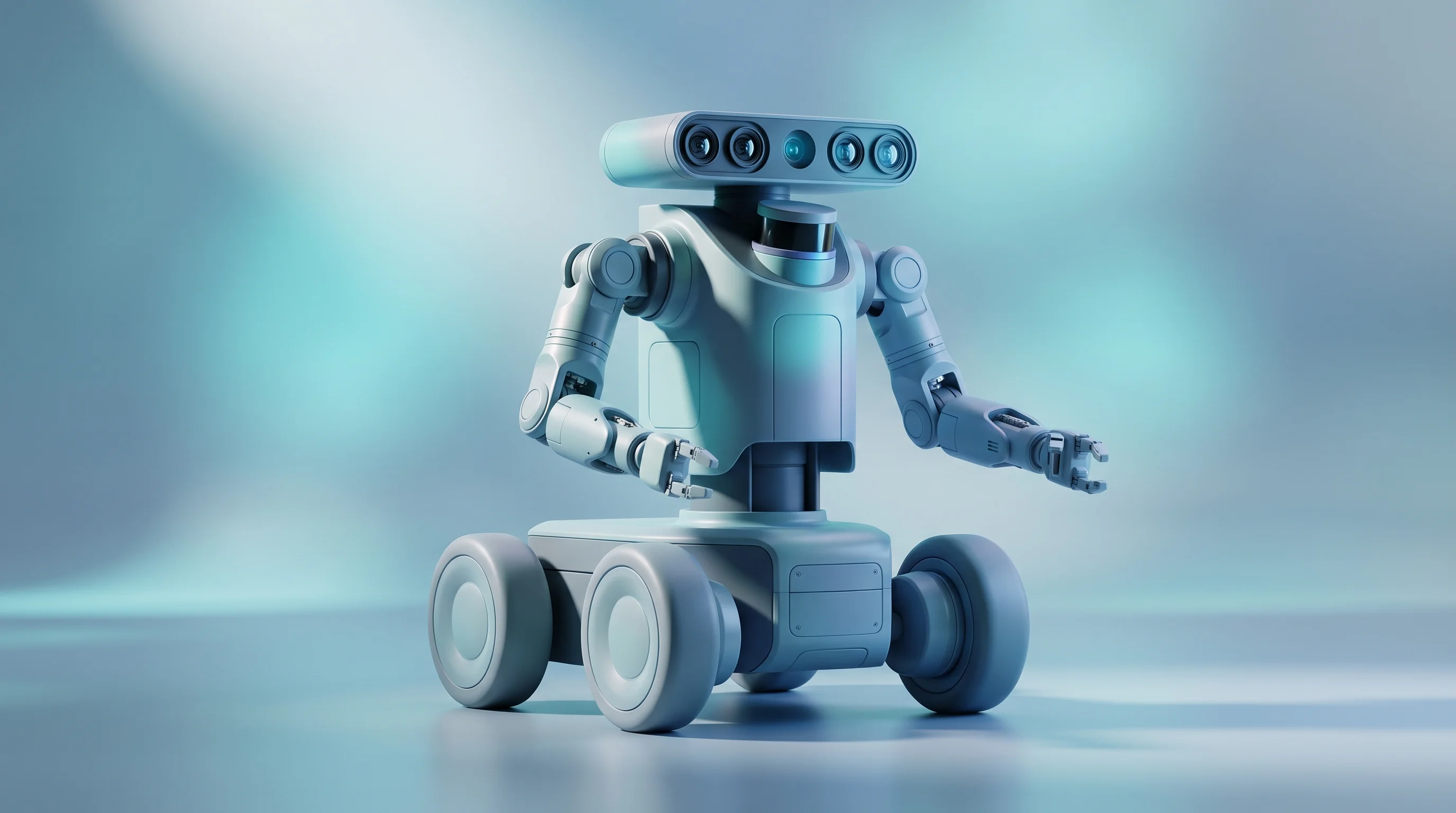
Nori's L3, the higher-end model slated for fall shipment, is a bimanual wheeled platform with 20 degrees of freedom in the arms, 1 kg payload capacity per arm, a 12-meter lidar sensor, four 720p cameras, onboard audio, and a six-to-eight-hour battery. It's not a bipedal humanoid in the traditional sense. No legs, no dynamic balancing, no stair-climbing. The company's website emphasizes teleoperation and a "skills marketplace," suggesting a hybrid model where humans can remotely control the robot to demonstrate tasks, which then feed into autonomous behaviors over time.
This architecture mirrors a broader industry trend in 2026. Companies like Apptronik explicitly position their Apollo 2 robot as a "data engine," using teleoperation to collect diverse trajectories that bootstrap policy learning—a "data flywheel" feeding partner foundation models. Apptronik opened its 90,000-square-foot Austin "Robot Park" facility in late June 2026 precisely to scale this kind of human-in-the-loop data collection. NVIDIA's Isaac GR00T platform and Google DeepMind's Gemini Robotics models (ER 1.6 released in April 2026, with "Gemini Robotics 2" coverage appearing in late July) provide the software infrastructure to turn teleoperated demos into generalizable skills.
Nori is betting it can leverage these same tools at a price point accessible to individual developers, small labs, and early-adopter consumers. A $1,688 robot won't replace a factory worker or autonomously fold your laundry out of the box. But it might let you experiment with embodied AI, contribute to open datasets, or prototype applications in environments where cost and safety constraints rule out heavier, more expensive platforms.
The question is whether there's a market willing to accept the hardware limitations in exchange for the price.
The Case for Skepticism
Gartner predicted in January 2026 that fewer than 20 companies would scale humanoid robots to production in manufacturing and supply chain by 2028, with fewer than 100 progressing beyond experimentation through the same period. The analyst firm's caution reflects a gap between demonstration videos and deployable products—a gap that roboticist Rodney Brooks has been highlighting since at least late 2025. Brooks, who co-founded iRobot and Rethink Robotics, has consistently warned that "humanoid hype" overlooks safety, dexterity limits, and the unglamorous realities of maintenance and total cost of ownership.
Market projections, meanwhile, swing wildly. Goldman Sachs raised its 2035 market estimate from roughly $6 billion (a January 2024 base case) to $38 billion in an October 2024 update. Bank of America Institute speculated in March 2026 that shipments could increase from about 90,000 units in 2026 to 1.2 million in 2030 and 10 million by 2035, with a long-term installed base that could hit 3 billion units by 2060.
Those are bullish scenarios, not certainties. The actual trajectory will depend on whether companies can solve reliability, safety certification, and real-world task performance at scale—challenges that have bedeviled robotics startups for decades.
Nori's approach—wheeled, teleoperation-enabled, priced for experimentation rather than production deployment—sidesteps some of these challenges by lowering the stakes. A $1,688 robot doesn't need to justify a multi-year ROI in a factory setting; it needs to be useful enough that developers, researchers, or hobbyists find it worth the price of a mid-tier laptop. If it breaks, or fails to perform, the downside is limited. If it works well enough to enable interesting applications, the upside could be a foothold in a market that's still figuring out what it wants to be.
The Regulatory Moat
The FCC's July 2026 import restrictions mean Nori won't face direct competition from Unitree's sub-$5,000 R1 in the U.S. market, at least not for new models. That's a regulatory moat the company didn't build but can certainly exploit. Whether four people in San Francisco can manufacture, ship, and support a consumer robotics product at scale is another question entirely—one that thousands of hardware founders before them have answered the hard way.
For now, though, Nori has something rare in deep tech: a clear price advantage, a regulatory tailwind, and a market that's just starting to wake up to the idea that humanoid robots might be buyable, not just fundable. The company ships in months, or so the website says. We'll see if the timing holds.


