

Most hardware startups spend years building prototypes in controlled lab environments. OS3, a company founded in 2025 and part of Y Combinator's Summer 2026 batch, claims it skipped that playbook entirely.
In late May, the two-person company quietly updated its website to declare it is "already deploying in hospitality today." No customer names. No deployment figures. Just a flat assertion that its semi-humanoid robots—wheeled bases with dual articulating arms—are working live shifts in real venues.
It's an eyebrow-raising claim for a team this small and this early. Hardware is slow, capital-intensive, and littered with the wreckage of ambitious timelines. Yet here sits OS3, projecting a confidence that borders on audacity.
"We control both ends of the puzzle, the hardware and the models together," the company's site reads. "Then we run it on a real floor."
Whether that floor is metaphorical or literal remains an open question.
Built for Work, Not Show
The robot itself isn't trying to win design awards. OS3 released technical specifications on May 24, 2026, outlining a machine engineered for utility over aesthetics. Standard battery life clocks in at nine hours; an extended configuration pushes that to eighteen. Each arm can hoist roughly 5 kilograms and sweep from floor level to six feet vertically—a range that suggests ambitions beyond simple tray delivery.
Navigation relies on a sensor suite combining cameras and LiDAR. Safety protocols include automatic power cutoff and an emergency stop button. The hardware was designed and assembled in the United States, according to the company. That level of control is unusual for an early-stage startup, where offshore manufacturing often provides the only economically viable path to prototyping.
But OS3's bet isn't just on controlling the metal and motors. The real differentiation, according to the company's technical documentation, lives in how the robots learn.
Training Robots by Watching Humans
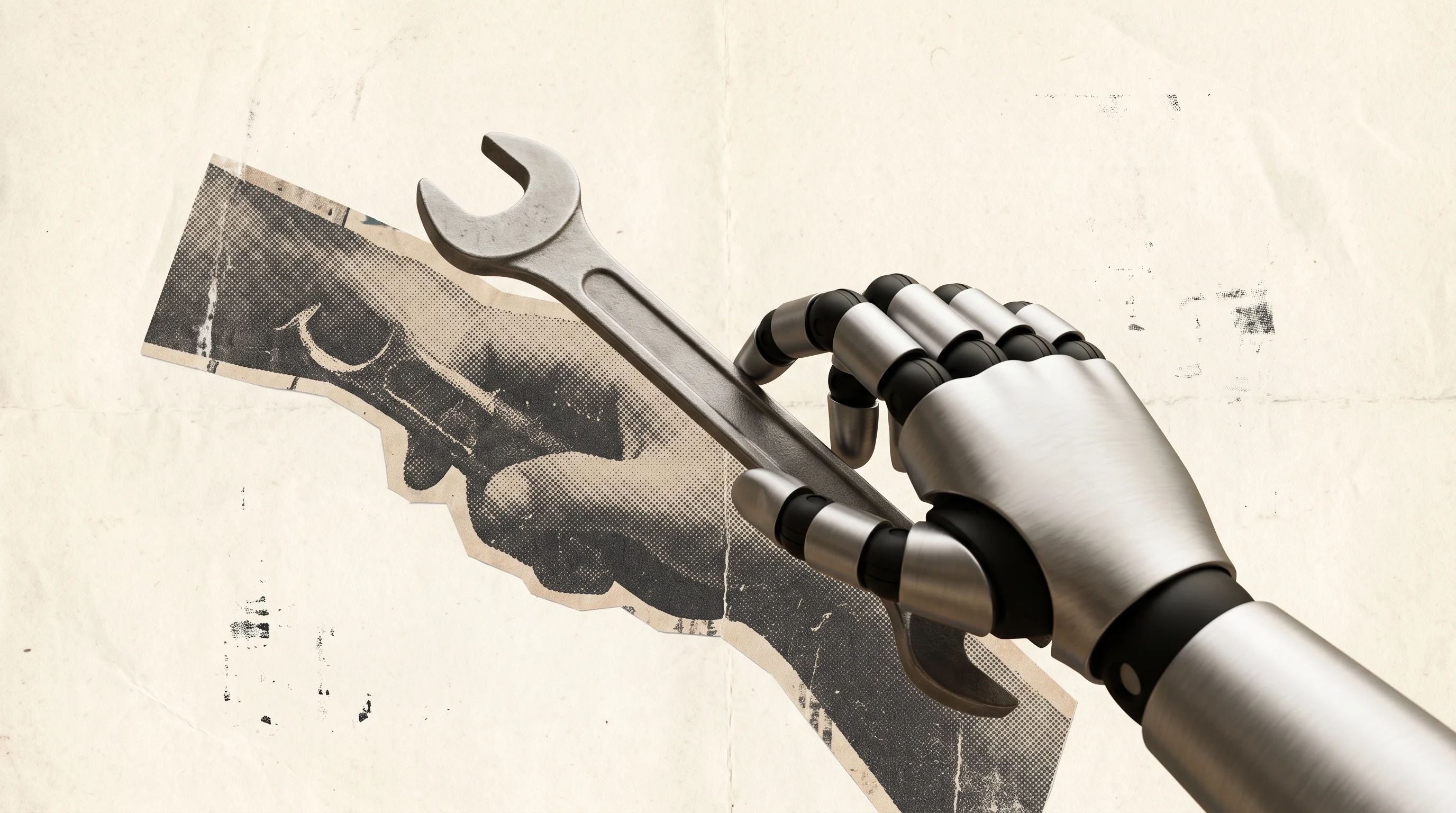
Rather than grinding through thousands of hours of real-robot trial-and-error, OS3 bootstraps its models using human video—egocentric footage of people performing tasks. The system learns from how humans move through physical work, then refines those behaviors through reinforcement learning on actual hardware.
It's a pragmatic workaround to one of robotics' most persistent bottlenecks: data collection is expensive and slow when every data point requires a physical machine in motion. If you can jumpstart training by observing humans first, perhaps you compress timelines that typically stretch into years.
The approach reflects the technical backgrounds of co-founders Rishabh Chanana and Chris Hailey. Chanana holds a master's in computer science from UC San Diego, with a focus on natural language processing and robotics. Before OS3, he trained large language models at ServiceNow. Hailey came through Coinbase's asset addition team and previously scaled a YC hackathon project to $10,000 in monthly recurring revenue. According to their Y Combinator profiles, both list research affiliations with Harvard Medical School and Georgia Tech.
Still, it's just the two of them. A recent contract posting for a mechanical design engineer listed compensation in Indian rupees—a signal that runway is being stretched through remote talent acquisition.
The Deployment Question

OS3's claim to have robots in the field remains maddeningly vague. The company's field logs page teases footage of an "early unit on the floor" via YouTube, but no video had surfaced at the time of this reporting. No customer names. No venue types. No task descriptions or performance metrics.
It's possible the deployment is narrower than the phrasing suggests—a pilot with one friendly customer, perhaps, or a limited trial in a controlled setting. Or it could be exactly what the website says: robots actively working hospitality shifts.
Either way, the sector makes sense as a target. Hotels and restaurants have faced relentless staffing shortages and margin pressures. The American Hotel & Lodging Association documented these challenges in reports published in January and April 2026. Meanwhile, the International Federation of Robotics flagged hospitality as one of the top three applications for professional service robots in its 2025 report, noting 9% year-over-year growth in unit shipments during 2024.
Demand exists. The question is execution.
A Crowded Field, Different Form Factor
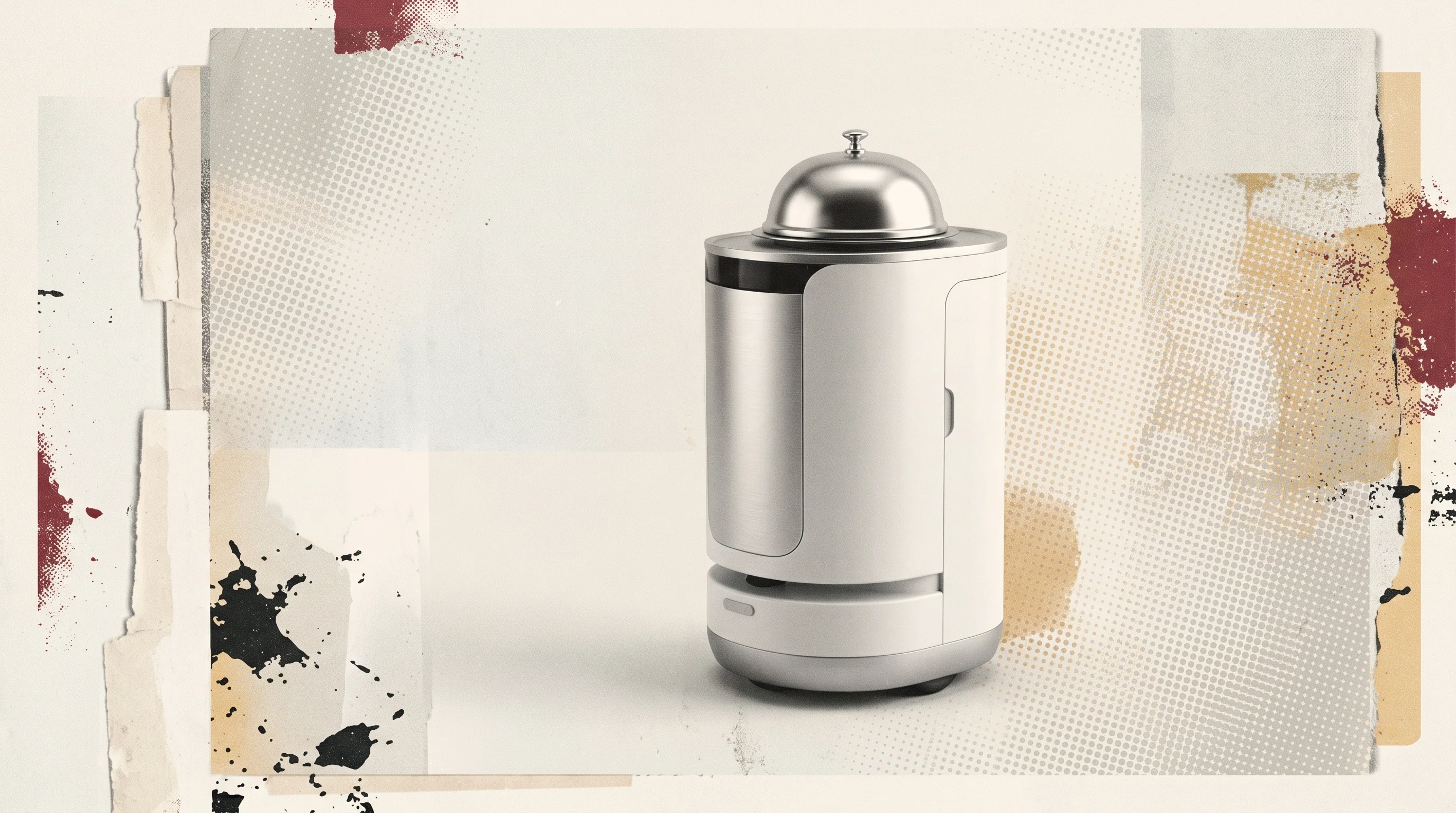
OS3 isn't alone in chasing hospitality automation—far from it. Pudu Robotics announced a "full-scenario robot-serviced hotel project" with Shenzhen CTID in June 2026. KEENON put its XMAN-R1 humanoid to work at a Shangri-La hotel in Shanghai late last year. Bear Robotics, which unveiled its Servi Q compact service robot at the National Restaurant Association Show in May, has publicly discussed deploying 10,000 restaurant robots. Tailos and Miso Robotics are running active hotel and kitchen automation programs.
Most of those competitors focus on narrow, repeatable tasks: delivering room service trays, clearing tables, manning fry stations. OS3's semi-humanoid configuration—with dual arms and vertical reach—suggests broader ambitions. The design implies flexibility across multiple workflows, though whether that versatility translates into real operational value remains unproven.
The company has not disclosed funding beyond Y Combinator's standard investment. No seed round announcement has emerged, though timing around Demo Day could shift that. For now, OS3 is running lean: minimal capital, minimal headcount, maximum secrecy.
Fast, Expensive, or Good—Pick Two
There's an old project management axiom: you can have something fast, cheap, or good—pick two. OS3 appears to be testing whether robotics startups can break that constraint. Hardware burns cash. Hospitality demands reliability. And two people can only execute so much, so quickly.
Yet if the deployment claim holds, OS3 will have shipped physical robots into live commercial operations faster than most robotics startups manage to ship a first prototype. That's either remarkably efficient engineering or a very generous interpretation of the word "deploying."
The company's opacity makes it hard to say which. But in an industry where most teams spend years in stealth before revealing anything substantive, OS3's willingness to make public claims this early—vague as they are—suggests a team unbothered by conventional wisdom.
Whether that's confidence or bravado will become clear soon enough. Hardware, unlike software, doesn't stay theoretical for long.


