

The haul trucks rumbling through Australian iron ore mines don't need drivers anymore. Some have logged over 100,000 hours of autonomous operation, hauling ore around the clock without complaint, bathroom breaks, or wage negotiations. But in Brussels, a different kind of machinery is grinding into gear—one that may reshape how autonomy gets built far more than any desert deployment ever could.
Come January 2027, the European Union's Machinery Regulation takes full effect. Autonomous machines using AI-driven perception systems will face scrutiny from notified bodies under frameworks that never anticipated neural networks. The EU AI Act, phasing in starting August 2026, piles on more: machine learning in safety-critical roles gets classified as high-risk. Explainability? Post-market monitoring? No longer optional. They're now regulatory prerequisites.
For the first time, autonomy developers can't just ship working systems. They have to prove them—according to standards that weren't written with deep learning in mind.
This isn't hypothetical compliance theater. It's rewiring the economics and engineering of autonomous machinery. And it's opening doors for startups that can thread the needle: building sensor fusion stacks that satisfy functional safety standards without sacrificing performance. Munich-based Driveblocks, founded in late 2021, is betting €2.2 million in seed funding (raised September 2023) on precisely that calculus. The company is now part of a pre-integrated European autonomy platform designed to help equipment manufacturers pass conformity assessments before the regulatory clock strikes midnight.
The Deployment Wave Nobody's Waiting For
Off-road autonomy isn't sitting around for regulatory clarity to arrive. The machines are already working.
Komatsu reports more than 875 autonomous haul trucks commissioned worldwide as of 2025, with over 10 billion metric tons hauled to date. They're adding 6 million metric tons daily. Caterpillar counts nearly 700 autonomous trucks globally—11 billion tonnes moved—and in 2024 began adapting its mine-proven stack to quarries. Bull Run Quarry in Virginia hit 1 million tons hauled autonomously by mid-2025.
The business case has hardened beyond mining's controlled environments. The Associated Builders and Contractors projects the U.S. construction industry needs approximately 439,000 new workers in 2025, then 499,000 more in 2026, with shortages persisting into 2027. Mines, construction sites, agricultural operations—they all need 24/7 uptime in places where recruiting operators is increasingly brutal. Autonomous systems fill that gap.
But scaling beyond fenced mine sites into messier operations—quarries, solar construction, terminal logistics—means navigating regulatory expectations that didn't exist when those first Australian trucks went driverless.
Built Robotics deploys autonomous trenching and solar pile-driving equipment for utility-scale projects, claiming 5× faster installation versus traditional methods. Outrider is moving to fully driverless yard truck operations in 2025, its functional safety approach vetted by TÜV SÜD under an AV Conformity Framework. John Deere announced next-generation autonomy kits for its 8R and 9R tractors this past February, offering both retrofit and factory-ready options.
The applications are diversifying. So are the certification demands.
The Brussels Effect, Industrial Edition
The EU Machinery Regulation—directly applicable across member states, no transposition needed—takes full effect January 20, 2027. It places autonomous mobile machinery under heightened scrutiny: failure handling, detection of humans and obstacles, and AI-based safety components all get special attention. These components now require notified-body involvement and digital traceability that simply didn't exist under the old Machinery Directive.
Running parallel is the EU AI Act, which classifies AI systems used in product safety domains—machinery included—as high-risk. Obligations around conformity assessment, data quality, logging, human oversight, and robustness phase in between August 2026 and August 2027.
Together, these regulations demand that machine learning models embedded in perception systems meet functional safety standards like ISO 26262 (automotive) and ISO 21448—known as SOTIF, covering performance insufficiencies and edge cases. Newer guidance like ISO/PAS 8800 extends those frameworks specifically to AI and machine learning components.
Off-road machinery standards add further layers. ISO 17757 for earth-moving and mining machine system safety. ISO 25119 for agricultural machinery. ISO 19014 for earth-moving functional safety. ISO 13849 for safety-related control systems in machinery generally. UL 4600, now in its third edition, provides an overarching safety case methodology for autonomous products.
The result? A complex conformance map where a single perception stack may need to satisfy multiple overlapping regimes. And documentation alone won't cut it.
The challenge is architectural. Traditional sensor fusion often relies on opaque neural networks—difficult to validate against these standards. If a deep learning model misclassifies an object in fog or fails to detect a pedestrian in dust, demonstrating compliance with SOTIF's requirement to address "unknown unsafe scenarios" becomes, well, a puzzle with missing pieces.
Regulators and notified bodies want explainability. They want evidence that system behavior is predictable and bounded. Both qualities are hard to extract from black-box models trained on millions of images.
Engineering for Auditors

Driveblocks frames the solution as a technical architecture choice, not a post-hoc documentation exercise. The startup's Mapless Autonomy Platform combines transformer-based neural networks for semantic understanding with what it calls "geometrically interpretable" sensor fusion. It's a hybrid: machine learning's pattern recognition married to physics-based algorithms that safety engineers can actually audit and validate.
Managing directors Dr. Stephan Matz and Dr. Alexander Wischnewski—along with a founding team that includes researchers from the Technical University of Munich—emphasize that transformers paired with explainable fusion enable certification in safety-critical operational design domains. The company has worked with TÜV SÜD on safe AI applications and is using seed funding explicitly to invest in data management infrastructure and prepare for series certification of its perception and sensor-fusion components.
The August 2025 platform release doubled down on off-road and defense use cases. New features: reliable perception through dust via fused LiDAR and camera data, 3D terrain understanding, and what Driveblocks describes as a "clearly explainable and certifiable safety layer."
That same year, the company joined forces with three partners—Apex.AI, SYSGO, and STW—to launch a pre-integrated software and hardware solution for off-road autonomy. The consortium's first use case, dubbed SafeZone, uses camera and LiDAR fusion to prevent collisions and can be certified under off-road functional safety standards.
The stack looks like this: Apex.AI supplies Apex.OS, a ROS 2-compatible middleware certified by TÜV Nord to ISO 26262 ASIL-D. SYSGO contributes PikeOS, a safety-certified separation kernel and RTOS with credentials including DO-178C DAL A, ISO 26262 ASIL-D, and IEC 61508 SIL 3. STW provides rugged off-highway controllers—its ESX family is rated up to SIL 2 / PL d and AgPL d under ISO 25119—designed for genuinely harsh environments.
Together, the stack offers a path to CE marking under the Machinery Regulation and conformity with AI Act monitoring requirements. It supports over-the-air updates and remote diagnostics. More importantly, it's designed to survive notified-body scrutiny.
The mapless approach matters for regulatory purposes, perhaps more than the founders initially expected. Traditional HD maps introduce a dependency that's hard to validate across changing environments and edge cases. By reconstructing the environment at runtime from sensor data, Driveblocks avoids maintaining massive map databases. It can argue that system decision-making is grounded in real-time perception rather than static, potentially outdated information.
For unstructured off-road sites—mines, construction zones, agricultural fields where conditions shift daily—this offers both operational flexibility and a cleaner safety case.
In May 2024, Driveblocks integrated its platform into TIER IV's Autoware-based highway trucking initiative, serving as a mapless safety layer for tests in Japan. The trials included GNSS-denied tunnels and 100 km/h scenarios. The collaboration demonstrated that certifiable perception could scale across use cases, from off-road to highway, if the architecture separated learned components from verifiable geometric reasoning.
The Academic Undercurrent
Driveblocks isn't alone in pursuing hybrid architectures. Academic research reflects the same trend, though with less regulatory urgency.
TransFusion, a transformer-based LiDAR-camera fusion method, uses "soft association" robust to sensor misalignment and illumination changes—critical for certification, since sensor calibration can drift in operational environments. Super Odometry, an IMU-centric LiDAR-visual-inertial estimator deployed on ground robots during DARPA's Subterranean Challenge, shows how multi-sensor fusion can maintain localization in perceptually degraded conditions. Deep Bayesian Future Fusion produces dense, long-range off-road maps at 2-centimeter resolution, improving navigation in terrain where traditional mapping fails.
SOTIF-focused datasets like RADIATE (radar, camera, and LiDAR in fog and snow) and SemanticSpray++ (wet-surface multimodal data) provide the validation benchmarks that notified bodies increasingly expect. Emerging frameworks tie runtime monitoring to ISO 26262, SOTIF, and ISO/PAS 8800, creating methodologies for assuring machine learning behavior over the product lifecycle. ISO 34502, which addresses scenario-based safety evaluation, offers a structured approach to demonstrating that a perception system handles its operational design domain.
Meanwhile, LiDAR hardware is scaling in volume and ruggedness. Hesai announced plans to double annual production capacity to over 4 million units per year by 2026, with more than 2 million cumulative deliveries by 2025. Rugged multi-echo LiDAR from vendors like SICK filters dust and rain—essential for mining, construction, and agriculture.
The sensor hardware is catching up to the software challenge. But only if the algorithms processing that data can be explained and validated.
The Near-Term Map
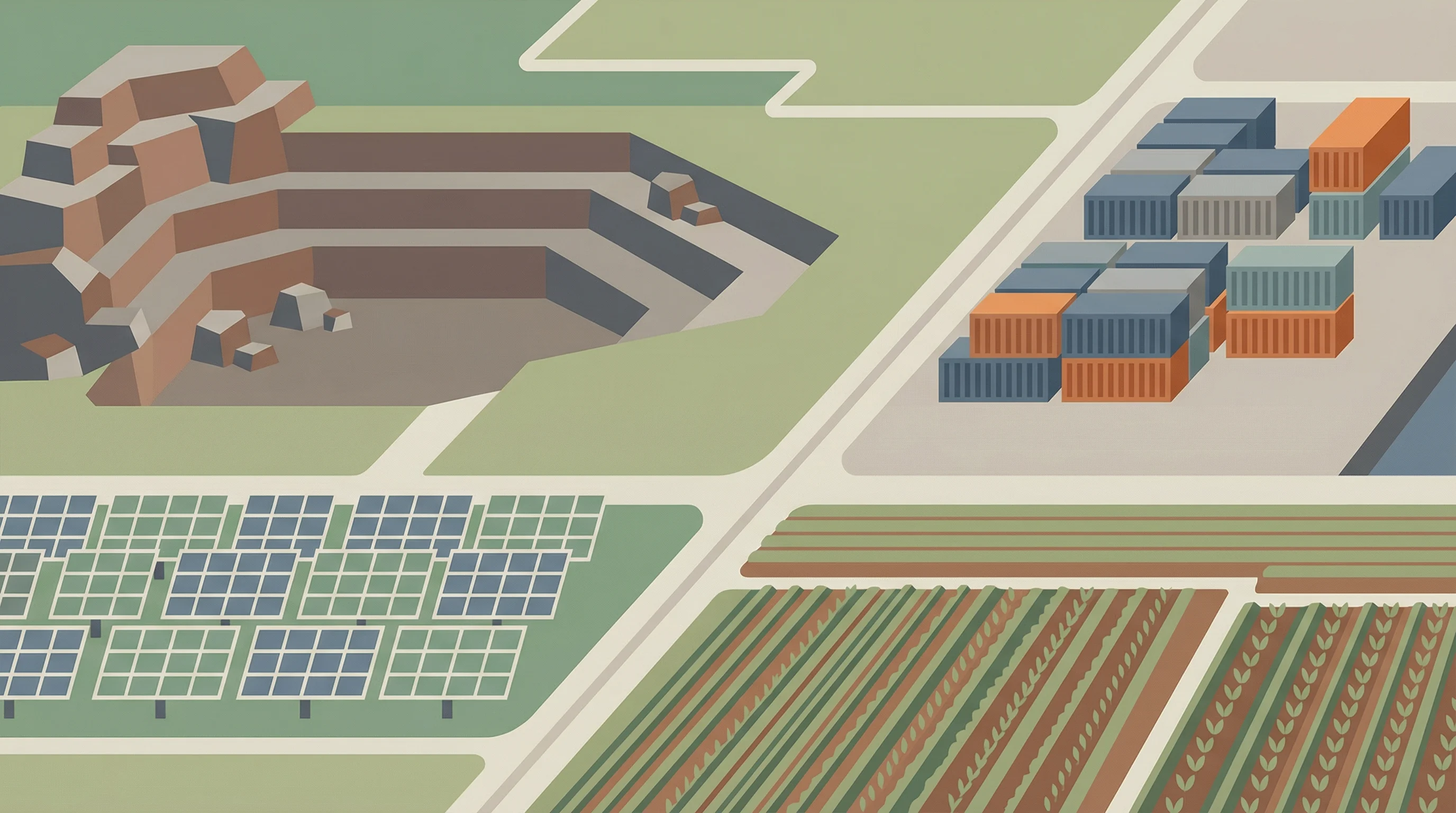
The opportunity remains concentrated in controlled operational design domains: mines, quarries, terminals, solar construction sites, agricultural fields. These environments offer constrained conditions where safety cases are easier to argue and where labor economics justify the compliance investment.
Caterpillar's expansion from mines to quarries signals that the business case is hardening beyond the earliest adopters. Between 2026 and 2028, expect a wave of pre-integrated platforms similar to the Driveblocks consortium. Equipment manufacturers facing dual compliance deadlines—Machinery Regulation in January 2027 and AI Act high-risk obligations through August 2027—will hunt for safety-certified middleware, OS components, and perception modules that reduce their conformity assessment burden.
Vendors embedding AI in safety layers will adopt Safety Element out of Context (SEooC) strategies to accelerate CE marking, much like automotive suppliers already do under ISO 26262.
The technical direction favors hybrid perception: semantic understanding from transformers, geometric fusion for explainability, runtime monitoring tied to safety performance indicators. Radar adoption will grow for adverse weather resilience, supported by datasets that underpin SOTIF validation. LiDAR's price-volume inflection broadens access, but the differentiator will be how well the fusion stack can demonstrate bounded, predictable behavior under the new regulatory frameworks.
Defense is an accelerant. Operational UGV deployments—Milrem Robotics is delivering over 150 THeMIS unmanned ground vehicles to Ukraine via a Dutch-led initiative for demining and combat support—will drive rugged, certifiable autonomy modules that transfer to civil sectors. The engineering rigor required for military reliability aligns with functional safety standards. There's spillover.
The Compliance Clock

For founders and technical leaders, the question isn't whether to pursue certifiable sensor fusion. It's how fast you can demonstrate conformance before the regulatory window closes.
The companies scaling autonomy beyond pilot projects are the ones building explainability into their architectures from the start, not retrofitting it for compliance audits. Europe's regulatory push may look like a burden—and to some vendors, it certainly is. But it's also defining the technical playbook that will shape autonomy deployments globally, including in markets that haven't yet figured out their own regulatory stance.
If you're building perception systems for safety-critical machines, the standards aren't constraints. They're the map.
Just maybe not the kind you can download and cache.


