

The problem wasn't supposed to be access to the scan.
For decades, Alzheimer's disease existed in a peculiar diagnostic limbo. Patients shuffled to tertiary medical centers for imaging that could take weeks to schedule, but the delay hardly mattered—there was nothing to do with a confirmed diagnosis anyway. The infrastructure for brain PET scanning remained deliberately small, confined mostly to research settings and academic hospitals. Why build capacity for a diagnosis that led nowhere?
That calculus shattered in July 2023. The FDA granted traditional approval to lecanemab, the first disease-modifying Alzheimer's therapy that actually required proof of amyloid pathology—via PET scan or spinal tap—before a patient could receive treatment. A year later, donanemab followed the same path. Suddenly, brain imaging wasn't just diagnostic window dressing. It became the mandatory gatekeeper to therapies for a disease affecting 7.2 million Americans over 65, with healthcare costs barreling toward $384 billion in 2025 alone.
The collision has been messy. Breakthrough treatments arrived decades ahead of the diagnostic infrastructure needed to support them, creating a bottleneck that's now reshaping medical imaging in real time. U.S. PET procedures surged 12.2% year-over-year in 2024, with 40% of imaging sites reporting wait times of eight days or longer—an eternity for anxious patients and frustrated neurologists. The European Association of Nuclear Medicine went further, predicting that demand for amyloid PET could spike up to 20-fold as therapy adoption broadens and insurance coverage expands.
The existing systems weren't built for this. Traditional hospital-based PET/CT scanners are massive machines requiring dedicated cyclotron facilities and capital outlays north of $2 million. They were designed for cancer staging, not high-volume outpatient dementia workups. And most dementia patients? They're managed in community neurology practices, far from the academic medical centers where the scanners actually live.
Which raises an uncomfortable question: What happens when you finally develop breakthrough drugs, but can't get patients scanned quickly enough to prescribe them?
A Market Transformed by Necessity
The dementia diagnostics market isn't evolving gradually—it's being forced to reinvent itself under therapeutic pressure. Globally, 57 million people live with dementia. Roughly 10 million new cases emerge annually. The economic burden approaches $1.3 trillion worldwide, with U.S. projections showing the patient population nearly doubling to 12.7 million by 2050 and care costs climbing toward $1 trillion domestically.
Patient demand is there. Surveys show 79% of Americans want to know their Alzheimer's status before symptoms interfere with daily life. Ninety-two percent would take a disease-slowing medication if one were available. But wanting treatment and accessing it remain very different problems.
Both lecanemab and donanemab require confirmed amyloid pathology before initiation—a hard dependency on PET scanning or cerebrospinal fluid testing. (Most patients, understandably, prefer brain imaging to a spinal tap.) The appropriate-use recommendations published in January 2025 by the Alzheimer's Association and Society of Nuclear Medicine identified 17 clinical scenarios where amyloid and tau PET imaging is rated appropriate, including mild cognitive impairment workup, atypical presentations, and treatment eligibility determination.
The landmark IDEAS study demonstrated that amyloid PET changed clinical management in roughly 60% of patients within 90 days and altered diagnosis in 35% of Medicare beneficiaries. It proved clinical utility convincingly. It also highlighted just how many scans would suddenly become necessary if treatments went mainstream.
The infrastructure wasn't ready. Average scans per installed PET/CT system increased 8.2% in 2024, yet capacity constraints persist. Most brain imaging still happens at academic medical centers and large hospital systems—exactly where most patients don't receive their primary dementia care. The result: a geographic and logistical mismatch between where patients are and where imaging capacity exists.
Something had to give.
Policy Shifts Open the Floodgates
Several converging regulatory and reimbursement changes have accelerated the transformation—turning brain PET from a hospital monopoly into something closer to a distributed network.
In October 2023, the Centers for Medicare & Medicaid Services retired its national one-scan-per-lifetime limit on amyloid PET, transferring coverage decisions to regional Medicare contractors and enabling multiple scans over a patient's lifetime. That potentially includes follow-up imaging to monitor therapy response, though clinical protocols for repeat scanning remain unsettled.
Then came the money. Starting January 1, 2025, CMS began paying separately for high-cost diagnostic radiopharmaceuticals exceeding $630 per day (proposed at $655 for 2026), removing a significant economic disincentive for hospital outpatient departments to offer amyloid PET. Previously, those costs were bundled into reimbursement, making the scans money losers.
The FDA updated labels for all three approved amyloid tracers—florbetapir (Amyvid), flutemetamol (Vizamyl), and florbetaben (Neuraceq)—in 2025 to explicitly include "selection for amyloid-directed therapy" as an indication. These administrative changes sound technical. In practice, they fundamentally altered the economics of building out dementia imaging capacity outside traditional hospital walls.
Blood-based biomarkers are entering the equation too, though perhaps not the way some expected. Quest Diagnostics and Labcorp launched p-tau217 testing in 2024. Roche's Elecsys pTau181 blood test received FDA clearance in October 2025 as a primary care rule-out tool. Early hopes that blood tests might eliminate the need for imaging have faded into something more pragmatic: They'll likely function as triage mechanisms, identifying high-risk patients who then proceed to confirmatory PET or CSF testing for therapy eligibility.
The clinical pathway emerging looks like this: blood test first, confirmatory imaging second, then treatment. That still requires PET capacity to scale significantly—maybe even more than before, if better triage means more appropriate candidates reaching the imaging step rather than fewer total scans.
Radiopharmacy networks are expanding accordingly. Life Molecular Imaging announced Neuraceq availability through PharmaLogic's Salt Lake City facility in 2025, part of a broader effort to ensure regional tracer supply. Medicare coverage for anti-amyloid monoclonal antibodies requires registry participation—the ALZ-NET pathway being predominant—and confirmed amyloid pathology, creating a regulatory floor beneath imaging demand that won't disappear.
The Compact Scanner Moment
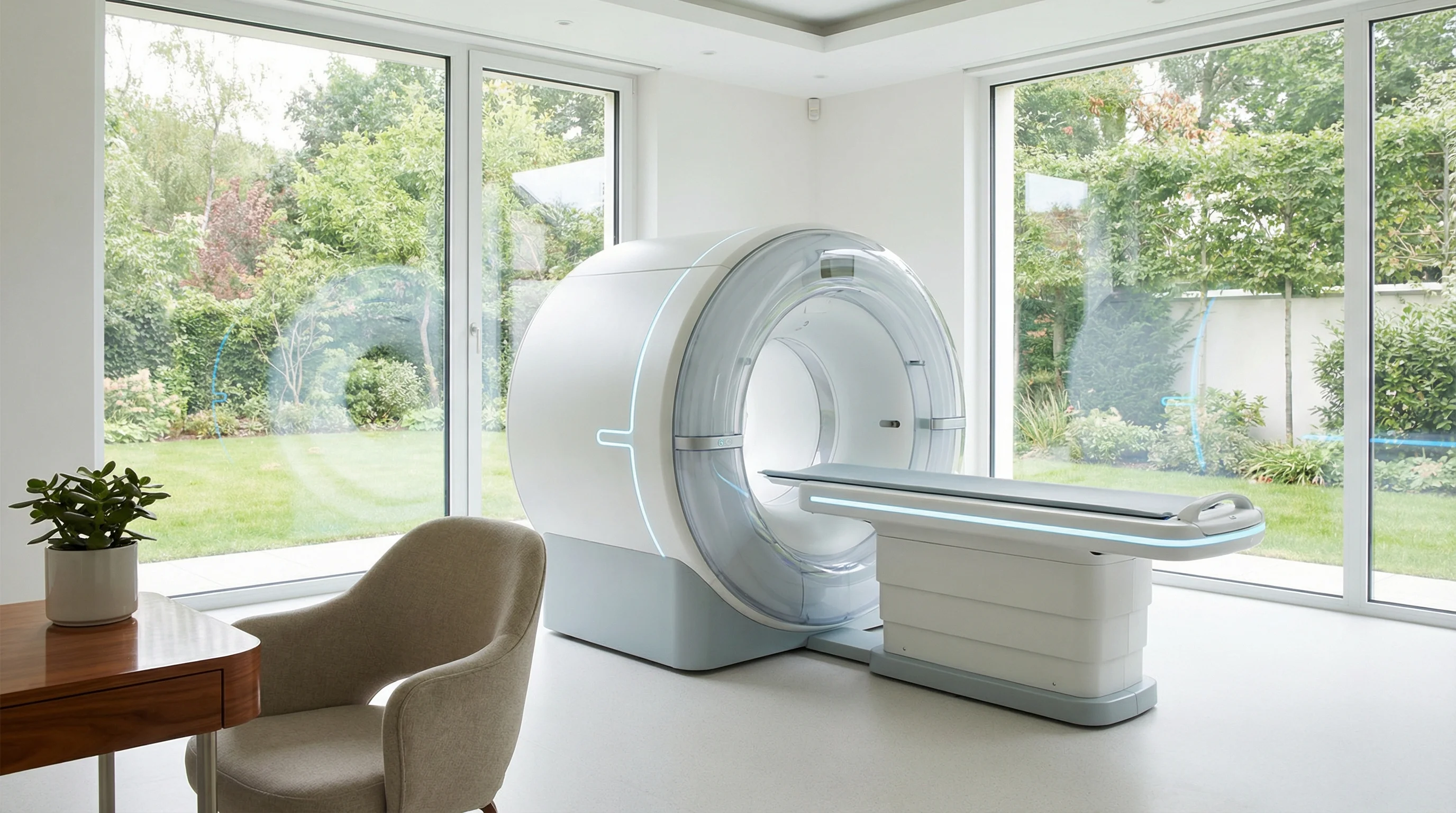
Into this capacity crunch has emerged a new category of technology: dedicated brain PET systems designed specifically for neuroimaging rather than whole-body cancer scans. These compact devices promise to bring PET out of hospital basements and into outpatient clinics, fundamentally changing who can offer the technology.
Whether they'll actually deliver on that promise at scale remains an open question.
Positrigo, an ETH Zurich spin-off founded in 2018, secured FDA 510(k) clearance for its NeuroLF system on July 16, 2024, followed by CE Mark approval under the EU's stricter Medical Device Regulation in October. The device is ultra-compact—marketed for 10-by-10-foot rooms with minimal modifications—and scans patients in a seated position rather than lying down. CEO Jannis Fischer has framed the company's mission as "making functional imaging accessible" at a moment when breakthrough therapies are creating unprecedented demand.
The first U.S. system shipped before year-end 2024. In December 2025, The Neuron Clinic in San Marcos, California became the first independent neurology practice in the U.S. to install a NeuroLF, building an in-office dementia diagnosis and treatment pathway around the technology. Beverly Hills Medical Imaging ordered two units in October 2025. LMU Hospital Munich made the first major German hospital purchase in August 2025, and the University Hospital of Genoa became the first Italian site in December 2025.
Positrigo closed a CHF 7 million financing round in June 2025 led by HealthCap, adding industry veterans Didier Deltort and Ajit Singh to its board—signals of commercial acceleration, or at least investor belief that the market timing is right.
The device competes in a rapidly evolving landscape. United Imaging's NeuroEXPLORER, a research-grade brain-dedicated PET/CT with an extended 49.5-cm axial field of view, earned a Journal of Nuclear Medicine Editors' Choice award in 2024 for performance and is deployed at Yale and UC Davis. OncoVision's CareMiBrain, distributed in the U.S. via Catalyst MedTech as of 2025, claims FDA status, though specific clearance details remain vendor-asserted and less transparent.
Meanwhile, the major PET manufacturers—Siemens, GE HealthCare, Philips, Canon Medical—continue advancing digital PET and long-axial field-of-view systems like United Imaging's uMI Panorama GS for total-body or near-total-body imaging that also covers neurological applications. These aren't direct competitors to compact brain systems so much as parallel evolution: different solutions for different parts of the ecosystem.
The shift toward outpatient deployment is perhaps most evident at The Neuron Clinic, where the explicit strategy is keeping dementia patients within the practice's continuum rather than referring them out for imaging that may take weeks and fragment care. It's a model that could replicate across thousands of neurology practices managing Alzheimer's patients, provided the economics work.
That's an open question. Typical PET/CT capital expenditures run $1.5 to $2.8 million, with ongoing maintenance costs around $85,000 annually. Compact systems theoretically offer lower acquisition costs and smaller footprints, though manufacturers have been reluctant to disclose public pricing. There's also the matter of radiopharmacy logistics, quality control, staffing, and whether outpatient practices can realistically manage the operational complexity.
What Comes Next

The trajectory appears to be toward a distributed, multi-tiered imaging ecosystem rather than a single technology dominating. Blood biomarkers will triage. Compact dedicated brain PET will expand access in outpatient settings—or try to. High-end long-axial-field systems and traditional PET/CT will anchor academic and hospital networks. AI quantification tools—including experimental PET-from-MRI synthesis research and web-based Centiloid pipelines—will standardize interpretation as volumes surge and specialist capacity lags.
International rollout of donanemab approvals (UK in October 2024, Japan in September 2024, China in December 2024, European Commission authorization in September 2025) signals that demand pressures are global, not just a U.S. phenomenon. Reports from the UK National Health Service highlight similar infrastructure bottlenecks, with insufficient PET/MRI scanners and specialists threatening to delay therapy access even as drugs gain approval. The case for compact, purpose-built systems becomes stronger when existing capacity is maxed out and geographic distribution is uneven.
Two uncertainties loom large.
First, clinical evidence on repeated amyloid PET for therapy monitoring is still emerging. The European Association of Nuclear Medicine published an editorial in 2023 discussing potential roles, but payer policies haven't yet embraced routine follow-up imaging. If monitoring becomes standard practice—say, annual scans to track treatment response—demand could spike beyond even the 20-fold estimates floating around. That would be a different problem entirely.
Second, the interplay between blood biomarkers and imaging remains genuinely unsettled. Will blood tests reduce PET demand by ruling out the worried well, or amplify it by identifying more candidates who need confirmatory scans? Early indications suggest the latter—better triage means more appropriate patients reaching the imaging step, not fewer total scans. But the data isn't definitive yet, and much depends on how primary care physicians actually use these tests in practice versus how researchers envision them being used.
The Billion-Dollar Gap

For healthcare investors and medical device executives, the opportunity lies at the intersection of enabling technology and unmet infrastructure need. The Alzheimer's drugs exist. The patients exist. What's missing is the diagnostic capacity to connect the two at scale, at the point of care where most patients are actually managed.
Companies that solve the access problem—whether through compact hardware, radiopharmacy networks, AI interpretation, or integrated clinical pathways—stand to capture economics in a market approaching $1 trillion in annual care costs. The shift from hospital-centric to distributed brain imaging isn't theoretical anymore. It's happening, system by system, clinic by clinic.
Driven, improbably, by the collision of breakthrough science and decades of diagnostic underinvestment that nobody particularly noticed until the treatments finally arrived and the waiting rooms filled up.
The scans were always supposed to be the easy part.


