

The numbers from MÜNCHENSTIFT's 2023 pilot program arrived with the kind of clarity that makes you pause: Nearly three in ten residents screened had eye conditions no one knew about. No diagnosis. No treatment plan. Just years of gradual vision loss, unnoticed and unaddressed.
For many of these Munich nursing home residents, the last time they'd sat in an ophthalmologist's chair was a matter of speculation. Mobility issues made the journey daunting. Appointment backlogs stretched on for months. And finding a specialist willing to make house calls? That was a different kind of impossible.
Dr. Claus Gruber wasn't surprised. During his research stint at London's Moorfields Eye Hospital—one of Europe's most respected ophthalmology centers—he'd watched the same pattern play out across the continent. The structural problem was clear enough: over 100 million Europeans, concentrated heavily in rural pockets and senior facilities, couldn't access specialist eye care when they needed it. In Germany, the math was getting worse. Roughly 30% of ophthalmologists had already crossed 60 and were eyeing retirement. In underserved regions, wait times could hit a year.
So in July 2022, Gruber and his co-founder Dominik Pederzani launched Mirantus Health with a proposition that felt almost obvious in its directness: If patients can't reach ophthalmology, bring ophthalmology to them.
When McKinsey Meets Medicine
Pederzani was an unusual fit for healthcare entrepreneurship, at least on paper. Nearly five years at McKinsey, followed by a turn as COO at LINUS Digital Finance—his background was all systems thinking and operational efficiency. Gruber brought the clinical weight and a hypothesis sharpened at Moorfields: telemedicine could handle ophthalmology screening, but only if you designed the workflow correctly from the start.
Four months later, in November 2022, they'd closed a pre-seed round. Revent, Entrepreneur First, and Springboard Health Angels backed them. The pitch wasn't complicated, though the execution would prove otherwise: deploy mobile screening teams, route results to remote physicians, build a distributed ophthalmology network that could actually scale.
What emerged—branded simply as "mira"—doesn't position itself as a replacement for traditional ophthalmology. Mirantus is careful to spell this out in its terms: it's not a medical provider, it doesn't diagnose. Instead, think of it as a triage layer. A way to get preliminary screenings done locally, flag the urgent cases, and route people to the specialists who can help.
Inside the Augenmobil
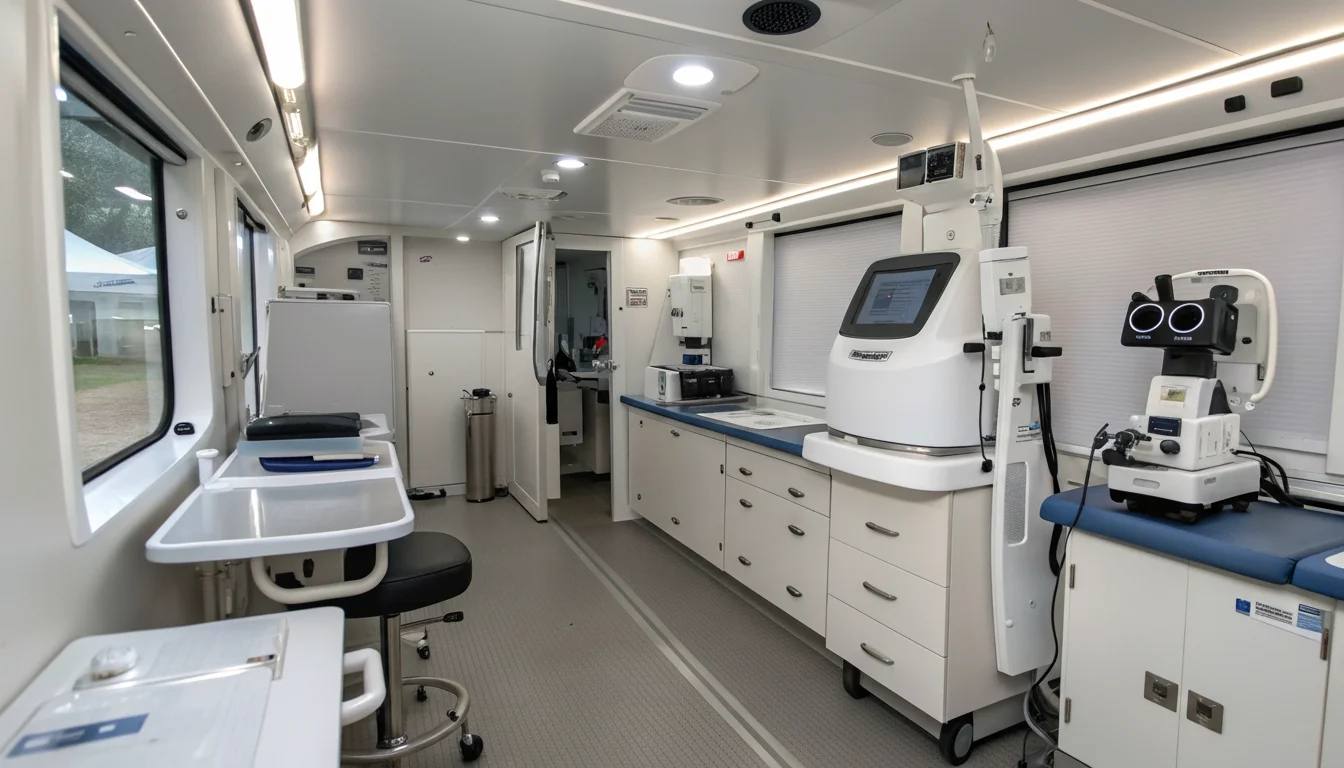
Step inside a Mirantus screening and you won't find an ophthalmologist. You'll meet optometrists or trained medical assistants capturing a suite of measurements: retinal images, intraocular pressure, slit-lamp photographs, refraction tests, visual acuity checks. The data feeds into the mira platform, where a network of more than 400 ophthalmologists reviews everything remotely.
Turnaround runs 24 to 48 hours. Patients get a written report—not a diagnosis, the company stresses, but a results summary indicating whether follow-up care makes sense. If a video consultation is warranted, those visits can be billed directly to Germany's statutory health insurance. When in-person appointments become necessary, Mirantus helps route patients to its ophthalmologist network.
For municipalities and care facilities, the value proposition practically sells itself. Mirantus's mobile "Augenmobil" rolls into nursing homes, workplaces, town squares. In 2024 and 2025, the van made recurring stops in places like Schmölln, Neustadt an der Orla, Genthin—towns you've probably never heard of unless you're from there. Appointments often booked out completely, prompting return visits. Pricing typically sits at €69 per screening, though some municipal programs have negotiated rates as low as €49.50.
For ophthalmologists, it offers supplemental income and workflow relief. Doctors can list their practices on Mirantus's open booking platform to capture triage referrals, or perform remote evaluations when their schedules allow. The company frames it as a way to monetize downtime while addressing genuine access gaps—though whether enough specialists will participate at scale remains an open question.
Numbers That Tell a Story
By early 2024, Mirantus had served more than 5,000 patients. Platform usage jumped nearly 70% in the first quarter alone, according to investor Noaber—one of those metrics that sounds impressive until you remember they were starting from a relatively small base. The company hit 200-plus active locations and kept adding municipalities and care facilities throughout the year. As of late 2025, they report crossing 20,000 customers across 250-plus sites.
Partnerships brought validation. MÜNCHENSTIFT, satisfied with its pilot results, expanded Mirantus screenings across all its facilities. Helios Klinik Leisnig integrated the mobile exams into its service offerings. A tie-up with Sanoptis—a major ophthalmology practice operator—signaled potential for broader network integration, though details remain sparse.
In 2023, Handelsblatt and Techniker Krankenkasse named Mirantus a Top-10 finalist for the Health-i Award. That recognition mattered in Germany's tight-knit digital health community, where credibility opens doors.
Still, the model carries complexities worth noting. The €69 screening fee comes out-of-pocket; statutory insurance won't cover it. Only the follow-up video consultations qualify for reimbursement. That places Mirantus somewhere between consumer wellness service and clinical pathway—an in-between space that works in a market where patients are conditioned to long waits and often willing to pay for faster access. But it's also a positioning that could prove fragile if reimbursement rules shift or competitors offer subsidized alternatives.
€5.5 Million and the Push Into Austria and Switzerland

On November 20, 2025, Mirantus closed a €5.5 million seed round. The investor roster included returning backers Revent and Entrepreneur First, joined by Redstone, Noaber, Arve Capital, and a handful of notable angels. Among them: Kai Eberhardt, who helped scale digital health platform Oviva, and Katharina Jünger, formerly of TeleClinic.
The capital is earmarked for expanding mira across Germany, Austria, and Switzerland—the so-called DACH region. Mirantus is targeting more than 1,000 locations by 2027. That's a quintupling of its current footprint in roughly two years, ambitious by any standard. But demand signals are there. Multiple towns have requested return Augenmobil visits after initial deployments sold out.
The funding also plants Mirantus more firmly in a competitive landscape. Fielmann—Germany's dominant optical retailer—runs its own screening initiative through a partnership with the Ocumeda network. In a February 2024 interview with trade publication DOZ, Gruber acknowledged the parallel but emphasized differences: Mirantus focuses first on underserved populations like nursing home residents, uses delegated screening models, and operates an open network rather than a closed chain.
Whether those distinctions matter to municipal buyers or care operators isn't entirely clear yet.
The Real Challenge Isn't Vans, It's Infrastructure

Reaching 1,000 locations isn't just about buying more vehicles. It means operationalizing partnerships with hundreds of municipalities, care operators, and employers. Maintaining quality control across a distributed network of screening teams and remote reviewers. Navigating Germany's labyrinthine healthcare reimbursement system, where the boundary between preventive wellness and covered care remains frustratingly blurry.
Mirantus employs between 11 and 50 people, according to its job listings—a lean team for such outsized ambitions. Leadership includes Pederzani as CEO, Gruber as managing director and chief medical officer, and Philipp Deutschen, another McKinsey alum, as chief commercial officer. That's a lot of consulting DNA for a healthcare startup, which could be an asset or a liability depending on how execution unfolds.
Perhaps the real test isn't hitting the 1,000-location milestone. It's whether Mirantus can transition from being a novel solution to becoming infrastructure—embedded in the structural fabric of European elder care, not as an innovation but as a standard. That MÜNCHENSTIFT discovered undiagnosed conditions in 28% of residents suggests the clinical need isn't debatable. Whether Mirantus can meet it at scale, profitably and sustainably, is still very much being written.
For now, the Augenmobil keeps rolling.


