

The pitch sounds almost too good: structural parts produced one hundred times faster than conventional methods, weighing a fraction of their metal equivalents. Yet Hybron Technologies, a composites manufacturer tucked into El Segundo's aerospace corridor, just convinced investors it's worth betting $20 million that the claim isn't vaporware.
The April 2026 Series Seed round—oversubscribed, according to company communications—was led by Marque Ventures and joined by Veteran Ventures Capital. Both firms specialize in defense technology, and both are wagering that Hybron's manufacturing platform can solve what has become an uncomfortable problem for the Pentagon: how to produce munitions and aerospace components faster, lighter, and without relying on foreign supply chains that may not be there when you need them.
Whether Hybron can actually deliver on that 100x speed-up at production scale is the question no one's answering yet. But for now, the startup has the runway to try.
A Platform Built for Bottlenecks
Brennan Lieu and Aaron Guo, Hybron's co-founders, aren't exactly strangers to the defense-industrial complex. Both graduated from the Northrop Grumman Technology Accelerator, and both landed spots on Forbes' 30 Under 30 list for Transportation & Aerospace in 2026—the kind of credential that opens doors in venture circles, even if it doesn't guarantee the technology works at scale.
The company, founded in 2022, originally operated under the name BladeX Technologies before rebranding roughly a year ago. (The reasons for the name change haven't been made public, though it's not uncommon for early-stage firms to rebrand as their market focus sharpens.)
Hybron's core offering is a composite manufacturing platform that can produce components up to 90 percent lighter than aerospace-grade metals under certain conditions. Early prototypes include composite casings for 155mm artillery shells and turbine fan blades—applications where every ounce matters and where legacy processes like autoclaving and hand lay-up have long been criticized for being painfully slow.
Artillery shells, in particular, have become a focal point. Global demand for 155mm rounds has outstripped supply, and traditional manufacturers are struggling to ramp up. If Hybron's process proves viable, it could represent a meaningful shift in how munitions are made—though perhaps not as dramatic as the company's marketing suggests.
Defense Dollars, Dual-Use Dreams
The capital will go toward advancing engineering development, expanding manufacturing capacity, and moving toward what Hybron describes as "initial munitions production." That last phrase is doing some work. It suggests the company isn't quite there yet, even as it secures contracts and investor backing.
One detail that likely mattered to Marque Ventures: Hybron maintains an all-U.S. supply chain. That's table stakes for any firm hoping to win defense contracts in an era when supply chain sovereignty has become something of an obsession in Washington. Marque, a seed-to-Series A fund, invests exclusively in technologies intended for U.S., NATO, and Five Eyes use cases—meaning it's not interested in companies that might find their way onto an export control watch list.

Veteran Ventures Capital, which participated in the round, invested from its $60 million Fund II, which closed in 2025. The firm focuses on backing veteran founders and defense-adjacent startups, a niche that has grown more crowded as capital has flowed into the sector.
Some industry newsletters circulated a $25 million figure for the raise, but official releases from both investors and Hybron confirm the round at $20 million. Additional participants, if any, haven't been disclosed in public filings.
The Munitions Campus Bet
Hybron is also among the first cohort of 16 companies executing agreements to operate at ACMI's Munitions Campus, a Department of Defense-backed shared infrastructure pilot announced in 2025. The initiative is part of a broader effort to lower barriers for emerging defense manufacturers and bring critical munitions production back onshore.
Being part of that cohort gives Hybron a degree of credibility—and access to infrastructure that would otherwise require significant capital outlays. It also ties the company to a policy bet: that the future of defense manufacturing will involve more startups, more distributed production, and less reliance on a handful of entrenched primes.
S&P Global reported in March 2026 that venture capital investment in defense technology continues to climb even as mergers and acquisitions in the sector have slowed. That divergence creates a window for companies like Hybron, which can attract early-stage capital without facing immediate pressure to sell or go public.
The Proof-of-Concept Problem
Hybron's stated target applications are broad: aerospace structures, unmanned systems, industrial equipment, next-generation defense platforms. That's the dual-use playbook—appeal to both military buyers and commercial markets to derisk the business model.
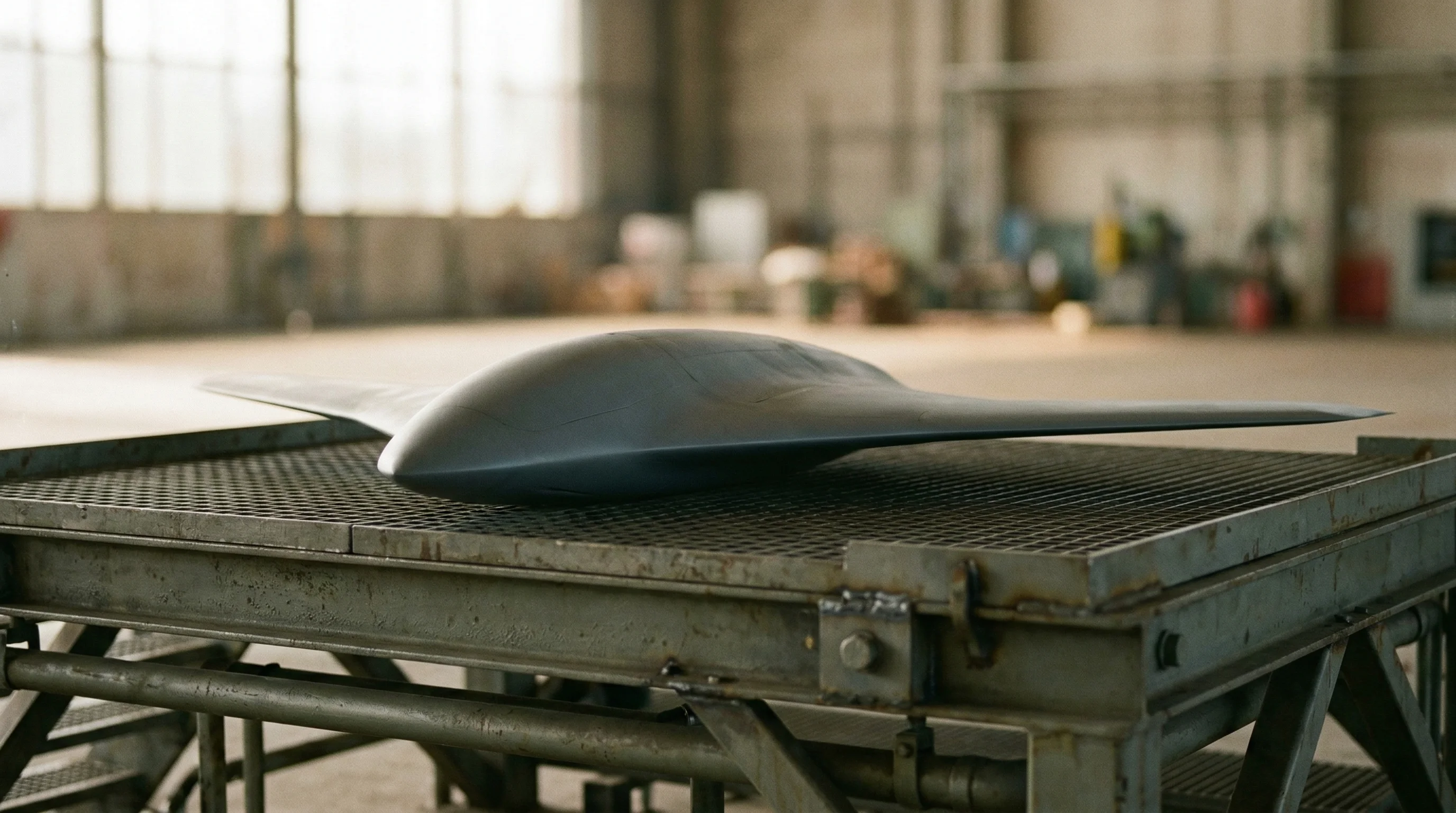
But the real test will come when the company has to scale beyond prototypes. Composite manufacturing has long promised revolutionary improvements in speed and weight, and the industry is littered with firms that nailed the lab demonstration but stumbled when it came time to produce thousands of units under cost and quality constraints.
For now, Hybron has the capital, the pedigree, and the partnerships. Whether it can turn a compelling pitch into a production line that actually moves 100 times faster than the incumbent processes—well, that's the $20 million question.


