

The summers are getting hotter, the wildfires more ferocious, and Europe's fleet of aging amphibious firefighting aircraft—some pushing four decades in service—groans under the strain. Enter HYNAERO, a French aerospace startup that believes it has the answer: a purpose-built, fly-by-wire water bomber designed for the climate reality of the 2030s.
On March 22, 2026, the company closed a combined Seed and Series A funding round totaling €117 million, capital it will use to push its Fregate-F100 amphibious aircraft from concept sketches toward a preliminary design and, eventually, operational deployment. The funding comes from undisclosed investors—a choice the company has not publicly explained—but it arrives at a moment when France in particular faces a looming crisis with its own fleet.
As of mid-2025, the French state operated a dozen Canadair water bombers, workhorses that averaged roughly 30 years of age. By the time HYNAERO aims to deliver its first aircraft in late 2032, those planes will be north of 40 years old. Perhaps more urgently, there are vanishingly few alternatives on the market.
A Market With Almost No Competition
The Fregate-F100 is designed to haul 10 tons of water at a 250-knot cruise, with endurance exceeding four hours—a performance envelope that positions it as a generational leap over the planes it seeks to replace. HYNAERO has outfitted its design with modern avionics: fly-by-wire controls, head-up displays, and an integrated predictive maintenance system built around digital twin architecture. The company's roadmap also includes variant configurations for search and rescue, air ambulance missions, and a passenger-cargo version capable of seating 36 or ferrying five tons over commercial ranges beyond 2,500 kilometers.
It's an ambitious technical program for a startup, though HYNAERO has assembled a network of heavyweight partners. Airbus Defence & Space formalized a strategic cooperation agreement in February 2025. The March funding announcement named six technical collaborators: Airbus itself, along with Akkodis, Altitude Aerospace, Capgemini, R&R Consulting, and Zelin.
Still, the development timeline has already shifted. Early projections from 2025 pointed toward a prototype flight in 2029 and entry into service by 2031. The updated schedule now calls for a Preliminary Design Review in autumn 2028, first flight tests in early 2031, and initial customer deliveries sliding to the end of 2032. Whether that reflects technical realism or the complexity of certifying a clean-sheet amphibious design remains an open question.
Istres, Public Support, and the France 2030 Bet

The €117 million in private capital follows €7 million in public support committed through the France 2030 program in June 2025, when HYNAERO relocated its industrial operations from Bordeaux to the Jean Sarrail Aeronautics Cluster in Istres, a site with deep roots in French aerospace and defense work. Région Sud co-funded that earlier commitment alongside the national government, a signal that local authorities see HYNAERO as an economic development play as much as a strategic one.
The new funding will bankroll both the Concept Design and Preliminary Design phases, build out manufacturing infrastructure in Istres, and scale the engineering team from its current size to 60 employees within a year and 140 by the close of 2027. French media estimates from mid-2025 pegged the total program cost at around €1 billion to reach entry into service—a figure HYNAERO has not confirmed but also has not disputed.
The startup held letters of intent for 27 aircraft from France's Civil Security agency and two private operators as of mid-2025. The company has not updated those figures publicly since, and the March press release referenced "continuing support" from French Civil Security and private operators without offering hard numbers. That lack of detail leaves open how much of the order book is firm versus aspirational.
What HYNAERO Is Up Against
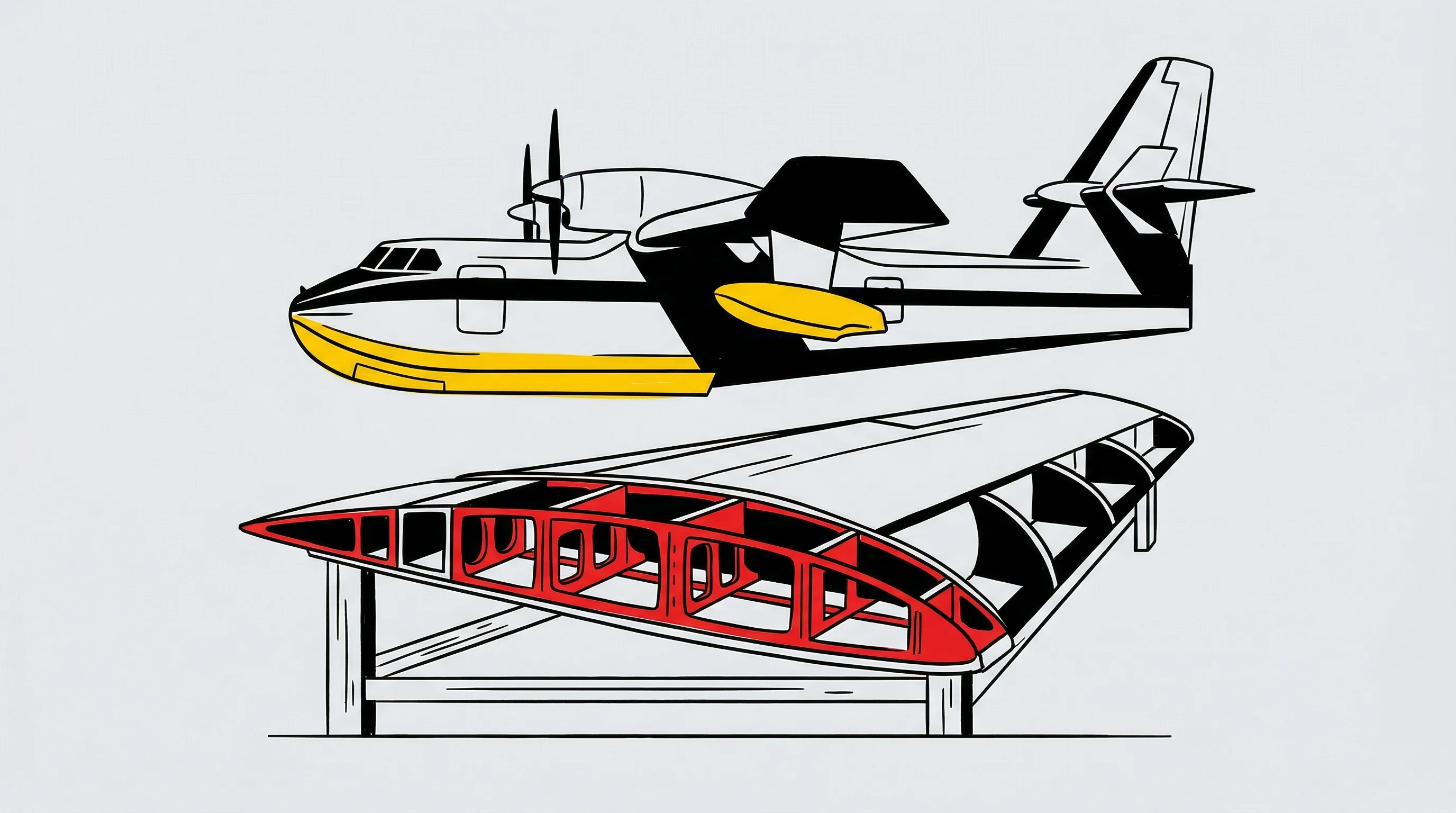
The amphibious water bomber market is not crowded, but it is constrained. De Havilland Canada's DHC-515, the only other purpose-built amphibious scooper in active production, hit a manufacturing milestone in March with the completion of its first 28.6-meter wing box at the company's Calgary facility. But even that program, backed by the EU's rescEU procurement framework, won't see initial deliveries until late 2027 or 2028. By the time HYNAERO reaches operational status in 2032, the window for European fleet renewals will be wide open—assuming the company can execute on a schedule that aerospace startups, historically, have struggled to meet.
There's also the question of certification and operational validation. Amphibious aircraft operate in one of the most demanding environments in aviation: low-altitude runs over terrain, scooping from open water, dumping payloads in turbulent conditions. HYNAERO has never flown a prototype. It will need to prove the Fregate-F100 not just on paper, but in the kind of real-world scenarios where legacy Canadairs have logged tens of thousands of hours.
The funding, then, is a vote of confidence but also a down payment on a very long road. With wildfires intensifying across Southern Europe and the Mediterranean, the need is undeniable. Whether HYNAERO can deliver on the timeline—and the performance—remains the question that €117 million is meant to answer.


