

Ilion Water Technologies raises $4.5 million to prove that electricity can replace crushing force in water purification—a physics gamble that could upend a $20 billion industry.
The pitch sounds almost too simple: apply a few volts to a membrane and let electricity do what typically requires pressure equivalent to stacking water 600 meters high. Yet that's precisely what Ilion Water Technologies is attempting, and the Paris-based startup just secured $4.5 million in seed funding to prove the physics work beyond the lab bench.
The round, led by Demea Sustainable Investment with participation from Critical Path Ventures, includes an additional €1.3 million in non-dilutive support from Bpifrance, Région Île-de-France, and the CNRS research ecosystem. For a company incorporated on February 6, 2025, it's a meaningful vote of confidence in technology that challenges orthodoxy.
"We're replacing mechanical force with electrical control," CEO Lucie Ries said, describing an approach the team calls Voltage Induced Reverse Osmosis, or VIRO. Where conventional desalination plants force seawater through membranes at up to 60 bar—roughly the pressure found six stories underwater—Ilion's system uses voltage gradients to coax salt and water apart.
The Science Behind the Bet
The technology traces back to nanofluidics research at ENS-PSL's Laboratoire de Physique, where Lydéric Bocquet, one of Ilion's co-founders, spent years exploring how fluids behave at molecular scales. Bocquet won the CNRS Innovation Medal in July 2024, a recognition typically reserved for researchers whose lab work shows commercial promise.
Whether that promise translates to deployment is the question investors are now funding. Reverse osmosis consumes roughly 70 percent of the energy footprint across the industry's 22,000 desalination plants worldwide. Shaving even a few percentage points off that figure represents hundreds of millions in annual savings—and potentially a new standard for an industry where efficiency gains have become incremental.
Ilion's system pairs voltage oscillation with on-membrane sensing, a design the company says reduces fouling—the bane of membrane operators everywhere—while cutting chemical cleaning cycles and capital costs. The startup won both the Pollutec Innovation Challenge and Bpifrance's i-Lab award in 2024, judged by panels that included executives from Suez and Vinci, incumbents with little incentive to hype unproven alternatives.
Still, awards and lab results are one thing. Durability at scale is another. Veolia announced contracts in October 2024 targeting 2.9 kilowatt-hours per cubic meter, a frontier benchmark in conventional reverse osmosis. Ilion will need to demonstrate not just proof-of-concept but sustained throughput, membrane lifespan under real-world fouling, and cost parity in pilot environments where seawater doesn't behave as politely as it does in controlled experiments.
A Small Team, Big Ambitions

The founding team includes Zacharie Pilo as Directeur Général, alongside Paulina Sarnikowski, Frédéric Hammel, Ries, and Bocquet. Corporate directories and recent job postings suggest the company employs fewer than ten people, though openings for process and membrane engineers hint at pilot programs with unnamed early customers.
No pilot sites or performance data have been disclosed publicly—a gap that's either prudent confidentiality or a sign that field validation remains ahead. Ilion operates out of incubators Agoranov and PC'UP—Incubateur ESPCI Paris, locations that offer proximity to both research infrastructure and the capital's venture network.
An Industry Exploring Alternatives
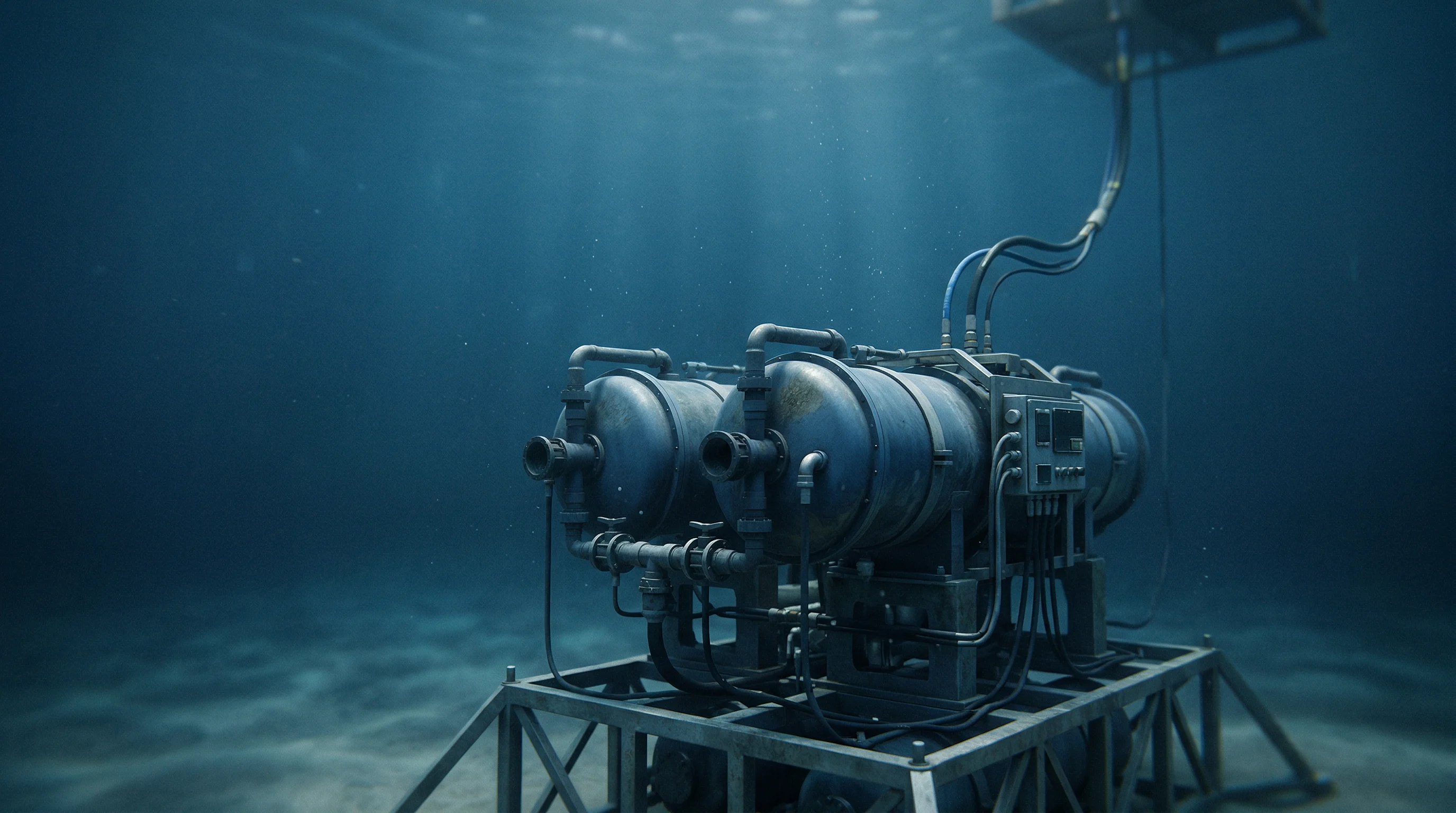
Ilion enters a desalination landscape that's quietly getting more experimental. Norway's Flocean raised $22.5 million last November—with strategic backing from Xylem—to test subsea desalination units that harness hydrostatic pressure at depth. In the U.S., Active Membranes is developing electrically conductive RO membranes for brackish water, supported by Department of Energy funding.
The common thread? Incumbents and investors alike are probing unconventional architectures, searching for breakthroughs beyond the marginal energy improvements that have defined the sector for the past decade.
The fresh capital will fund Ilion's transition from controlled experiments to field validation. If voltage-driven separation holds up under variable salt concentrations, temperature swings, and the unforgiving economics of municipal water contracts, the company may find itself in conversations with the same water giants that once dismissed pressure-free desalination as a laboratory curiosity.
Perhaps more than the founders anticipated, the hard part lies ahead: proving that elegance in the lab survives contact with seawater, calcium buildup, and the brutal arithmetic of cost-per-gallon.


