

On a clear morning last August, Consumers Energy dispatched 40 drone pilots across Michigan to inspect 400 miles of transmission lines. Each pilot operated a single drone. Each drone flew for perhaps 30 minutes before needing a fresh battery. The math was punishing—and revealing.
This is the state of utility inspection in 2025: widespread drone adoption, enormous promise, and a stubborn endurance ceiling that keeps the technology tethered to human logistics. Meanwhile, the American power grid faces what S&P Global calls a $1 trillion infrastructure reckoning between now and 2029—$214.7 billion this year alone, climbing to $233.3 billion by 2027. Utilities are also burning through $6 to $8 billion annually just keeping vegetation away from existing lines, a Sisyphean task made all the more urgent by wildfire liability that now runs into the billions.
PG&E absorbed $2.137 billion in penalties for the 2017-2018 California wildfires. Southern California Edison settled the 2020 Bobcat Fire case for $82.5 million this past May. These aren't abstract risk assessments. They're quarterly earnings events that force utilities to treat every overgrown branch and worn conductor as a potential catastrophe.
Now a handful of startups are making an audacious wager: that the best way to keep inspection drones flying isn't better batteries or hydrogen fuel cells, but teaching them to refuel from the very power lines they're inspecting.
It sounds almost absurdly recursive. But if the technology works—and that's still a significant if—it could unlock the kind of persistent, autonomous inspection networks that utilities desperately need and can't quite build with today's tools.
The Endurance Trap
Drone inspection of power infrastructure has long since graduated from novelty to standard practice. NYSEG and Rochester Gas & Electric inspected thousands of miles of line through 2024. Georgia Power claims its drone program slashed inspection time by roughly 40 percent and costs by around 60 percent compared to traditional methods. San Diego Gas & Electric examines some 13,000 poles annually through what it calls a Risk-Informed Drone Inspection program.
PG&E, operating under the kind of regulatory microscope that comes with causing multiple deadly fires, has woven drones into its 2026-2028 Wildfire Mitigation Plan. The utility deployed Skydio Dock systems at more than a dozen substations, layering drone imagery with AI weather forecasts and grid sensors. It's also burying 1,100 miles of line over the next three years, a tacit acknowledgment that some risks can't be managed, only eliminated.
Fortune Business Insights pegs the global utility drone market at just over $1 billion this year, headed toward $3.16 billion by 2034. North America accounts for roughly a third of that. But the growth trajectory depends entirely on solving a fundamental constraint: battery life.
Most commercial quadcopters fly for 20 to 40 minutes before requiring a swap or recharge. That's fine for inspecting a substation or a wind farm. It's borderline unworkable for the 200,000-plus miles of high-voltage transmission lines strung across the United States. Even the largest drone fleets still rely on pilots shuttling batteries, returning to charging stations, or coordinating logistics chains that reintroduce the very inefficiencies the technology was meant to eliminate.
The buildout numbers make the problem stark. According to FERC data compiled by Americans for a Clean Energy Grid, the U.S. added just 888 miles of new high-voltage transmission lines in 2024—down from roughly 4,000 miles built back in 2013. Grid Strategies noted in July that transmission expansion is "lagging far behind national needs." The Department of Energy finalized a $1.6 billion loan guarantee last October for American Electric Power to rebuild some 5,000 miles of line across five states. That's one utility. The backlog is measured in decades.
The Convergence
Three forces are colliding to make the endurance problem not just annoying, but existential.
First, regulation is finally catching up to reality. On August 7 of last year, the FAA published a Notice of Proposed Rulemaking for what it calls "Normalizing UAS BVLOS"—jargon for letting drones fly beyond visual line of sight without the case-by-case waiver process that has throttled commercial deployment for years. The agency denied a comment extension in September, then abruptly reopened comments on January 28 for another two weeks, a procedural hiccup that signals finalization will probably slip into late 2026. But the direction is clear. Routine corridor inspections without visual observers are coming.
Second, wildfire liability has migrated from a cost-of-doing-business risk to an existential threat. California utilities, in particular, now treat vegetation encroachment and conductor wear the way insurers treat flood zones—as actuarial certainties requiring preemptive action. When a single settlement can wipe out a quarter's earnings, you stop thinking of inspection as a maintenance line item and start thinking of it as loss prevention.
Third, the sheer scale of deferred grid modernization is coming due all at once. Data centers, EVs, heat pumps, reshoring industrial activity—demand projections that looked fanciful a few years ago now look conservative. And the infrastructure required to meet that demand can't be built using inspection methods designed for a slower, less litigious century.
Manual patrols and scheduled helicopter flights no longer match the pace of risk. Which is why utilities are now spending real money on autonomous systems that promise to inspect more frequently, more consistently, and with less human exposure to danger.
The Dock Solution—and Its Limits
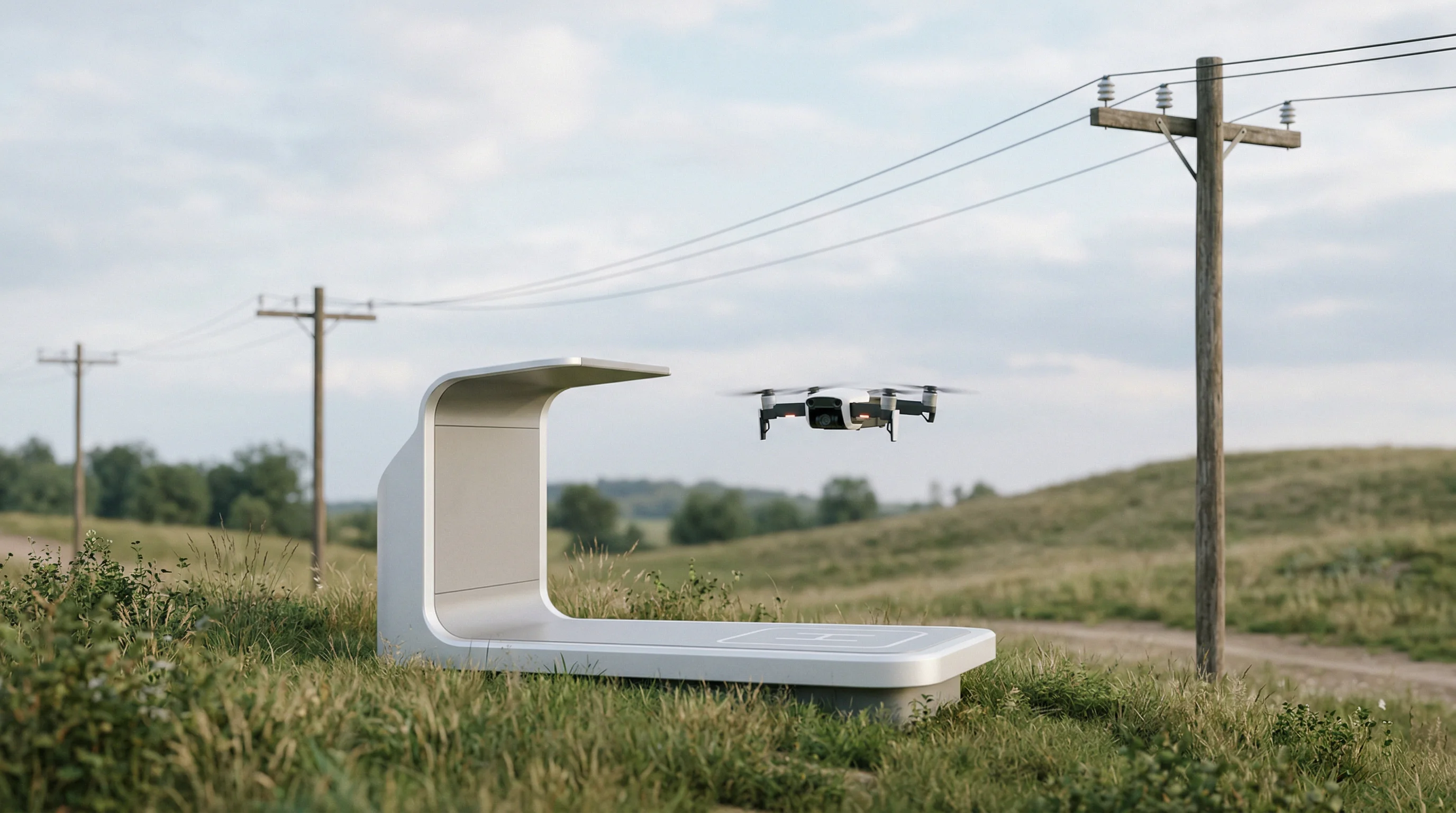
The first wave of autonomous drone platforms leaned heavily on fixed docking infrastructure. Percepto secured nationwide shielded BVLOS waivers in 2023 and won FAA approval in November of that year to operate up to 30 drones under a single remote operator. In November 2025, the company received EPA approval for autonomous optical gas imaging inspections—a significant validation that industrial autonomy could meet regulatory scrutiny.
Skydio began shipping its Dock for X10 system in January 2025, positioning U.S.-made drones that could fly missions via 5G or Starlink and return to weatherproof charging stations. DJI launched its Dock 3 in February, pairing mobile deployment with the Matrice 4D enterprise platform, though U.S. operations still require BVLOS waivers.
These systems work well for substations or facility inspection—essentially turning a fixed drone into a persistent sensor that can launch on-demand when something triggers an alert. But they don't really solve long-distance corridor inspection. A drone that must return to a depot every 40 minutes can't efficiently patrol a 100-mile transmission line. You'd need dozens of docks, each requiring power, connectivity, maintenance, and permitting.
Alternative endurance strategies have emerged. Doosan Mobility Innovation's DJ25 hydrogen fuel-cell drone claims up to 5.5 hours of flight time under ideal conditions, with typical inspection missions running north of two hours. Skyfront's Perimeter 8+ hybrid gas-electric platform advertises five hours with no payload, two to three hours carrying 5 kilograms of sensors. Both extend range significantly, but they're still consumable-fuel platforms. Someone still has to land them, refuel them, and launch them again.
The Academic Curiosity That Became a Startup Pitch
A more radical idea appeared in academic literature a few years ago, then mostly languished there. An MDPI paper published in September 2023 described a line-mounted charging station that clamps onto overhead conductors and harvests energy inductively via a split-core transformer. The system weighed about 5 kilograms and was designed for UAV installation. An IEEE conference paper from 2021 detailed a 400-watt inductive charging prototype specifically for overhead line patrol.
The concept was elegant: install charging stations directly on transmission lines, then design drones that can perch, clamp on, and recharge from the grid itself. For years, it remained a lab curiosity—interesting in theory, daunting in practice.
Then in early 2025, two startups began talking publicly about commercializing the approach. Laki Power, an Icelandic company, promoted a 2025 partner program around its LKX Drone concept in an October 2024 blog post. And Voltair, a Y Combinator Winter 2026 company founded by four University of Washington engineers, launched with an explicit pitch: drones that charge directly on transmission lines.
Voltair's team—CEO Ronan Nopp, CTO Hayden Gosch, Chief Growth Officer Avi Gotskind, and COO Warren Weissbluth—had won $15,000 from the UW Environmental Innovation Challenge in April 2025 and $25,000 from the UW Dempsey Startup Competition in May. Their stated mission, per a July feature in UW Engineering's news feed: "enable autonomous inspections of the power grid with the goal of completely eliminating wildfire risk for public utilities that use our technology."
That's ambitious phrasing, perhaps more so than the founders intended. Eliminating wildfire risk entirely is the kind of claim that draws skepticism from anyone who's spent time around utility risk management. But the underlying technology does address a real gap. The company describes a fixed-wing VTOL platform with what it calls patent-pending inductive charging IP, capable of drawing power from AC lines of any voltage.
The YC launch page, posted about a month ago, frames the use case around rapid post-storm and wildfire damage assessment: drones already positioned on the grid, able to launch on-demand rather than waiting for a pilot to drive out with fresh batteries. The company is currently hiring a founding autonomy engineer and a drone pilot/field technician, which suggests early field deployments are in motion.
No utility partnerships have been publicly announced yet. That's not surprising—utilities don't typically announce early-stage technology pilots until they're confident the technology won't blow up in their faces, literally or figuratively. But the concept addresses something dock-based systems and consumable-fuel platforms both struggle with: truly persistent, infrastructure-light inspection at scale.
A drone that charges off the grid it's inspecting could, in theory, patrol indefinitely without ground support. Whether that theory survives contact with utility safety standards, live-line regulations, and FAA scrutiny is the question the next 18 months will likely answer.
The Safety Gauntlet
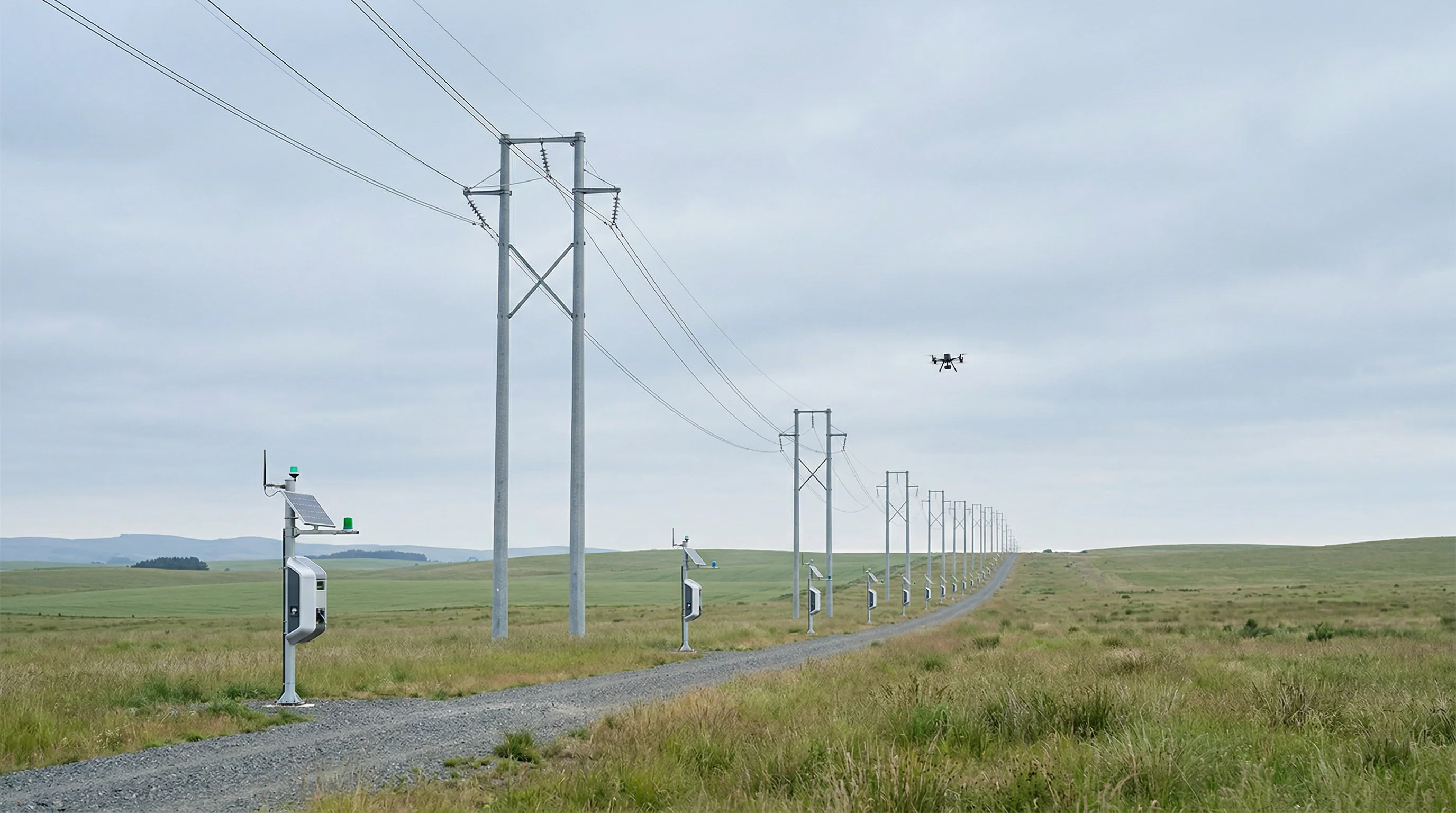
If Voltair or its competitors can thread what might generously be called a regulatory and engineering needle, the payoff could be significant. Imagine a transmission corridor with charging nodes every 50 miles, each hosting a drone capable of patrolling its segment autonomously. Conductor sag, vegetation encroachment, insulator condition, thermal anomalies—all monitored in near-real time without requiring humans to climb poles or charter helicopters.
That vision aligns neatly with the broader shift toward grid-enhancing technologies. LineVision's dynamic line rating sensors, deployed with National Grid and AES in 2023-2024, have demonstrated 20 to 40 percent capacity gains on instrumented lines. Coupling real-time line capacity data with continuous aerial inspection could enable condition-based maintenance and loading decisions that today require conservative estimates and safety margins.
Oak Ridge National Laboratory demonstrated autonomous drone response to grid events in August 2024, showing how drones could launch automatically when sensors detect anomalies. The technology works. The question is whether it can work safely enough, reliably enough, and at a cost that makes sense against helicopters and ground crews.
Because the technology is only half the equation—perhaps less than half. Live-line safety protocols exist for good reasons. Any device that contacts or even closely approaches energized conductors must account for voltage classification, minimum approach distances, recloser logic, and arc flash hazards. A drone clamping onto a 345 kV transmission line is, functionally, performing live-line work. That means it must meet OSHA requirements under 1926.964, comply with NERC vegetation clearance standards, and satisfy the same engineering rigor utilities apply to human crews.
This isn't a software challenge. It's a materials, electrical engineering, and safety validation challenge that will require extensive testing, likely a few high-profile failures, and probably some revisions to regulatory frameworks that were written long before anyone imagined autonomous aircraft refueling from overhead power lines.
The FAA's BVLOS rule, expected to finalize in 2026 despite the comment period hiccup, will determine how fast these systems can scale. The proposed Part 108 framework eliminates the waiver-by-waiver slog that has throttled commercial drone deployment. If it lands roughly as drafted, expect utilities to move quickly toward remotely managed inspection networks—whether dock-based, self-charging, or some hybrid of both.
The Cultural Hurdle

Early commercialization evidence suggests 2025 and 2026 are transition years. Prototypes exist. Competition exists. What doesn't yet exist is public evidence of a utility signing a multi-year contract for autonomous self-charging inspection. That will require more than technical validation. It requires cultural buy-in from organizations that have spent a century optimizing for safety over speed, and which have good reason to be conservative about new technologies that involve live electrical infrastructure.
Still, the convergence is hard to ignore. Over $1 trillion in grid spending on the horizon. Wildfire penalties that dwarf the cost of preemptive inspection. A regulatory environment moving, however haltingly, toward normalized beyond-visual-line-of-sight operations. And a handful of well-funded startups betting that the best place to refuel a grid-inspection drone is the grid itself.
Perhaps the most telling signal isn't the startups, though. It's how many traditional drone vendors—Percepto, Skydio, even DJI—are now investing heavily in autonomy, remote operations, and multi-drone management. They're acknowledging, implicitly, that manual piloting doesn't scale to the problem size. One pilot, one drone, one battery at a time just doesn't work when the inspection backlog is measured in hundreds of thousands of miles.
The race isn't just to build drones that can charge on power lines. It's to prove they can do it safely, reliably, and at a price point that makes sense against the alternatives. If they can—and it's still a meaningful if—the 200,000-mile U.S. transmission network might finally get the persistent eyes it needs.
And utilities might stop spending quite so much time wondering which overgrown tree branch will ignite the next multi-billion-dollar wildfire settlement.


