

Eighteen months is a blink. In Silicon Valley time, it's barely enough to ship a second product iteration or weather a single funding winter. Yet that's how long Physical Intelligence existed before Alphabet's venture arm handed it $600 million.
The November 2025 round—led by CapitalG, with Jeff Bezos, OpenAI, and a constellation of heavyweight investors piling in—valued the San Francisco startup at $5.6 billion. Not for a consumer app with viral growth. Not for an enterprise SaaS platform with recurring revenue. For an idea: software that can control any robot, anywhere, doing anything.
The company calls itself Pi (π), which feels both playfully mathematical and subtly grandiose. What they're building is harder to dismiss. A foundation model for physical machines—the kind of AI brain that learns from watching millions of robot movements, then transfers that knowledge across different bodies, different tasks, different environments entirely. Think GPT, but for robotic arms folding your laundry or factory equipment assembling chocolate boxes at 5:30 a.m. on a Tuesday.
If it works—and that's doing considerable lifting—it would represent something close to the holy grail of robotics. A generalist intelligence untethered from specific hardware. Software that makes machines useful without custom programming each task from scratch.
The Team That Didn't Need a Pitch Deck
Physical Intelligence launched in 2024 with the kind of founding team that opens investor checkbooks through reputation alone.
Karol Hausman, the CEO, spent years inside Google and DeepMind's robotics labs. He holds an adjunct appointment at Stanford, the kind of credential that signals continued academic legitimacy. Sergey Levine runs one of UC Berkeley's most influential robot learning groups—the kind researchers cite reflexively in papers. Chelsea Finn, at Stanford, pioneered meta-learning approaches that let robots master new tasks with minimal examples. Brian Ichter came from Google Brain and DeepMind's research ranks.
These weren't entrepreneurs hunting for a thesis. They were academics who'd already collaborated on something ambitious enough to attract attention: the Open X-Embodiment project. That sprawling effort corralled 34 labs into aggregating more than a million real robot trajectories across 22 robot types. The dataset, published at the International Conference on Robotics and Automation in 2024, became foundational—literally—to Pi's cross-embodiment strategy.
"Bring AI to the physical world with a universal model that can power any robot or any physical device," Hausman told Bloomberg in March 2024. Simple enough to understand, maddeningly difficult to execute.
They weren't alone in chasing this. Figure AI, backed by OpenAI and Microsoft, is building humanoid robots with their own intelligence stack. Skild AI raised a massive round specifically for "robot brains." Covariant has carved out warehouse manipulation. But Pi positioned itself differently from the start: pure software, deliberately hardware-agnostic, maximum generalization across embodiments. No manufacturing constraints. No single-use case lock-in.
Shipping Fast, Really Fast
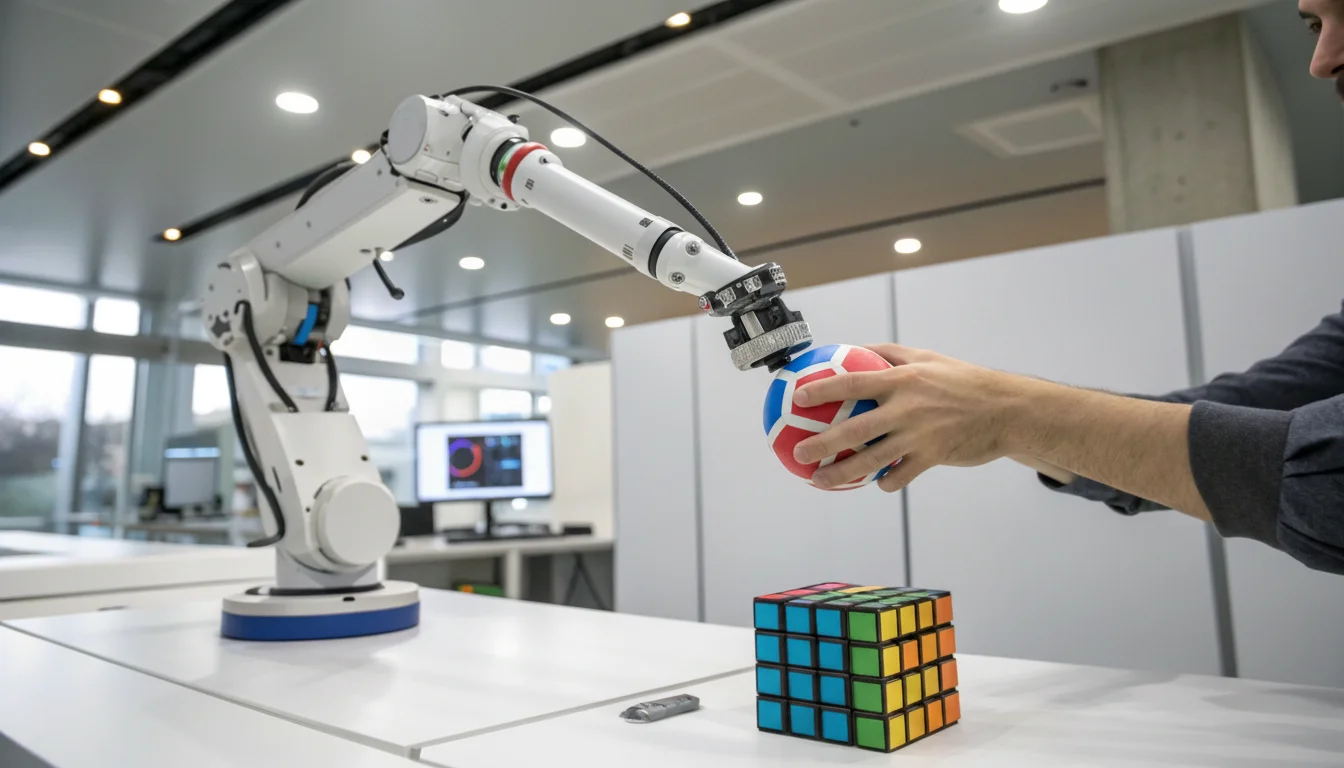
By late October 2024—barely months after incorporation—Pi released π0 (pi-zero), its first generalist robot policy. The technical architecture combined internet-scale vision-language models with continuous action outputs, trained on the Open X-Embodiment data plus Pi's own dexterous manipulation datasets.
The demos cut through typical robotics hype. A robot folding laundry—including the genuinely difficult task of unloading a dryer and handling crumpled fabric. Bussing tables while distinguishing dishes from trash. Assembling boxes using coordinated multi-arm systems. Pi published uncut videos, single-policy executions. No cherry-picking the successful runs, or at least that's what they claimed.
Then the releases turned into a drumbeat.
January 2025: FAST, a discrete action tokenizer using DCT and BPE compression that accelerated training 5x over diffusion methods. Zero-shot performance on DROID benchmarks across novel environments. February: "Hi Robot," a hierarchical reasoning system that let the same vision-language model essentially converse with itself to guide low-level motor control. April: π0.5, co-trained on heterogeneous datasets to handle unseen households. May: "Knowledge Insulation," a training recipe that preserved language model capabilities while adding motor skills. June: "Real-Time Chunking" to solve latency problems—important for delicate tasks like lighting matches or plugging in Ethernet cables without jamming connectors.
The November 2025 release felt like a culmination. π*0.6 incorporated reinforcement learning through something Pi called "Recap"—advantage-conditioned policies learning from demonstrations, human corrections, and autonomous trial-and-error. In an unnamed factory, the system assembled and labeled 59 chocolate boxes. In a new home environment, it folded laundry for hours straight. At one undisclosed test site, it made espresso drinks from 5:30 a.m. until 11:30 p.m.
The operational endurance matters more than the tasks themselves. Robotics startups love showing 90-second demos. Running continuously for six hours, or eighteen, without human intervention? That's different.
On February 4, 2025, Pi did something unexpected for a heavily-funded startup guarding trade secrets: they open-sourced π0. Code, weights, checkpoints for ALOHA and DROID systems went public. Hugging Face built a PyTorch port within weeks. Universities from Washington to Montreal to KAIST began testing the checkpoints in their own labs.
It was partly generosity, partly confidence. Mostly strategy. Give away the foundation, establish the standard, build the commercial layer on top later.
Money Flows Toward Belief (or FOMO)
The funding trajectory tells a compressed story about investor conviction—or perhaps fear of missing the next platform shift.
Pi reportedly raised $70 million in a seed round during March 2024, at roughly a $400 million valuation. Thrive Capital led. Eight months later, on November 4, 2024, the company announced $400 million more at a $2.4 billion post-money valuation. CNBC confirmed Jeff Bezos participated. So did OpenAI, Thrive again, Lux, Bond, Redpoint, Sequoia, and Khosla Ventures. The New York Times broke the story first—always a signal about which startups have mastered the media game.
Twelve months after that, CapitalG's $600 million landed. Index Ventures and T. Rowe Price joined the existing roster. Total known capital raised: $1.07 billion. Valuation path: $400 million to $2.4 billion to $5.6 billion in roughly eighteen months.
Look at that investor list closely. Bezos built Amazon on the back of warehouse automation—robotics are infrastructure, not novelty. OpenAI wants artificial general intelligence to extend beyond screens into physical reality. Alphabet, through CapitalG, sees strategic value even while Google DeepMind builds its own robotics models internally. These aren't purely financial bets. They're positioning moves by people who understand that whoever controls the operating system for physical machines controls something valuable.
Or they're hedging against being wrong about which approach wins. Hard to say.
What They're Not Saying

Physical Intelligence has been careful about promises. The company website lists 60-plus team members; third-party estimates put total headcount between 100 and 120. No named commercial customers appear in press releases. No announced enterprise partnerships. The π*0.6 blog post references "continuous operations in a real factory" for chocolate box assembly but declines to identify the partner.
What Pi does have: relentless technical output. Seven major releases across thirteen months. Open-source contributions that other labs build upon. Research that shapes academic discourse. A WIRED profile described their San Francisco warehouse facility—tabletop arms folding T-shirts, larger robots shuffling pantry items, the π symbol on the front door. Very Silicon Valley.
The competitive field is brutal and getting more crowded. Figure AI is raising at multi-billion dollar valuations for humanoid robots. Agility Robotics, 1X, Sanctuary AI, and Apptronik are all pushing physical hardware. FieldAI disclosed a $405 million raise in August 2025. Google DeepMind is working on Gemini-based robotics models. Tesla's Optimus program looms in the background. Everyone sees the same convergence opportunity: large language models meeting physical control systems.
Physical Intelligence is pursuing a platform play in a space dominated by hardware companies. The theory: generalist software trained on massive cross-embodiment datasets, continuously improving through reinforcement learning, becomes the operating system for physical machines. It's elegant. Whether it scales to messy real-world deployments—retail stores with unpredictable layouts, construction sites with variable conditions, homes where nothing is standardized—remains genuinely uncertain.
Vision or Vapor?
The company hasn't disclosed revenue. No business model details have emerged. No go-to-market strategy beyond the implied "become the standard." It remains primarily an R&D operation, albeit one with extraordinary technical talent and extraordinary funding.
Hausman's original framing still defines the mission: "any robot, any physical device, any application." That's either hubris or vision, and the line between them is thinner than founders usually admit.
With over a billion dollars raised and backers who built Amazon, OpenAI, and Google, Physical Intelligence has the resources to find out which one it is. The $5.6 billion valuation suggests investors believe the answer is yes, or at least that the potential upside justifies the considerable risk.
Eighteen months from founding to decacorn territory. The speed alone should raise eyebrows. But in an era when foundation models reshaped software in two years, maybe—maybe—it's not crazy to think the same thing could happen for hardware. If Pi's software becomes as essential to robots as iOS became to phones, the valuation will look conservative in hindsight.
And if it doesn't? Well, there's a billion dollars to cushion that particular landing.


