

Libra Robotics has begun deploying coordinated teams of three robots that autonomously install solar panels under supervised field operation—a pitch to contractors struggling with labor shortages and the relentless pace of renewable energy buildouts. The Y Combinator-backed startup announced the commercial launch last month alongside an eye-catching claim: more than 7 gigawatts in letters of intent representing roughly $56 million in potential deployment value, with pilot projects fully booked through March 2027.
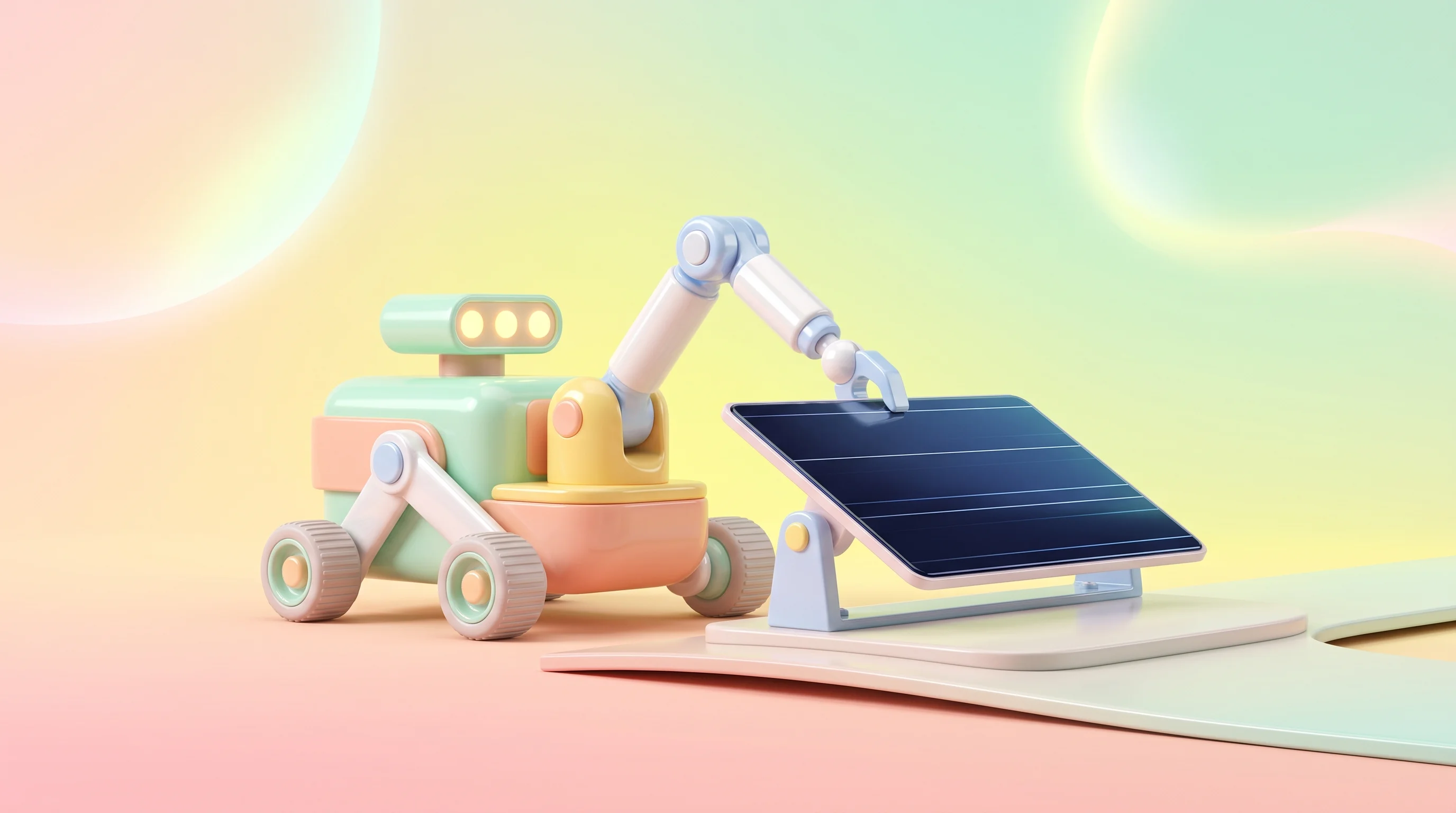
The setup is specialized. One robot—designated LIBRA-002A—handles placement and alignment. A second, 002B, manages transport and staging. The third, 002C, fastens panels to racking. The machines communicate as a single system, handing off tasks in sequence to complete the full installation cycle from pickup through final inspection, according to the company's August launch materials.
Each robot can handle panels up to 250 pounds and measuring 100 by 60 inches. Libra targets a cycle time of 45 to 120 seconds per panel under supervised field operation, with designed productivity ranging from 30 to 80 panels per hour.
"You go to bed, and by the time you wake up, the solar farm is built," founder Jermaine Zhao wrote in the launch announcement—a sentiment that captures the ambition, if not yet the complete reality, of overnight autonomous construction.
Rather than selling hardware, Libra operates on a Robot-as-a-Service model. Contractors pay for completed work instead of purchasing equipment outright. The startup provides the crew, handles deployment and supervision, and manages maintenance. Zhao noted in a LinkedIn post that one person can supervise four or more robots, a ratio that could reshape project economics if it holds at scale.
A Stanford-Bred Robotics Team
Zhao, the company's CEO, studied electrical engineering, mechanical engineering and computer science at Stanford, where he previously built autonomous agricultural robots. Co-founder Yaojing Huang, now COO, defended a Stanford PhD focused on construction robotics and later taught the university's construction robotics course. Through her research at Stanford's Center for Integrated Facility Engineering, Huang worked with more than 40 contractors and robotics companies—experience that appears central to Libra's commercial positioning.
The two-person team (according to Y Combinator materials) is based in Newark, California, and participated in Y Combinator's recent cohort.
Libra has deployed robots on commercial utility-scale sites in California and demonstrated the system live to more than 50 engineering, procurement and construction firms, plus solar developers, in the 10 weeks before the August launch. Alongside the 7+ GW in letters of intent, the company secured 20+ megawatts of planned deployments—a smaller but more concrete measure of near-term traction.
The robots rely on more than 15 sensors, combining vision, force and motion feedback for rack-relative alignment before placement. Libra claims to hold "10+ robotics patents" and "5+ racking-system patents," though the company has not published a patent list. The platforms come in tracked and wheeled configurations designed to navigate slopes, sand, soft soil and confined sites—the uneven terrain typical of solar farm construction.
Testing Compatibility with Leading Hardware
Libra participated in FTC Solar's inaugural "Robo Day" on July 1 at the company's ASTAAR facility in Seguin, Texas. More than 20 EPC and developer organizations attended the event, which featured live demonstrations from seven robotics providers including Aonics, BotCrew, Civ Robotics, Cosmic Robotics, Ozzies and RoboForce, according to a July 8 press release from FTC Solar.
"Our robotic installation system is now compatible with FTC Solar's 1P Pioneer Tracker," Libra wrote in a company LinkedIn post from July. Compatibility with established tracker systems matters. It signals whether a robotics startup can integrate into existing supply chains or will demand costly workarounds from contractors.
Navigating a Competitive Market
Libra is far from alone. The market for solar construction automation has attracted a wave of startups, many chasing the same bottleneck: installation labor that can't keep pace with renewable energy demand.
Gritt raised between $32 million and $34 million in July, TechCrunch reported. Cosmic Robotics—also a Y Combinator alum—deployed a 10,000-pound robot that the company says has installed tens of thousands of panels at double the productivity of manual crews. Charge Robotics, which graduated from Y Combinator in 2021, similarly targets labor-intensive solar farm tasks.
Built Robotics offers autonomous heavy equipment widely deployed for solar piling. Luminous Robotics operates in Australia and the U.S. with claims of 3.5x installation efficiency, according to an AWS blog post. Layout-focused competitors include Dusty Robotics, which automates floor plan printing, and Civ Robotics, which uses GPS-guided robots for solar pile layout.
The crowded field suggests both robust investor appetite and uncertain market dynamics. It's not yet clear which technical approach will dominate or whether multiple systems will coexist.
Beyond Solar: Infrastructure Ambitions
Libra's longer-term roadmap extends beyond solar farms. The company aims to transfer what it calls "reusable construction skills" to data centers, according to its Y Combinator profile. The startup framed demand in its launch post around electricity needs for data centers, which are expected to nearly double by 2030—adding roughly 465 terawatt-hours annually—with about half that growth to be met by renewables.
Whether construction robotics developed for open-field solar farms can translate to the tighter tolerances and varied tasks of data center builds remains to be seen.
Libra has not disclosed funding beyond Y Combinator's standard deal. Third-party aggregator Robo2u listed a $500,000 pre-seed round from Y Combinator, though Libra has not confirmed a priced financing round. The company's pilot calendar runs through March 2027, with five or more projects already scheduled—a timeline that will test whether the robots can deliver at the pace and scale the founders envision.

For now, the 7 GW in letters of intent offers a measure of industry interest, though letters are far from binding contracts. The more telling metric will be how many of those megawatts actually get installed by Libra's machines in the months ahead.


