

A small California startup thinks it can solve the solar industry's chronic labor shortage with fleets of autonomous robots that install panels around the clock. Libra Robotics said in early August it has landed its first paying customer in the U.S. and is chasing five more contracts for machines that mount solar modules while human supervisors watch from afar.
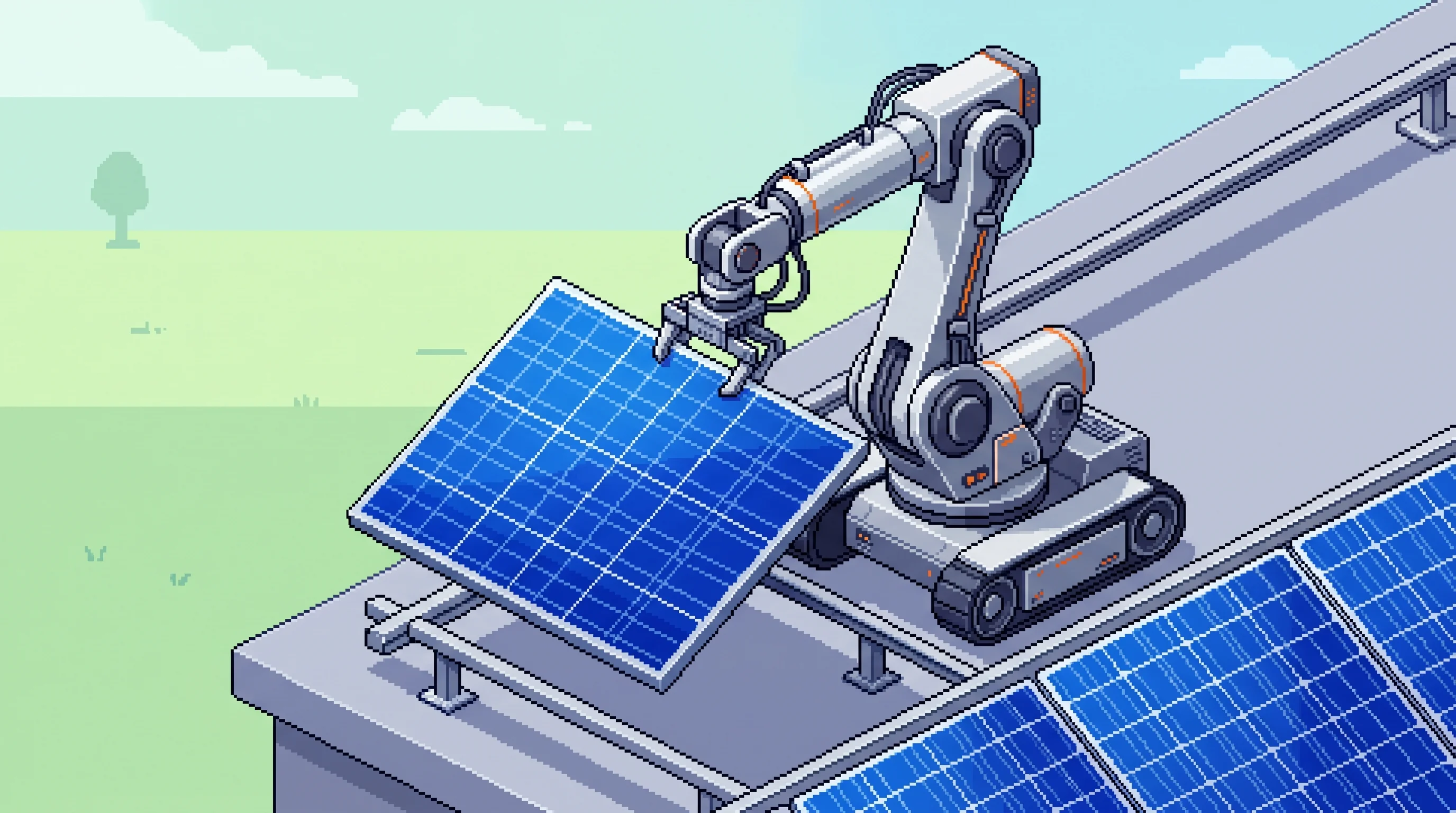
The Newark-based company, fresh from Y Combinator's Summer 2026 cohort, builds multi-robot squads designed to handle the full sequence of panel installation at utility-scale solar farms. That means hauling pallets of modules across construction sites, lifting them with suction grips, positioning them on tracker frames, then fastening everything with clips and rivets. One person can oversee four or more robots remotely, Libra says, and the company has field-tested the setup at night to keep installation running after dark.
The pitch arrives as the solar sector faces a gap it can't quite bridge. Industry data suggests the U.S. will need roughly 355,000 solar workers by late 2026 to support planned installations of 60 to 70 gigawatts, according to figures from the U.S. Energy & Employment Report and IREC National Solar Jobs Census cited by pv magazine Global in July. Right now, the industry is short about 53,000 positions.
Utility-scale solar contracts jumped 15 percent year-over-year in the first quarter of 2026, driven in part by AI data centers hungry for power, a June report from the Solar Energy Industries Association and Wood Mackenzie noted. Solar and storage made up more than 90 percent of new generation capacity added during that period, SEIA said.
Coordinated Teams, Not Solo Acts
Libra's approach hinges on robots working in tandem rather than operating independently. The company's second-generation Libra-002 series, launched in late July 2026, includes transport bots that carry up to 1,500 kilograms of solar panels and hoist pallets as high as 1.5 meters, according to specifications on its website. Installation units then retrieve panels from staging zones, align them using what Libra calls "rack-relative perception," and bolt them to tracker systems.
Each robot installs between 30 and 80 panels per hour, Libra claims, finishing individual modules in 45 to 120 seconds. The company delivers the technology through a Robotics-as-a-Service contract, sidestepping the capital outlays that would come with buying hardware outright.
Co-founder Yaojing Huang defended a Stanford PhD dissertation focused on construction robotics before launching Libra in 2025 with Jermaine Zhao, who studied electrical and mechanical engineering at the same university. The two-person operation graduated from Y Combinator in 2026 and secured the accelerator's standard investment that June, Dealroom data shows. The company claims to hold more than 10 robotics patents and more than five racking-system patents, though the startup declined to share patent numbers.
Testing Compatibility in Texas Heat
In July, Libra announced its robots now work with FTC Solar's 1P Pioneer Tracker system. The company put the technology on display July 8 at FTC's first Robotics Day in Seguin, Texas, where it shared the stage with six other automation vendors including Civ Robotics, Cosmic Robotics, and RoboForce.
FTC Solar framed the event as a proving ground for how different robotic tools might coexist on actual job sites. Andrew Morse of FTC Solar offered a blunt assessment on LinkedIn afterward: "No single robot wins the job site."
A Crowded Field
Libra is hardly alone in chasing solar automation contracts. Gritt raised $34 million in July to build robots using off-the-shelf components, TechCrunch reported. Cosmic Robotics teamed up with KUKA to mount a robotic arm on a tracked base, according to a December 2025 case study from the German manufacturer. Luminous Robotics secured AUD $4.9 million from Australia's renewable energy agency in July 2025 for deployments at two projects totaling 600 megawatts.
China's Leapting installed robots at Australia's Culcairn Solar Farm in 2025 that the company said cut installation costs by as much as 30 percent, pv magazine Australia reported. RoboForce pulled in $15 million in May 2025 for its TITAN outdoor platform, which the company deployed at Colorado's Two Rivers Solar Farm by mid-2026. Meanwhile, Built Robotics has staked out dominance in autonomous pile driving, a distinct phase of solar farm construction that happens before panels ever arrive.
The competition suggests investors see opportunity in an industry that can't hire fast enough. But translating venture capital into machines that perform reliably in dust, heat, and wind remains the harder part.
Pitching Speed and Simplicity
Libra is courting engineering, procurement, and construction firms as well as tracker manufacturers for pilot deployments. The company says it can deliver a compatibility assessment and schedule a demonstration within two weeks for potential partners who meet its criteria.
Jermaine Zhao distilled the company's ambition into a single line on Y Combinator's directory: "Go to sleep. Wake up. The solar farm is built." Whether that vision scales beyond a handful of projects will depend on factors the founders can only partially control—how well the robots handle unpredictable conditions, how much developers trust automation over human crews, and whether the labor shortage persists long enough to justify the switch.


