

There's no Slack channel where a marketing team debates which TikTok creative to run. No general manager logs into Shopify at 9 a.m. to check inventory levels. At four e-commerce stores operating under the Light Anchor umbrella, those decisions get made by AI agents—software constructs modeled after roles like CEO, marketing director, and operations lead. They draft the ads, upload the campaigns, monitor the metrics, and pull the plug when something isn't working.
It's an audacious experiment, even by Silicon Valley standards. Light Anchor, a San Francisco startup participating in Y Combinator's Spring 2026 batch, isn't selling tools to help merchants run faster. The company is operating the stores itself, end-to-end, through autonomous agents. Co-founders Sangha Park and Chase Kim describe it as running businesses "at the speed of compute, not headcount." The Y Combinator listing lays out the endgame plainly: thousands of consumer businesses humming along with little to no human intervention.
Whether that vision materializes—or crashes into the messy reality of customer service, supply chain snags, and platform policy violations—remains an open question. But as of this spring, Light Anchor's public portfolio shows four live brands. Seoul Dispatch ships Korean beauty boxes across the Pacific. LA-004 Meme Tees sells custom apparel. Each storefront processes real orders, managed by agents that handle everything from product sourcing to uploading ads on Meta and TikTok.
For a two-person startup, it's either a compelling proof point or an elaborate demo. The company has not publicly disclosed detailed financial performance metrics as of the available data.
Decision-Making by Algorithm
Light Anchor's architecture revolves around giving each brand what the founders call independent decision-making capacity. According to the company's website and YC materials, every brand operates with its own memory, policies, and proposal system. The agents don't simply execute tasks handed down from above. They generate options, weigh trade-offs, and make operational calls.
Marketing agents create ad creative, upload campaigns, monitor performance in real time, and trigger kill-or-swap logic when a campaign underperforms. Merchandising agents propose new products and manage integrations with fulfillment services like Printful. Operations agents process support tickets, track inventory levels, and send automated Slack briefings—presumably to Park and Kim, though the company hasn't clarified exactly where human oversight begins.
Activity log snippets visible on Light Anchor's site reference agents updating product detail pages, syncing fulfillment, and cycling through campaign iterations. Every action feeds into what the company describes as a "central consumer simulation"—a unified model that tracks how real shoppers respond to ads, pricing shifts, and product mixes. The idea, in theory, is that the system improves by running actual businesses rather than training on static datasets.
It's a thesis that hinges on volume and compounding knowledge. Whether four stores generate enough signal to validate it is unclear.
From B2B Pivot to Autonomous Retail
Park and Kim aren't academic researchers building a proof-of-concept. Both spent years at Sendbird, where Park led product and Kim ran forward deployment. According to Light Anchor's site, they spearheaded Sendbird's 2024 pivot into AI agents for customer experience—work that gave them a front-row view of what agents could and couldn't handle in operational environments.
Light Anchor's earliest press coverage, appearing in March, positioned the company as a B2B data operations platform with design partners in finance and distribution. An April interview with Korea's Maeil Business Newspaper mentioned a demonstration involving a U.S. financial firm. But by the time the public-facing site launched, the pitch had shifted entirely to autonomous e-commerce.
A March 24 blog post titled "The Signals" lays out the founders' reasoning. The execution layer of operations, they argued, is the real bottleneck. Agents only improve by running real processes. "Operational knowledge compounds," they wrote. Running their own brands lets them test that thesis directly—and iterate without needing to convince outside merchants to hand over the keys.
It's a model closer to a holding company than a SaaS play, at least for now. Whether that evolves into a platform offering remains to be seen.
Live Testing Ground for AI Models
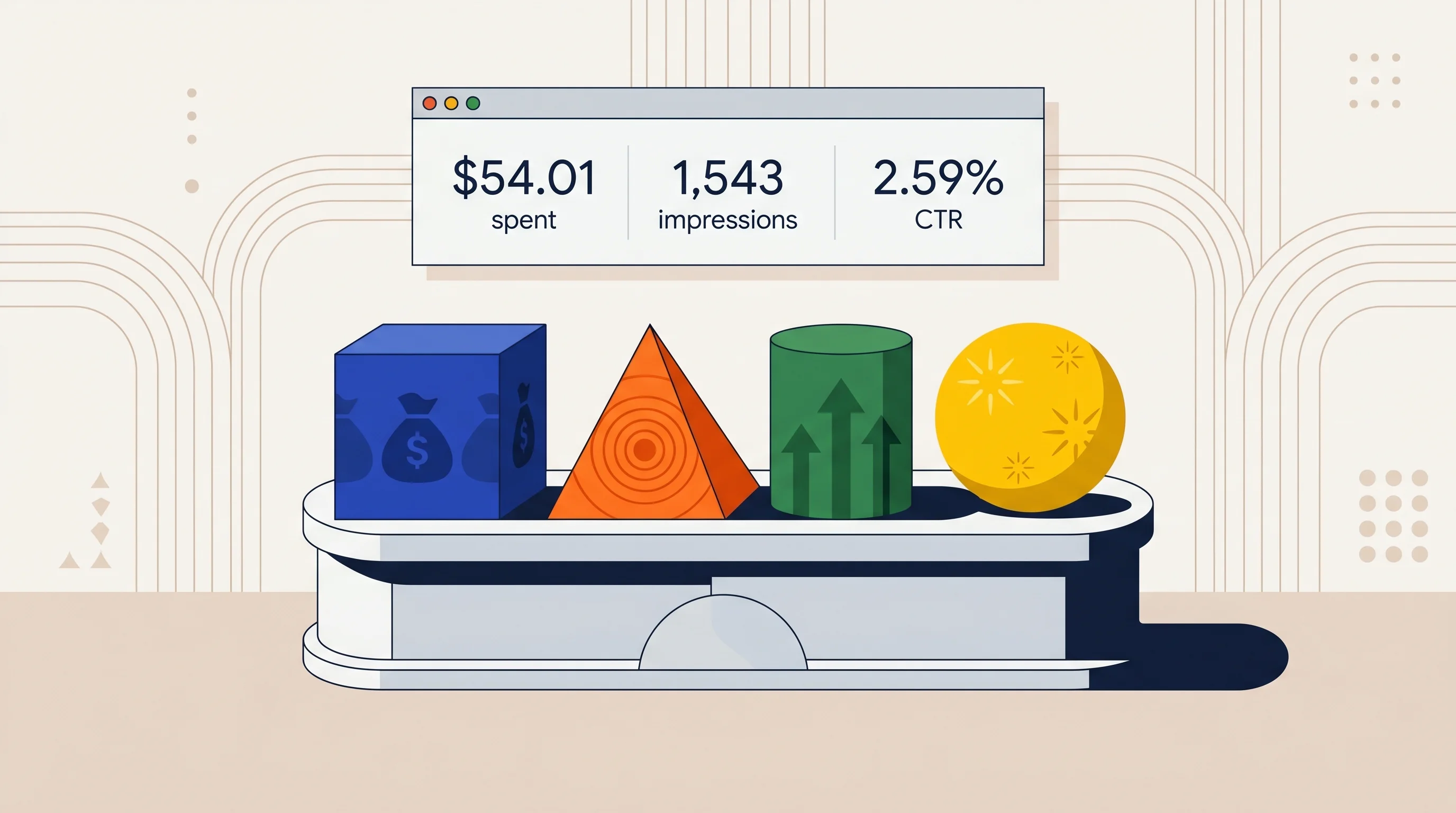
Light Anchor is also developing AdBench, a tool designed to pit different AI models against each other in live ad campaigns. A preview page shows actual Meta ad metrics from a brief labeled "hl-2026-05-03": $54.01 spent, 1,543 impressions, 40 clicks, a 2.59% click-through rate. Four models—Claude Opus 4-7, Gemini 3.1 Pro, GLM-5.1, and GPT-5.5—each generated creative for the same brief. AdBench tracked which performed best.
The product is labeled "Coming Soon" with a waitlist, but the live data suggests Light Anchor is using its own stores as a testing ground. If you're running ads at scale, knowing which model writes sharper copy or selects more compelling images isn't an academic question. It's margin.
There's a recursive logic to it: run stores with agents, benchmark which agents perform better, improve the models, scale up. It works, of course, only if the underlying economics hold.
Funding and the Question of Traction
Light Anchor's initial round included undisclosed amounts from Krew Capital and ASQ, reported in February, according to Korean tech outlets Wowtale and VentureSquare. Y Combinator selected the company for its Spring 2026 batch, which was reported in March, and added follow-on investment. CB Insights notes a $500,000 convertible note, with the date potentially being approximate based on latest information, though the company hasn't disclosed a total amount raised.
The YC listing shows a team size of two; LinkedIn suggests somewhere between two and ten employees. For a company running four live brands, those numbers are either impressively lean or a signal that much of the work is, in fact, automated.
Seoul Dispatch's homepage advertises both subscription and one-time purchase options, but there's no public data on monthly box shipments, repeat rates, or unit economics. Without those numbers, it's hard to assess whether Light Anchor's agents are running profitable brands or simply running brands. The distinction matters.
The Agentic Commerce Land Grab

Light Anchor isn't operating in isolation. The space has grown crowded quickly. Shoplazza announced an "AI-native commerce operating system" in April. Firmly launched Firmly Connect in March, a platform that integrates agents with existing merchant infrastructure. Runner AI claims to have built "the first autonomous ecommerce engine." Logicbroker introduced an "Agentic Commerce Orchestration Engine" as early as October 2025.
Most of these companies are selling tools to existing merchants—helping them automate inventory management, customer service, or ad optimization. Light Anchor's bet is structurally different: own the brands, run them with agents, compound the operational knowledge, and potentially (maybe) offer the platform to others later.
McKinsey projected last October that agentic commerce could orchestrate up to $1 trillion in U.S. B2C retail by 2030. Industry analysts expect AI agents to handle one to four percent of digital payment transactions by 2029. Those projections carry the usual caveats, but they suggest meaningful capital flowing into the space.
The harder question is execution. Moving from "agents can place orders" to "agents run profitable brands at scale" involves navigating edge cases, platform policy shifts, and the kind of operational judgment that compounds slowly, if at all.
The Autonomy Question

Light Anchor's public materials emphasize full autonomy, but critical details remain undisclosed. Do agents set their own ad budgets, or do Park and Kim approve spending limits? Can an agent decide to discontinue a product line, or does that require founder sign-off? When a customer files a dispute, an ad campaign violates Meta's policies, or a supplier runs out of stock—who handles it?
The activity logs show agents proposing and executing, but they don't reveal the guardrails. And guardrails, perhaps more than the founders expected, might determine how far this model can scale.
The company's March blog post argued that agents improve by operating real processes, not by optimizing proxies. Running live stores forces the system to handle messy reality: refunds, stockouts, policy violations. Whether Light Anchor's agents navigate those moments gracefully—or escalate them to humans—determines how autonomous these brands really are.
The Long Bet
For now, four storefronts are live. Agents are running campaigns. Boxes are shipping from Seoul. That's further than most startups talking about agentic commerce have actually gotten.
Whether it scales to the "thousands of consumer businesses" envisioned on the YC page depends on whether the unit economics work—and whether agents can learn operational judgment fast enough to justify the cost of compute. Light Anchor is running the experiment in real time, with real inventory and real ad dollars. The results, when they come, won't be theoretical.


