

The numbers arrive with a certain grim predictability. Data centers are projected to consume 565 terawatt-hours of electricity in 2026—a 26 percent leap from 447 terawatt-hours in 2025, according to Gartner's forecasts. The International Energy Agency, never one for hyperbole, expects computing facilities to grow their electricity appetite by roughly 15 percent annually from 2024 through 2030. That's more than four times the pace of other sectors. Silicon, it turns out, has a power problem that's becoming impossible to ignore.
A handful of startups think they've found the answer, and it's squishy, biological, and a little unsettling.
In San Francisco, Y Combinator-backed Parasma is developing algorithms to transform human neurons into computational substrate. In Melbourne, Cortical Labs has opened developer access to something called the CL1 platform, where around 200,000 brain cells learned—however clumsily—to navigate the pixelated corridors of Doom. Over in Switzerland, FinalSpark runs what it calls the "Neuroplatform," offering remote access to organoid-based wetware systems that researchers can rent like cloud computing instances. The pitch, when stripped of its jargon, is consistent: your brain runs on about 20 watts. A GPU cluster burns megawatts. Maybe, these founders suggest, we've been building computers wrong all along.
The Constraint No One Saw Coming
The U.S. Energy Information Administration flagged something noteworthy earlier this year—the strongest four-year electricity growth since 2000, driven overwhelmingly by large computing facilities. Lawrence Berkeley National Laboratory's energy analysis suggests data centers could claim up to 11.8 percent of U.S. electricity consumption by decade's end under certain scenarios. For AI companies racing to scale training workloads and inference engines, power availability has become the binding constraint. Not capital. Not talent. Electricity.
Which makes the brain's efficiency somewhat embarrassing to conventional computing. FinalSpark's Fred Jordan has suggested that organoid-based systems could eventually replicate large-language-model capabilities with far fewer neurons and orders of magnitude less energy—though these remain promotional claims rather than peer-reviewed findings. Cortical Labs' Chief Scientific Officer Brett Kagan told journalists the company is "just scratching the surface" of what neural cultures can achieve, repeatedly invoking the brain's lopsided advantage over silicon. These are promotional claims, not peer-reviewed findings. But the underlying market pressure—AI's spiraling energy footprint—is real enough.
When Neurons Started Gaming
The field has moved, perhaps faster than many expected, from academic curiosity to something resembling a product pipeline. Cortical Labs published work in Neuron back in 2022 showing that neuronal cultures grown in vitro could learn to play Pong through feedback loops. By early this year, the company released footage of neurons playing Doom on its CL1 hardware—a biological computer built around human brain organoids interfaced with microelectrode arrays.
The performance, to put it charitably, was crude. Neurons demonstrated rudimentary behaviors: enemy detection, turning when hit. But coverage across outlets like Popular Science, The Guardian, and TechRadar noted the system "plays badly." Still, the demo achieved something. Developers noticed.
Cortical Labs positioned CL1 as a developer platform rather than a research curiosity. TechRadar reported in 2025 that the hardware carried a price tag around $35,000, with weekly remote rentals via "Cortical Cloud" running about $300. The company has since published Python SDK documentation and released the cl-sdk package on PyPI, letting researchers run closed-loop experiments on living neural tissue from wherever they have an API key and a decent internet connection.
FinalSpark took a different approach. The Swiss startup's "Neuroplatform" offered cloud access to human brain organoid "wetware" for research applications, with academic pricing reportedly starting at $500 monthly as of August 2024—though those figures may have shifted since. The company's broader pitch emphasized hybrid architectures: silicon handling structured tasks, neurons contributing parallel processing and adaptability. A path, they argue, to energy-efficient AI.
Intactis Bio entered the conversation earlier this year with a press release announcing lab-grown neurons that performed matrix math and output "Hello, World!" The company raised $250,000 from Nucleus Fund and began positioning a rack-mountable "bio-accelerator" product. Forbes covered the milestone under a headline that captured the field's oddness perfectly: "Neurons Playing Tetris—Intactis Bio Joins the Biocomputing Industry."
The Compiler Problem
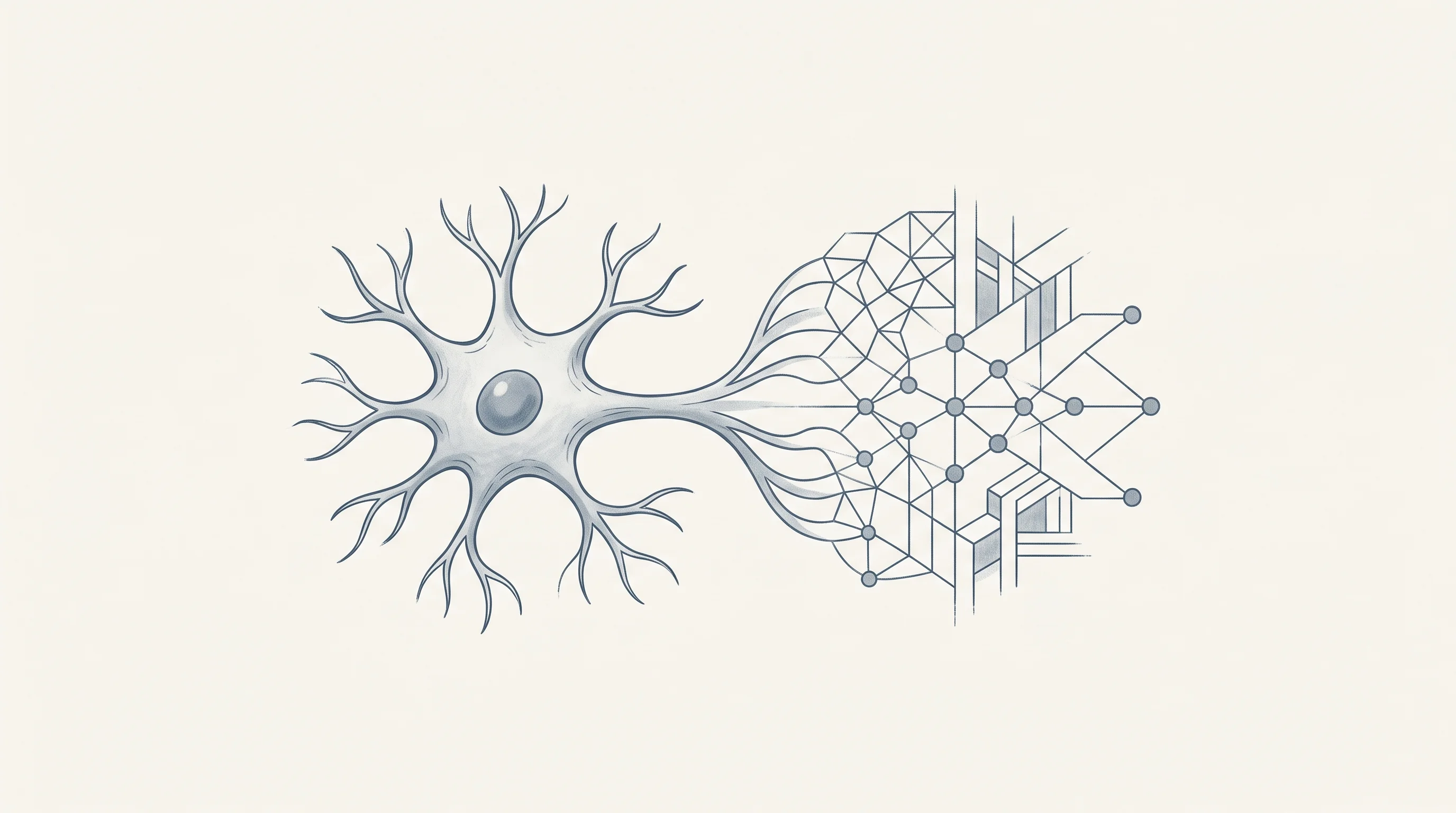
Parasma, backed by Y Combinator, is betting the bottleneck isn't hardware but software. Founder Sean Cole—who contributed to the viral Doom demo while at Cortical Labs—launched Parasma with a focus on the algorithmic layer that turns neurons into usable compute. The company's tagline manages to be both technical and slightly ominous: "We train brain cells for compute. We write the algorithms to turn brain cells into compute."
In mid-2026, Parasma announced its YC backing alongside a research note addressing a question that hovers over the entire field: consciousness and suffering in neural training systems. Cole's argument runs like this—competence doesn't equal consciousness. The training protocol uses low-amplitude, biphasic, charge-balanced electrical pulses (a few microamps at frequencies ranging from a few hertz to around 100 hertz) applied to neurons that lack nociceptors, the receptors responsible for pain signals. The intent, Cole wrote, is to avoid creating conscious systems while building useful ones. Whether that line holds philosophically is another matter.
Parasma's site describes two use cases that sound almost prosaic until you remember what's doing the computing. In "Token Prediction," a sentence gets encoded into stimulation patterns; the system decodes neural responses back into tokens, no GPU required. In reinforcement learning, a game frame becomes stimulation, neurons produce an action, and a silicon-based critic supplies surprise-scaled feedback to update the biological network.
The pitch is early-stage—Parasma's Y Combinator directory listing shows a team size of one—but it signals where the market might be heading. If wetware represents the hardware frontier, someone needs to write the compilers. Dealroom lists a seed round of $125,000 for Parasma, though that figure is a third-party estimate and the company hasn't publicly disclosed funding amounts beyond confirming YC participation. Parasma is also recruiting: a "Founding Scientist" role appeared on Y Combinator's jobs board, listed as San Francisco-based with remote flexibility.
The Infrastructure Takes Shape

Behind the startup activity sits a maturing, if still nascent, infrastructure. Microelectrode array vendors like 3Brain and Axion BioSystems have refined platforms for interfacing with 2D cultures, 3D organoids, and multi-organ systems. Recent work published in Microsystems & Nanoengineering described multilayered MEAs designed to capture 3D organoid activity, addressing what's been a persistent challenge: brain organoids larger than roughly 1.5 millimeters in diameter risk developing necrotic cores without vascularization. The hardware is improving. But organoid longevity, reproducibility, and scale remain stubborn constraints.
On the software side, Cortical Labs detailed its closed-loop API in an arXiv paper, supporting sub-millisecond feedback loops and declarative Python contracts for experiment design. The CL API includes a simulator for offline development, allowing researchers to prototype before running experiments on live tissue—a practical necessity when your compute substrate has a limited lifespan. A proposal floated on arXiv suggested using large language models to assist in designing environments and scaling protocols for organoid agents. A hint, perhaps, at how AI might bootstrap its own biological successors.
Standardization efforts are underway, though slowly. The National Institutes of Health announced the nation's first dedicated organoid development center in late 2025, aiming to reduce reliance on animal models and improve reproducibility for regulatory acceptance. A review published in Trends in Biotechnology highlighted how machine learning and AI are enabling organoid workflows through automation, monitoring, and quality assurance—an ironic recursion where AI helps build biological computers that might someday rival AI itself.
The academic community formalized organoid intelligence as a research field with the "Baltimore Declaration" in early 2023, and Johns Hopkins has anchored much of the foundational work. Federal funding followed, as it tends to when a field gains momentum. The National Science Foundation announced $14 million for seven projects under its EFRI "Biocomputing through EnGINeering Organoid Intelligence" program in 2024, with projections of $15 million annually moving forward. The NIH BRAIN Initiative continues to fund neuroAI integration, and DARPA's O-Circuit program explicitly aims to harness biological efficiency for what it calls "a new class of computer at the tactical edge."
The Governance Question
A Nature editorial published recently flagged what might be called a regulatory blind spot. Existing institutional review boards for stem cell research typically oversee biomedical applications: regenerative medicine, disease modeling, drug screening. But when researchers in computer science or engineering departments start running reinforcement learning experiments on human-derived neurons, those projects often fall outside traditional oversight frameworks. The editorial called for independent review committees dedicated to biocomputing, distinct from biomedical ethics structures.
The consent question, naturally, gets thorny. Organ donation protocols govern tissue sourcing, but those frameworks were designed for transplantation and medical research—not for turning cells into processors. The field's ethical scaffolding remains very much under construction. The Baltimore Declaration and subsequent reviews have laid out foundational perspectives on organoid intelligence ethics, but implementation varies widely. The NSF's 2024 BEGIN OI solicitation required ethics co-investigators on funded projects, at least a signal that oversight is on someone's agenda.
STAT News reported last year that multiple organoid scientists worried about hype-driven backlash. One recurring theme: federal dollars from NSF and DARPA could accelerate progress, but overpromising risks public and regulatory blowback before the technology matures. The Doom demo went viral, but the coverage oscillated between fascination and skepticism. TechRadar's headline posed a question and then answered it: "Can it play Doom?"—barely.
What Comes Next
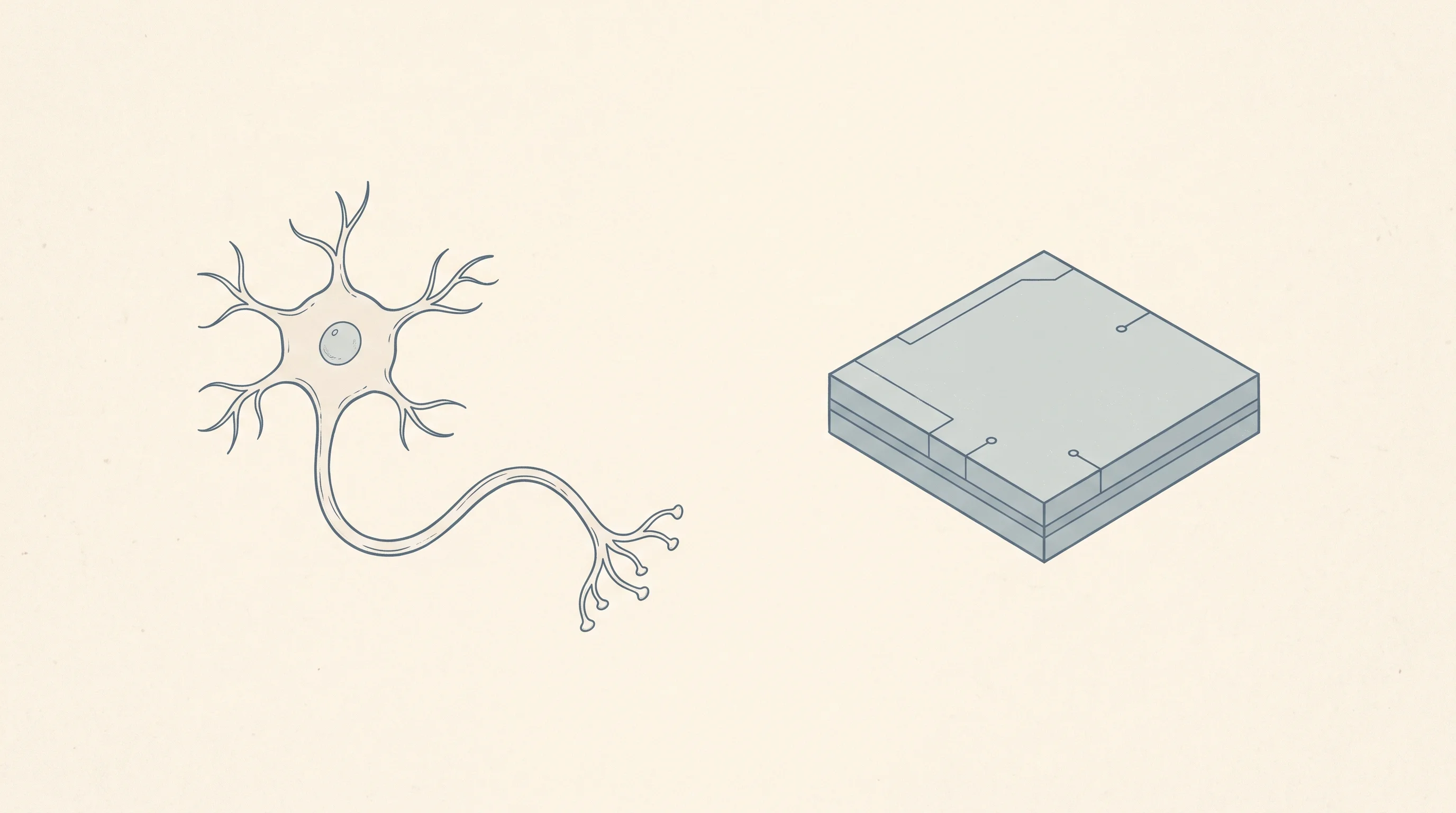
No one is replacing GPUs with neurons anytime soon. The literature contains no standardized, peer-reviewed, head-to-head comparisons of wetware versus silicon across common machine learning tasks. The Doom demo was a proof of concept, not a performance benchmark. Organoids remain difficult to scale, standardize, and maintain. The infrastructure is primitive compared to decades of semiconductor R&D and trillions in capital investment.
But the trajectory exists, even if the destination remains unclear. A recent review in Nature Computational Science traced the arc from neuromorphic chips—silicon designed to mimic neural architecture—to organoid intelligence, positioning biohybrid computers as the next frontier. The authors argued that digital systems face fundamental limits in flexibility and parallel processing that biological substrates might sidestep. Whether that thesis holds depends on solving hard problems in tissue engineering, signal processing, and closed-loop control. Exceedingly hard problems.
Parasma's bet—that software and training algorithms will unlock wetware's potential—echoes earlier waves of compute innovation. GPUs existed for years before deep learning frameworks made them indispensable for AI. Maybe neurons need their TensorFlow moment. Or maybe the whole idea remains a niche curiosity, useful for certain edge cases but irrelevant to the trillion-parameter models running in hyperscale data centers.
The energy math, though, keeps pulling the industry back to biology. Gartner's forecast shows data center electricity consumption jumping from 447 terawatt-hours in 2025 to 565 terawatt-hours in 2026, and the EIA projects continued growth through at least 2027. Power availability is constraining AI capacity today, not tomorrow. If silicon's trajectory proves unsustainable—and the numbers suggest it might—alternatives will get a serious look.
Whether those alternatives involve living cells trained to play video games, or something else we haven't imagined yet, is the question researchers, founders, and funders are now racing to answer. In the meantime, somewhere in Melbourne, neurons are still trying to clear a room in Doom. Badly, but persistently.


