

Living neurons learning to play Doom. Brain cells trained to balance a virtual pole. Organoids recruited to process speech patterns.
What reads like speculative fiction has quietly become the foundation of a nascent industry now raising tens of millions in venture capital. As AI spending barrels toward $2.59 trillion in 2026—driven by a 47% compound annual growth rate from 2020 to 2026, according to Gartner—a handful of startups and academic labs are betting that the answer to computing's energy crisis might be growing, quite literally, in laboratory dishes.
The pitch lands with immediate force: human brain tissue consumes roughly 20 watts of power. Large AI systems? Orders of magnitude more. Now, companies spanning Y Combinator–backed solo founders to $25 million seed rounds are racing to transform "organoid intelligence" from laboratory curiosity into something you might one day rent by the hour. But the journey from academic demonstration to productized hardware has surfaced questions that reach well beyond technical feasibility. Questions about consent. About consciousness. About what happens when biology itself becomes infrastructure.
Wetware Goes Commercial
The field calls itself "wetware biocomputing," and it's categorically different from neuromorphic chips that merely mimic neural architecture in silicon. This approach interfaces actual living neurons—grown from induced pluripotent stem cells into 2D cultures or 3D organoids—with microelectrode arrays, optogenetics, and microfluidic systems. The academic vision was articulated in a Frontiers in Science roadmap published in February 2023. By 2026, commercial platforms have begun to materialize.
Cortical Labs raised $10 million in 2023 and now sells what it calls the CL1—a "code-deployable biological computer" integrating microelectrode arrays, life support systems, and proprietary software the company brands as "biOS" for closed-loop control. Their product literature claims cultures can be maintained for up to six months, though CEO Hon Weng Chong mentioned in March 2026 media interviews that some cells in the company's Melbourne prototype facility have survived 500 days. The company operates a 120-unit "Bio Data Centre" and has announced expansion plans in Singapore alongside data center partner DayOne.
FinalSpark pursued a different model entirely. In May 2024, the company launched its "Neuroplatform" for remote access to 16 human brain organoids. By August 2024, media outlets reported a $500-per-month pricing tier, positioning wetware not as physical hardware but as a cloud service—neurons-as-a-service, if you will.
Then there's The Biological Computing Company, which emerged in February 2026 with a $25 million seed round led by Primary. The startup uses dishes containing roughly 100,000 neurons interfaced through 4,096 electrodes to generate what it describes as biological "adapters" that enhance AI models. It's a hybrid play: augmenting silicon rather than replacing it wholesale.
And in June 2026, Parasma launched with Y Combinator backing. A single-founder venture, it bills itself as building "algorithms and infrastructure that turn living neurons into programmable compute." The company gained public attention through the widely covered Doom experiment—yes, actual neurons learning to navigate the iconic first-person shooter.
The Energy Argument (And Its Caveats)

The energy pitch reverberates through every investor deck, every conference panel. Research published in March 2026 estimates that six leading AI firms alone will consume between 239 and 295 terawatt-hours annually by 2030, up from approximately 118 TWh in 2024. The U.S. Energy Information Administration has flagged data center server energy as a major growth driver in projections extending through 2050. Virginia has moved toward rulemaking to shift upstream electrical infrastructure costs onto data centers after severe electricity price hikes rattled the state.
Against this backdrop, the brain's efficiency becomes almost irresistible as a narrative device. Claims of "million times" lower power consumption have circulated in media coverage of FinalSpark and similar platforms.
But those figures remain unaudited at the system level, and the industry knows it.
Cortical Labs reports approximately 30 watts per CL1 device—but that doesn't account for incubators, perfusion pumps, or the computational overhead required to interface with living tissue. It's one thing to point at the neurons themselves; it's another to tally the entire support ecosystem they require to stay alive and functional.
The scientific validation, at least, has advanced considerably. A 2022 paper in Neuron demonstrated that 2D neuronal cultures could learn to play Pong through closed-loop feedback—rudimentary, perhaps, but genuine learning. Nature Electronics published organoid reservoir computing results in December 2023, showing speech recognition and nonlinear prediction capabilities. Most strikingly, a Cell Reports study from February 2026 showed brain organoids learning goal-directed behavior in a cart-pole balancing task. That's rigorous reinforcement learning happening in living tissue.
Princeton researchers developed a 3D device hosting roughly 70,000 neurons in April 2026. UC Santa Cruz's Braingeneers initiative is scaling to hundreds of parallel organoid experiments. Government interest has crystallized as well: the National Science Foundation announced $14 million across seven organoid intelligence projects in late 2024 through its EFRI program, explicitly integrating ethics components. DARPA launched its O-Circuit program seeking self-contained biological processing units, holding a Proposers' Day in May 2026.
The pieces, in other words, are moving into place.
Three Approaches, Three Bets
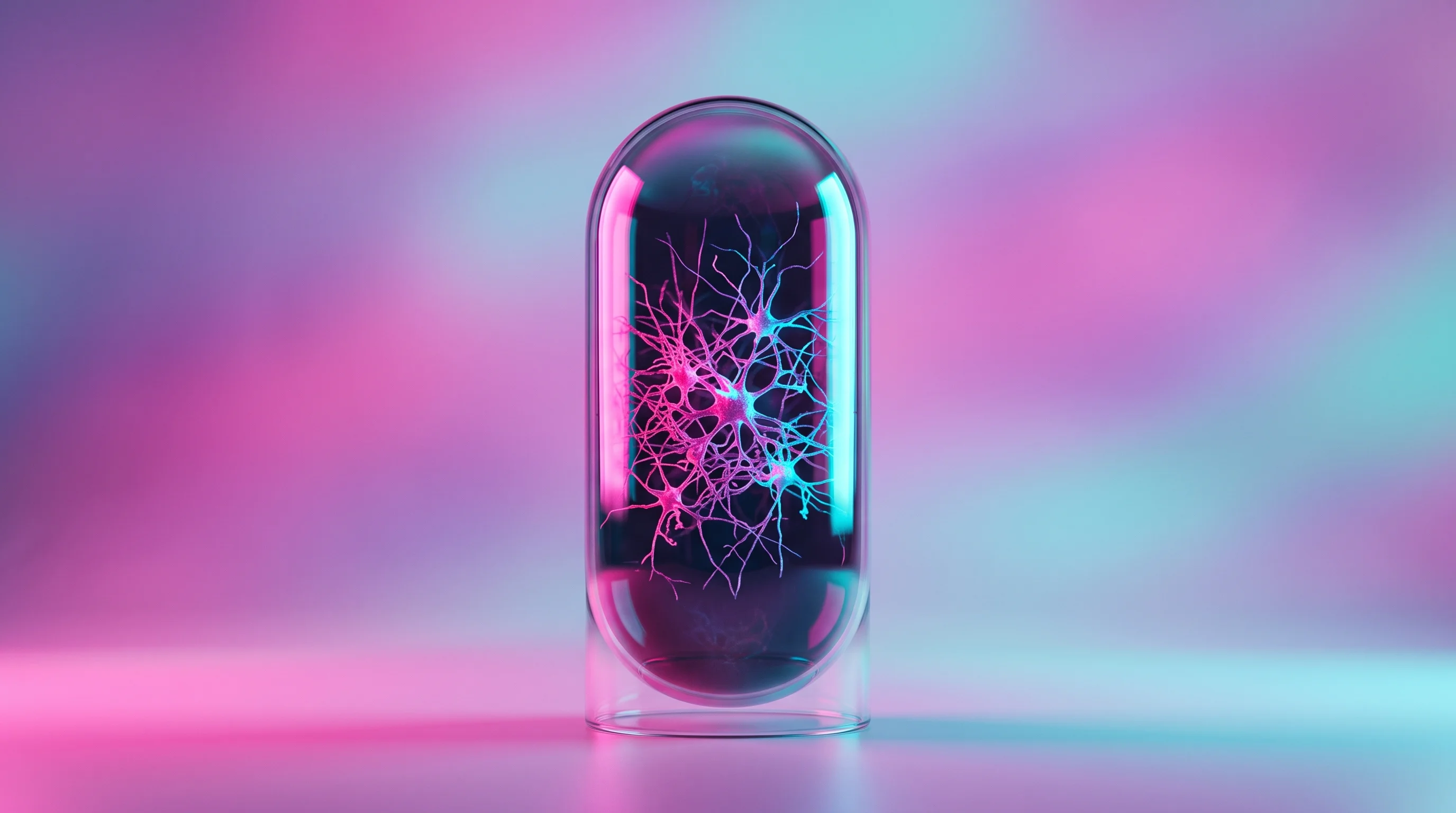
Parasma represents the new wave: minimal headcount, maximum ambition, ethics-forward positioning from day one. Founder Sean Cole published a research note in June 2026 arguing that their cultures—around 200,000 neurons, roughly bee-scale—lack the anatomical structures necessary for consciousness. The note details conservative biphasic stimulation parameters measured in microamperes, framing ethical guardrails not as afterthought but as technical specification. The company's website showcases token prediction and reinforcement learning concepts, positioning neurons as a substrate that can be programmed rather than merely studied.
Cortical Labs, meanwhile, embodies the infrastructure play. Their CL1 platform packages the entire stack: microelectrode arrays for recording and stimulation, automated media perfusion, temperature control, APIs for developers who would rather not master sterile technique. The Melbourne Bio Data Centre—120 CL1 units running in parallel—represents perhaps the first attempt at wetware at rack scale, the kind of deployment that starts to resemble actual data center thinking. Hon Weng Chong has spoken publicly about the need for "cell foundry" manufacturing to achieve commercial viability, acknowledging with refreshing candor that biology isn't yet semiconductor-grade reproducible.
The Biological Computing Company is pursuing what might be the most pragmatic route: hybrid integration. Using neuronal responses as preprocessing layers that feed into conventional AI models, the company's approach with 4,096-electrode arrays generates high-dimensional biological representations that, they claim, help models adapt and stabilize. It's an architecture that doesn't replace entire AI stacks with petri dishes—potentially more tractable than the moonshot alternatives.
Each company faces the same bottlenecks highlighted in recent academic reviews: batch-to-batch variability, maturation timelines often exceeding three months, lack of vascularization in organoids, and the conspicuous absence of industry-standard quality metrics. Tools are maturing—Axion BioSystems and 3Brain showcased high-density microelectrode arrays at conferences throughout 2026—but standardization remains aspirational. Perhaps more aspirational than anyone publicly admits.
Ethics, Regulation, and the Specter of Backlash
The ethics conversation has sharpened considerably, and it needed to. A Nature perspective published in July 2026 warns of donor consent gaps, noting that people who donated tissue for research likely never imagined their cells performing computation in a commercial system. The UK's Nuffield Council on Bioethics released recommendations in May 2026 calling for explicit consent options, independent oversight committees, and Home Office guidance updates. Multiple papers from 2026 emphasize consciousness thresholds and sentience monitoring as the field scales.
There's also regulatory ambiguity—the kind that makes lawyers nervous and investors cautious. The EU AI Act, which became fully applicable in August 2026, was drafted with "machine-based" systems in mind. Legal scholarship published in May 2026 highlights the definitional mismatch when the substrate is biological. U.S. frameworks default to IRB protocols designed for medical research, not computational infrastructure. What committee, exactly, reviews a data center that happens to be alive?
A November 2025 article in STAT captured the community's deeper apprehension: senior organoid scientists worry that commercial biocomputing hype could trigger public backlash that damages broader organoid research in disease modeling and drug development. The field remembers—vividly—how embryonic stem cell research nearly froze after political controversy erupted. Nobody wants that sequel.
The Road Ahead (And What Could Derail It)

Technical unknowns loom large, perhaps larger than the pitch decks suggest. Long-term stability under continuous stimulation remains unproven at scale. Can cultures maintain learning capacity while running 24/7 for months on end? The manufacturing reproducibility challenge—what Chong calls the "cell foundry" problem—will likely determine whether this becomes infrastructure or remains boutique neuroscience. And the logistics of sterile perfusion, media changes, and waste handling at data center scale? Uncharted territory.
Yet momentum is undeniable. Cloud platforms are live. Government programs are funded. Private capital is flowing—albeit in amounts that suggest early exploration rather than deep conviction. The next 12 to 24 months will likely bring additional API pilots, academic benchmarking studies comparing wetware to silicon on energy-per-operation and accuracy metrics, and perhaps the first peer-reviewed, system-level energy audits that either validate or quietly deflate the efficiency claims.
For founders and investors, the opportunity sits at a peculiar intersection: AI's energy wall, biology's computational density, and society's growing unease with unconstrained technological acceleration. Whether living neurons become the substrate for edge AI, specialized pattern recognition, or remain scientific instrumentation depends on resolving questions that span materials science, ethics committees, and regulatory frameworks simultaneously.
The companies that navigate all three might just build the most literally alive technology stack in history.
Assuming, of course, they can keep the cells from dying first.


