

The logistics of magnetic resonance imaging have never been subtle. A conventional MRI scanner tips the scales at several tons, gulps power like a small factory, and demands a helium cooling system that costs thousands to refill. Then there's the room itself—reinforced, shielded, custom-built. It's the kind of infrastructure that belongs in hospital basements, which is exactly where most of these machines have lived for decades.
That concentration has consequences. For patients in rural Montana or underserved urban neighborhoods, getting an MRI often means a long drive, a months-long wait, or both. And in cancer care, time is outcome. Breast cancer caught early has a five-year survival rate near 99%, according to 2024 American Cancer Society figures. Let it spread, and that number drops to around 32% for distant-stage disease. Similar patterns show up in colorectal, kidney, and prostate cancers. The scan you can't access might as well not exist.
Now a handful of startups and legacy players are trying to crack what you might call the MRI portability problem—bringing scanners into parking lots, standalone clinics, even trucks that can operate off-grid. The question isn't whether portable MRI will happen. It's already happening, in fits and starts. What remains unclear is which technical approach actually works at scale, and whether the economics pencil out once you leave radiology's traditional four walls.
The Access Gap Nobody Has Solved
MRI equipment is big business—Fortune Business Insights pegged the global market at roughly $8.15 billion in 2025, with projections climbing toward $10.3 billion by 2030. Yet access remains absurdly uneven. OECD data from the past year shows Japan with something like 57 MRI units per million people, while many lower- and middle-income countries scrape by with fewer than one per million. Even in wealthier regions, scheduling backlogs and geographic barriers push diagnoses dangerously late.
Traditional mobile MRI has been around for years, but it's basically a conventional scanner strapped into a semi-trailer. Monthly rental rates typically run $18,000 to $55,000 for a 1.5-Tesla unit, and that doesn't count staffing, generator hookups, or site prep. Some turnkey programs push costs higher. These solutions help hospitals manage temporary capacity crunches, but they haven't fundamentally changed who can afford an MRI program or where scanning happens.
The constraint isn't purely capital anymore. Helium supply concerns have pushed vendors toward designs that use less of it or none at all. Philips reported over 1,000 installations of its nearly helium-free BlueSeal systems by 2024, and debuted a mobile BlueSeal unit in Europe that same year. Siemens rolled out its Free.Max 0.55-Tesla scanner with just 0.7 liters of sealed helium. Both designs cut operating costs and ease installation headaches. But they still rely on conventional gradient coils—those heavy, power-hungry electromagnets that do the spatial encoding necessary for imaging. And gradient coils, it turns out, are part of the problem.
A Different Kind of Physics
This is where Adialante enters the picture. The Minnesota-based startup, which came through Y Combinator's Spring 2026 batch, claims to have sidestepped the gradient coil problem entirely. Instead of using gradient electromagnets for spatial encoding, the company's approach leans on radiofrequency pulses—modulating them in a way that encodes spatial information through the magnetic field's B1 component rather than its B0 gradient.
The method has a name that sounds like it escaped from a physics lab: Frequency-modulated Rabi-Encoded Echoes, or FREE. It's rooted in research published around 2021–2022 and now protected by two U.S. patents issued in 2025 and 2026. If it works clinically—and that's still an if—the architectural shift translates into some striking practical gains. Adialante says its scanner weighs roughly 80% less than conventional systems and consumes about 60% less power.
Founder Efraín Torres and his four-person core team have pulled together $275,000 in NSF SBIR Phase I funding (2023) and $1.19 million in Phase II (2025), along with backing from Y Combinator and Brown Venture Group. By their May–June 2026 demo day, they'd assembled a scanner and claimed $12.75 million in letters of intent from six urology clinics—including a $30,000 deposit from what they describe as a top-ten urology group.
According to Adialante, they plan to own and operate the scanners themselves, parking them outside clinics and charging a per-scan fee. Clinics bill payers under existing diagnostic imaging codes and pocket the margin above Adialante's fee. No construction, no capital outlay for the clinic. The system fits in a box truck, potentially running off-grid.
Whether the image quality actually matches conventional MRI for prostate or other indications remains to be seen in peer-reviewed publications. The patents and NSF abstracts describe the technology; clinical validation data hasn't yet surfaced in the literature. That gap matters, particularly for diagnostic imaging where radiologists are trained to read images from Siemens, GE, or Philips machines.
Targeting the Prostate Market
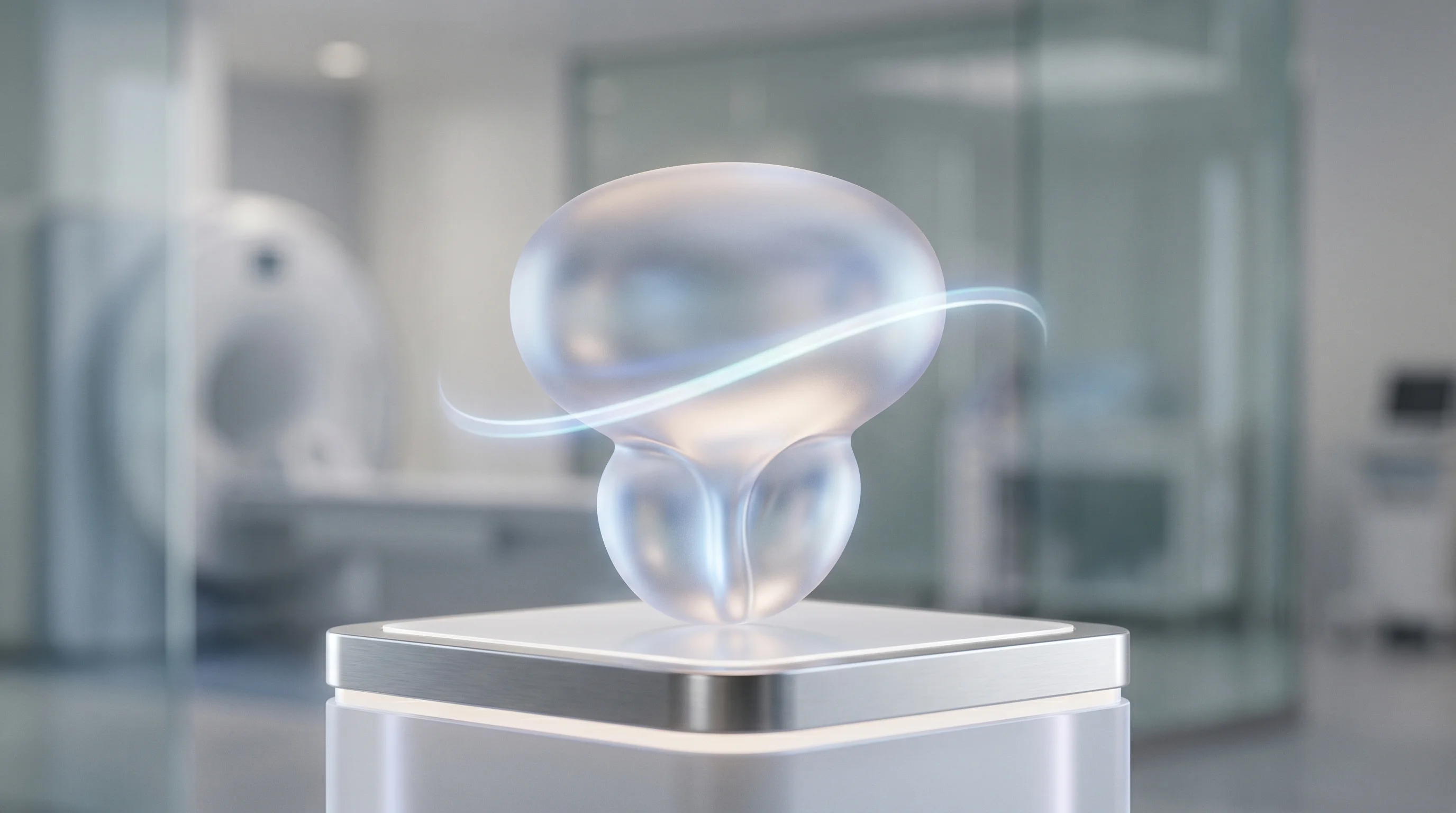
Adialante's initial focus—pre-biopsy prostate MRI at urology practices—aligns with evolving clinical guidelines, at least. Both the American Urological Association and National Comprehensive Cancer Network support using MRI before biopsy to improve detection of clinically significant prostate cancer and reduce unnecessary procedures. Meta-analyses published in 2025 suggest biparametric MRI, which skips contrast agents, can be noninferior to multiparametric protocols in many settings. That cuts scan time and cost.
Reimbursement follows diagnostic imaging codes—typically pelvic MRI CPT 72197—rather than "screening" codes, which is helpful. Payer coverage for supplemental or screening MRI in asymptomatic populations remains a patchwork. Prostate imaging in urology clinics sidesteps that ambiguity by sitting within the diagnostic pathway for patients already flagged by PSA or other risk factors.
The mobile model faces state-level regulatory hurdles, though. Many states maintain Certificate of Need laws that regulate MRI acquisitions, including mobile units. An NCSL map updated in January 2025 shows continuing variation; Adialante will need to navigate CON approvals where applicable, potentially slowing multi-state rollout. ACR accreditation and quality standards apply regardless of where the scanner sits—parking lot or hospital basement.
The Competition Isn't Sitting Still
Adialante isn't alone in rethinking MRI access, of course. Hyperfine won multiple FDA 510(k) clearances in 2024–2025 for its ultra-low-field portable brain scanner—64 millitesla, for those keeping score—including a next-generation system with AI-enhanced reconstruction. The Swoop targets point-of-care neuroimaging: stroke workflows, ICU monitoring. Different physics, different use case. Not really competing for the same patients.
Meanwhile, direct-to-consumer whole-body MRI companies have been attracting both capital and controversy. Prenuvo keeps expanding its membership-based screening programs, with prices running $1,200 to $2,500 depending on package and market. SimonMed launched its simonONE whole-body MRI offering at roughly $650 in 2023 and announced a new longevity division in early 2026. Ezra got FDA clearance for its Prostate AI in March 2026 and has publicly set a goal of 15-minute, $500 MRI exams using AI acceleration.
Professional radiology societies, for their part, have not exactly embraced whole-body MRI screening for asymptomatic, average-risk individuals. The American College of Radiology's April 2023 statement and the Canadian Association of Radiologists' June 2025 policy both cite insufficient outcome data. The U.S. Preventive Services Task Force updated breast screening guidance in April 2024 to recommend starting biennial mammography at age 40, but found evidence still insufficient for supplemental MRI in average-risk dense breasts. The FDA's dense-breast notification rule, enforceable since September 2024, may increase referrals for supplemental imaging—though coverage decisions remain all over the map.
That evidence gap creates a strategic fork for MRI startups. Adialante's focus on diagnostic workflows within specialty clinics keeps it inside established reimbursement structures, at least for now. The company's roadmap includes musculoskeletal, breast, renal, and brain imaging. Expanding to true screening populations would mean navigating both the reimbursement vacuum and the professional society positions—or waiting for outcome data to shift them. Which could take years.
Economics and Endgames

The low-field MRI market, estimated at roughly $1.2 billion in 2025, is projected to hit around $2.5 billion by 2034, per third-party forecasts. Growth drivers include helium constraints, cost pressures, and AI reconstruction tools that can recover image quality from faster, lower-signal acquisitions. GE HealthCare's AIR Recon DL and Sonic DL platforms, Siemens' Deep Resolve suite—which cut scan times more than 20% at NHS Fife in early 2026—and third-party tools like Subtle Medical's SubtleSYNTH and SubtleHD (FDA-cleared in 2024–2025) are normalizing 15- to 30-minute abbreviated protocols.
Whether AI reconstruction alone can make mobile clinic economics work with conventional scanners is an open question. Adialante's bet is that fundamental hardware simplification—ripping out gradient coils—unlocks unit economics that software acceleration can't match. The company's per-scan fee model shifts capital risk from clinics to Adialante itself, which means they'll need to demonstrate utilization rates high enough to justify operating truck fleets and the operational overhead that comes with them.
Adialante claims six signed clinics and $12.75 million in letters of intent, including a deposit from a top-ten urology group—metrics that suggest market interest exists. But plenty can derail a hardware startup between demo day and deployed fleet. Manufacturing scale-up, regulatory approvals for each anatomical region, ACR accreditation timelines, state-by-state CON navigation, payer contract negotiations. Clinical performance data in peer-reviewed journals would help, particularly head-to-head comparisons against conventional MRI for prostate PI-RADS scoring or other diagnostic endpoints. That's the kind of validation that moves markets.
The broader question is whether distributed MRI—whether through gradientless hardware, ultra-low-field portables, or AI-accelerated conventional systems in smaller footprints—can actually bend the access curve in a meaningful way. Prospective studies like the Hercules multi-cancer whole-body MRI trial may eventually provide outcome data that shifts reimbursement and guideline landscapes. Until then, companies are threading a needle: deploying technology novel enough to change economics, but familiar enough to fit existing clinical and payment structures.
What Actually Happens Next
For most patients, the parking lot MRI remains more promise than reality. Adialante and its peers are testing whether the physics, the business model, and the regulatory environment can align in the same place at the same time. Early detection matters—the survival data proves that much beyond doubt. But getting the scan to the patient, rather than asking the patient to find the scan, may matter just as much.
Perhaps the real test isn't technical—it's whether enough parts of the healthcare system want this to work. Urologists who could own a piece of the imaging revenue, payers who might save money on late-stage cancer treatment, regulators willing to clear new pathways. Adialante's gradientless scanner could be brilliant physics and still fail if those stakeholders don't align. Or it could be the wrong technology entirely, overtaken by AI-accelerated conventional systems or ultra-low-field competitors.
What's certain is that the old model—multi-ton machines in hospital basements, months-long waits, geographic deserts—isn't sustainable. Something has to give. Whether it's a box truck in a parking lot or some other configuration, MRI will eventually go where the patients are. The only question is when, and who gets there first.


