

There's a certain rhythm to European startup funding stories. Paris gets the fintech rounds. Stockholm claims the gaming wins. London takes everything else. Barcelona, despite its technical talent and entrepreneurial energy, tends to watch from the sidelines when the really big checks get written.
Which makes what happened with Theker all the more striking.
The Barcelona-based robotics company has closed an $85 million Series A led by Silicon Valley's CRV, with participation from Samsung, LVMH-linked Aglaé Ventures, and a collection of European and Spanish investors. The round, announced in mid-June, is being called Europe's largest-ever Series A for a robotics startup—a claim that TechCrunch, at least, couldn't find a larger round to contradict in its records.
For founders Carla Gómez Cano and Jiaqiang Ye Zhu, who started Theker in 2020, it's a remarkable escalation. Less than twelve months earlier, the company had raised €18 million in what was then Spain's largest seed round. Now they're pulling in strategic capital from conglomerates that don't typically look twice at Spanish startups.
The Names That Showed Up
CRV's involvement is notable enough on its own—the firm doesn't often wade into Spain's startup waters. But Samsung and LVMH? That's where the story gets genuinely unusual.
Spanish business outlets reported that Samsung's participation marks the Korean giant's first-ever investment in a Spanish company. LVMH, through its venture arm Aglaé Ventures, is making its inaugural bet on Spain's startup scene. Whether those firsts carry symbolic weight or commercial significance remains to be seen, but they certainly signal something.
The rest of the syndicate reads like a pan-European who's who: Cathay Innovation, 20VC, Henkel Ventures, Korelya Capital, and Bright Pixel Capital, Sonae's venture arm. Previous backers—Inditex, Kfund, Kibo Ventures, Itnig, and Mission—all doubled down.
Reid Christian of CRV described Theker as building "general-purpose AI in real production," a combination of deep tech and actual commercial traction that he characterized as rare. Perhaps rarer than investors would like to admit.
What They're Actually Building
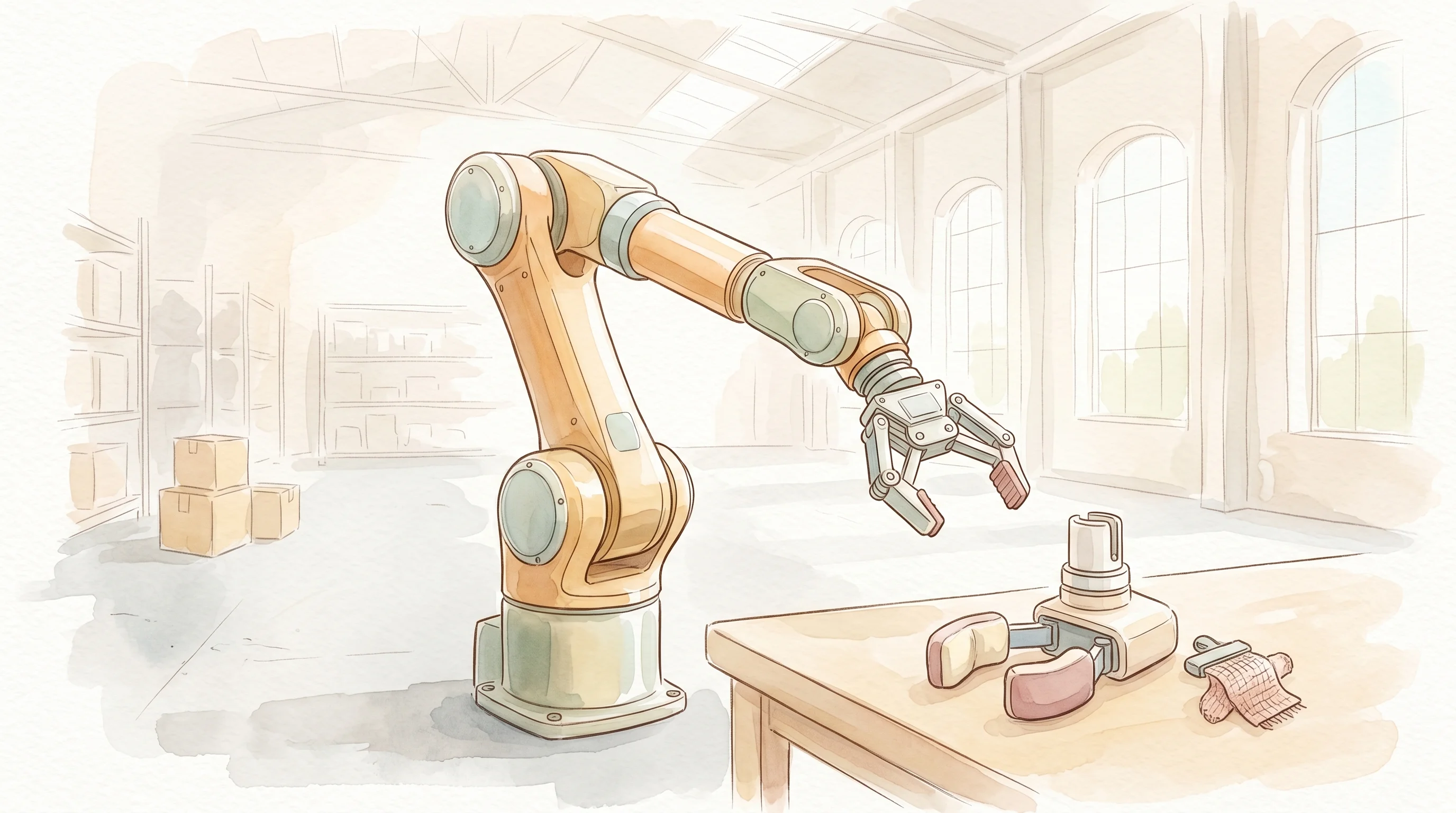
Theker makes AI-driven robots designed for the chaos of real-world industrial environments—factories, warehouses, logistics hubs. The pitch centers on reconfigurability: machines that can swap out hands, arms, and entire form factors to tackle different tasks. Sort parcels today, fold textiles tomorrow, handle bottles and cans the day after.
It's a deliberate break from the hyper-specialized automation that dominates industrial robotics, where a machine does one thing exceptionally well and nothing else at all. Theker's robots are meant to deploy in days rather than months and to keep learning once they're on the job.
The company has been running pilots at Paack warehouses for parcel handling and has demonstrated textile-folding automation—a notoriously difficult problem in robotics given fabric's tendency to behave unpredictably. Cloth doesn't cooperate the way rigid objects do.
Business-model-wise, Theker leans heavily on robotics-as-a-service, allowing customers to sidestep hefty upfront capital costs in favor of subscription-based operating expenses. Inditex, the Zara parent, has been both investor and early commercial partner—a dual role that clearly resonated with later backers looking for proof of concept.
"We didn't build Theker to run pilots," one founder said in a June interview. The focus, they insisted, is production deployment at scale. Bold words for a company barely four years old.
Where the Money Goes

The $85 million will fund faster deployments with major industrial operators, deeper investment in Theker's proprietary AI and robotics stack, and global expansion—including additional showrooms beyond Barcelona. Hiring is another priority. The company plans to grow from "dozens" of employees to roughly 120 by year's end, with open roles spanning software, electronics, mechanical engineering, and operations. By the time the funding was announced, Theker's co-founders projected they would field 15,000 job applications. Whether that number reflects genuine demand or just noise is hard to say.
The round also slots Theker into a broader European robotics funding wave. Germany's NEURA Robotics announced a potential $1.4 billion Series C around the same time, while RobCo and Sereact secured €100 million and €93 million, respectively, earlier in the year. Investors are calling it "physical AI," and the appetite appears real, at least for now.
Samsung's Angle

Samsung isn't just writing a check. The two companies are in what were described as "advanced discussions" for a more integrated relationship—one that could see Samsung act as customer, supplier, and investor all at once. That's the kind of strategic alignment that can accelerate a startup's trajectory or, if things go sideways, complicate it in unexpected ways. Theker seems eager to court backers who can open doors beyond capital: deployment partners, supply chain access, credibility.
Superlatives and Context
Whether this round genuinely sets a record depends on how you define categories and what funding data has been disclosed over the years. European venture markets don't always broadcast their largest deals with the same fanfare as Silicon Valley. But even allowing for some definitional fuzziness, an $85 million Series A for a Barcelona robotics startup less than four years old is a marker worth noting. Spain's venture ecosystem has historically struggled to attract the kind of global capital and strategic investors that routinely back companies in London, Berlin, or Paris.
Theker may not solve that structural problem on its own. But it's a data point. And in a market where data points like this are scarce, that counts for something.


