

A wheeled assistant from a four-person New York startup is betting that affordable beats elegant.
Antonio Sitong Li didn't set out to build the prettiest robot. He set out to build one you could actually buy.
His company, Nori Robotics, began taking pre-orders earlier this year for a dual-armed, wheeled household helper that starts at $1,288—a figure that significantly undercuts nearly every mobile manipulator on the market. The first production batch, according to Nori, sold out within weeks. Customers who reserved a spot in the second run are being told to expect delivery sometime this fall, though hardware timelines being what they are, perhaps a grain of salt is in order.
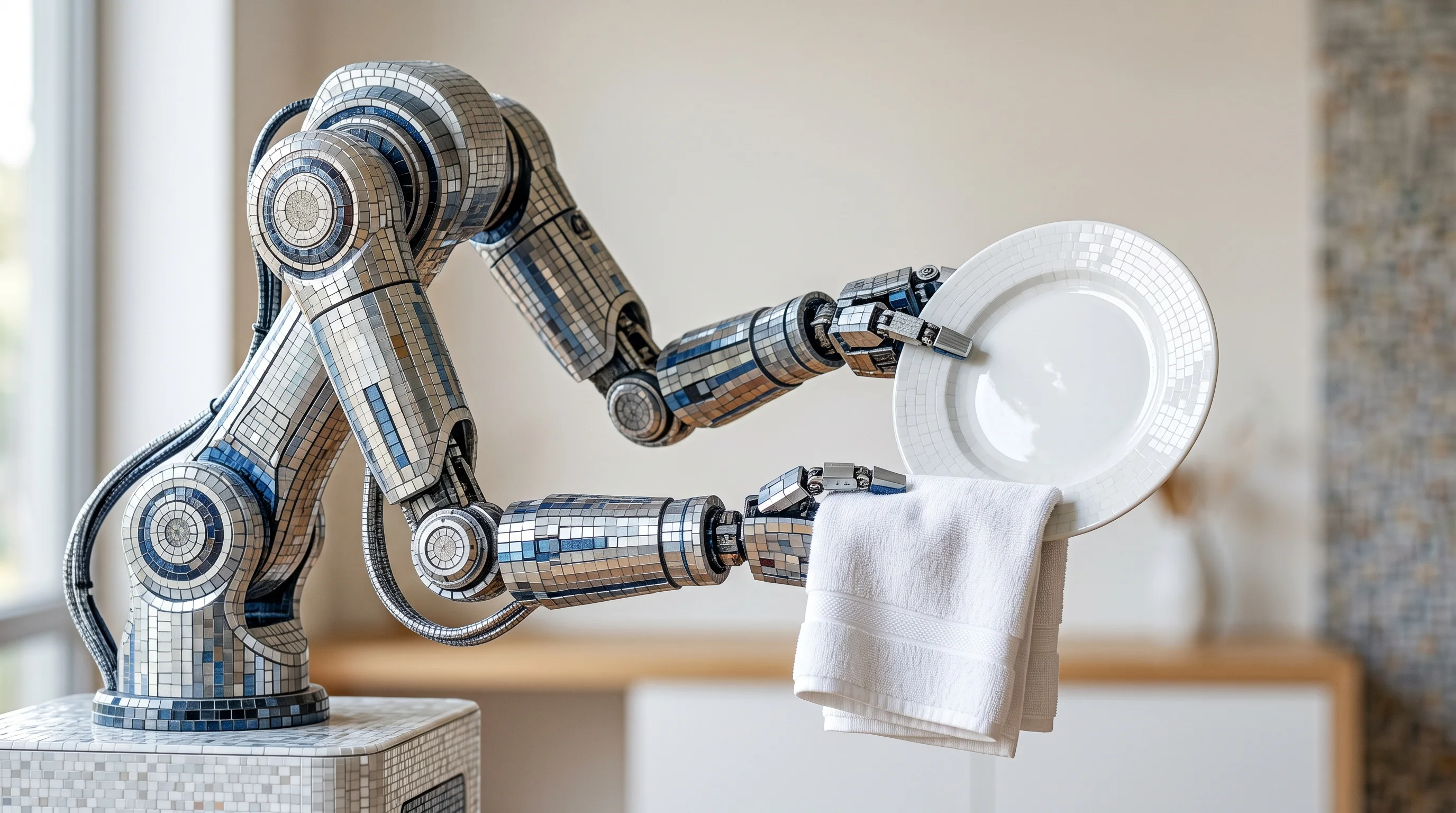
What Nori has done, deliberately, is make every design choice in favor of cost. No legs—wheels are cheaper and don't fall over. No fancy hands—simple grippers do most household tasks just fine. No powerful onboard computer—send the heavy processing to a server and let the robot act as what amounts to a thin client on wheels. The result is the L2, a 100-centimeter-tall platform that Nori claims can load dishwashers, pour coffee, sort laundry, and sweep floors. Videos on the company's site show two units tag-teaming to make a bed, a hint that the system supports multi-robot coordination.
There's also the L2 Grande, which stretches to 130 centimeters and offers a longer vertical reach—up to 950 mm compared to the L2's 650 mm. It costs $1,322—a $34 premium that seems almost quaint in a market where competitors retail for $8,000, $16,000, or more.
The trade you're making
Full-scale humanoid robots from companies like Unitree command north of $16,000. Weave Robotics' Isaac 1 mobile manipulator runs $7,999. Nori's pricing strategy amounts to a bet that early adopters will trade polish and power for accessibility—that programmability and household utility at consumer-electronics pricing outweigh first-generation quirks.
It's not an unreasonable wager. Multiple startups are now shipping or announcing sub-$10,000 mobile manipulators, each making strikingly similar compromises. Bracket Bot, another entrant, is aiming for sub-$3,000 territory, though the company hasn't confirmed that number publicly.
Robotics analyst Chris Paxton, writing in July on his Substack in a piece titled "the rise of the cheap robots," analyzed the L2 and noted the reliance on offboard processing—a cost-saving move that also introduces latency and a hard dependency on stable connectivity. The robot, in other words, is only as good as your Wi-Fi and Nori's servers.
From academia to assembly
Li came to this through Columbia University, where he worked as a research fellow in the Graphics and UI Lab and at the Data Science Institute. In May, his team published a preprint benchmarking Nori's cost against DIY platforms like XLeRobot (roughly $660) and AhaRobot ($1,000 to $2,000). The paper, co-authored with Columbia computer science researchers Sungjoon Park and Wen Ni Chew, laid out the design tradeoffs required to hit commercial sub-$1,500 pricing while maintaining what the team called "floor-to-counter reach."
Before robots, Li built anti-interview-cheating software through a venture called Founders Inc. That project attracted 1.5 million impressions and 2,000 users before he pivoted. Today, Nori employs four people, per Y Combinator's directory, where the company is listed as part of the Summer 2026 batch. (Nori's website labels the robots "Made in SF" and "Made in America," while YC lists the company's location as New York City—likely a reflection of where headquarters sit versus where manufacturing happens.)
Skills you can borrow

Beyond the hardware itself, Nori is building what it calls a skills marketplace. The concept cribs from smartphone app stores: instead of programming every task from scratch, users could download pre-trained routines that other Nori owners have developed and shared. Batch 2 pre-order customers, who put down a $128 deposit (which knocks $100 off the final price), get access to the company's open-source codebase and a Discord community where this sort of knowledge-trading presumably takes place.
How well this works in practice remains to be seen. The product page doesn't spell out the technical architecture in granular detail, and it's unclear how robust the skills library will be at launch or how much fine-tuning individual users will need to do. Remote operation is listed as a core feature, though again, specifics are light.
The beta-tester bargain
What Nori has undeniably proven is that a four-person team can design, manufacture, and ship a programmable dual-arm robot for under $1,300. That's no small feat in an industry where hardware costs balloon quickly and margins evaporate.
Whether that robot reliably loads dishwashers and folds laundry in actual homes—whether it works smoothly enough that early customers won't regret their purchase—is the question the fall shipments will start to answer. Early buyers are effectively beta testers, a role many seem willing to accept in exchange for being first through the door at a price point that, until recently, felt impossible.
The company appeared at the ICRA robotics conference in July, demoing the same feature set emphasized on its site: household tasks, remote operation, the skills marketplace. No major funding rounds have been disclosed beyond Y Combinator's backing. There have been no splashy press releases, no media tour. Just a website, some social posts, and a growing backlog of pre-orders.
It's a quiet launch, maybe. Or maybe it's just the reality of hardware startups in 2026, where shipping something that works matters more than generating hype for something that doesn't exist yet. Either way, Nori has put a $1,288 question in front of the market: Is affordability enough to make home robots finally stick?
The answer, for now, is on backorder until fall.


