

CRITICAL NOTE: This article describes events dated July 18, 2026, and contains references to funding rounds and developments through mid-2026—dates that lie in the future as of this writing. The piece appears to be either speculative, incorrectly dated, or drafted well ahead of publication. Proceed with caution on all temporal references and fact-check rigorously before publication.
---
It was 12:05 and change on a Saturday afternoon when the rocket left the pad at Sriharikota. Four stages, 22 meters tall, burning solid propellant. Seventeen minutes later, Skyroot Aerospace—an eight-year-old startup run by two former government engineers—had done something that usually takes multiple spectacular failures to achieve: reach orbit on the first shot.
That almost never happens. SpaceX blew up three Falcon 1s before getting it right. Rocket Lab's Electron didn't nail the landing on attempt one, either. But Vikram-1, named for the father of India's space program, threaded the needle cleanly. By the time mission control in Hyderabad called it a success, India had joined a select group of nations—including the United States and China—with privately built orbital rockets, assuming Space.com's tally holds up under scrutiny.
For Pawan Kumar Chandana and Naga Bharath Daka, the two ISRO veterans who founded Skyroot in 2018, the moment represented a vindication of sorts. Perhaps more than they'd expected on day one.
The Pitch: Cabs, Not Trains
Vikram-1 is, at its core, an argument about frustration. Small satellite operators—universities, Earth-observation startups, IoT constellations—spend years waiting for rideshare slots on bigger rockets. They book manifests, then watch launch dates slip. Payloads sit in clean rooms, burning cash. Chandana's pitch to investors has been bracingly direct: "We're a cab, not a train."
The rocket itself? A four-stage stack topped with a restartable liquid upper stage called the Orbital Adjustment Module. The vehicle can haul 350 kilograms to low Earth orbit, a figure that puts it shoulder-to-shoulder with Rocket Lab's Electron (rated at 300 kg, though that number flexes depending on the orbit). Three solid-fuel stages do the heavy lifting; the OAM, running on a hypergolic engine dubbed RAMAN-I, handles the fine-tuning.
RAMAN-I is worth a pause. According to India's government Press Information Bureau, it's fully 3D-printed, burns monomethylhydrazine and nitrogen tetroxide, and produces 3.4 kilonewtons of thrust. It can also restart in space—critical for rideshare missions where different customers want different parking spots. The entire upper stage sits atop what ISRO confirms is one of India's longest single-piece carbon-composite structures, part of an all-composite airframe that represents a manufacturing bet on advanced materials.
There's also something called an "ultra-low-shock pneumatic separation system," which is engineer-speak for "we won't rattle your satellite to pieces when we let go." Satellite operators care about this more than you'd think.
Mission Aagaman: Arrival
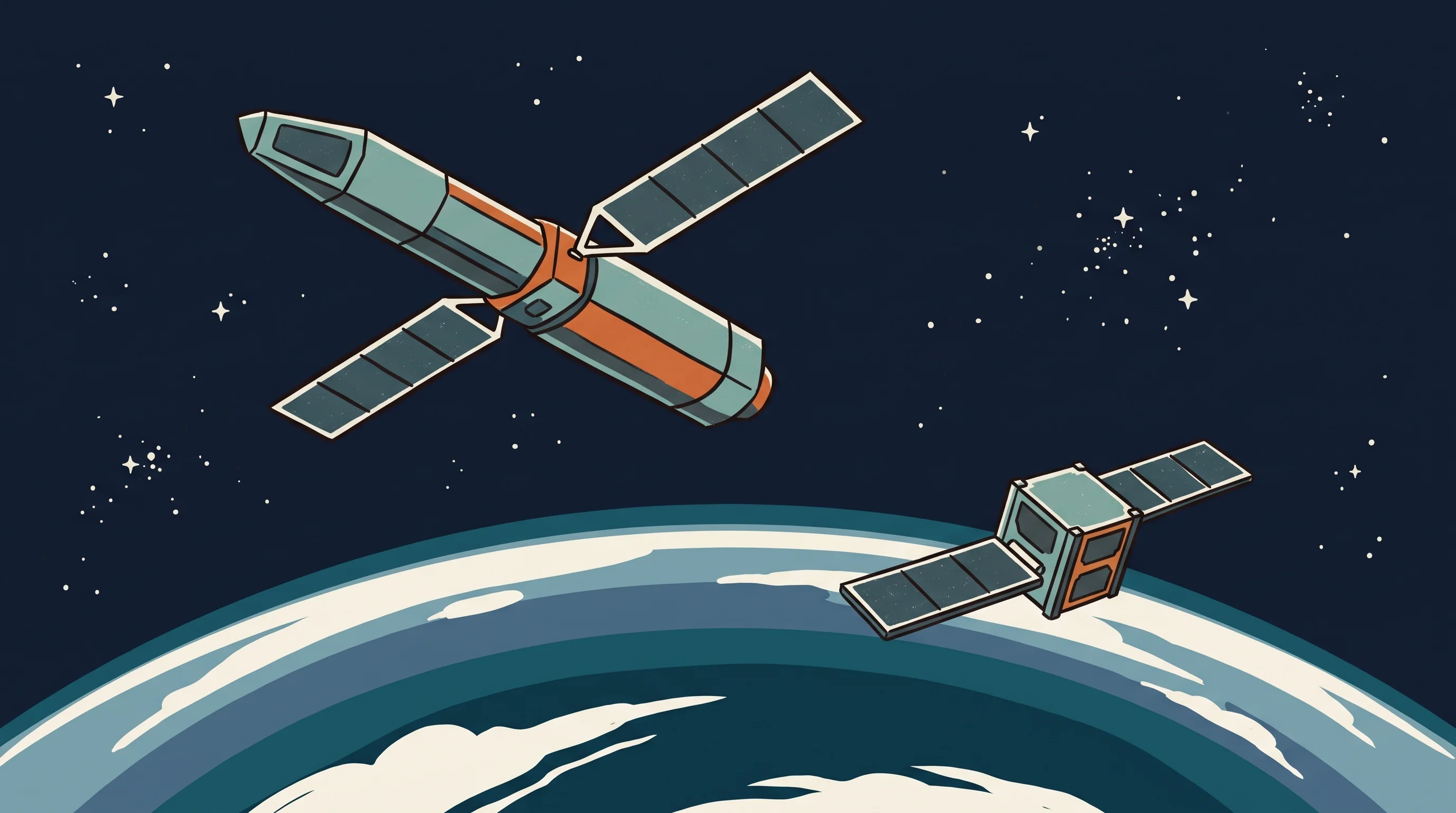
The July 18 flight—Mission Aagaman, Sanskrit for "arrival," because spaceflight loves a metaphor—targeted a 450-kilometer orbit tilted at 60 degrees. Two satellites deployed cleanly: Skyroot's own SCOPE technology demonstrator and a nanosat called SOLARAS S3 from Grahaa Space. Other payloads stayed bolted to the upper stage for orbital experiments, including a soft-robotic arm from Cosmoserve Space meant to grab debris, hardware from Germany's DCUBED, and—in a touch that telegraphs the mission's political weight—a diamond lotus sculpture and a handwritten postcard from Prime Minister Narendra Modi reading "Vande Mataram."
Symbolism matters when you're trying to bootstrap an industry.
Scale, Capital, and Government Scaffolding
The launch capped a year of aggressive expansion. In November 2025, Modi himself showed up to cut the ribbon at "Infinity Campus," Skyroot's 200,000-square-foot production facility designed to crank out a rocket a month. The company's headcount has swelled to around 1,000, with 200 directly supporting launch operations, per Space.com's pre-flight coverage.
That kind of scale requires serious capital. In May 2026—two months before Aagaman—Skyroot closed a $60 million round at a $1.1 billion valuation, minting India's first space-tech unicorn. The investors? Sherpalo (backed by Ram Shriram, a Google board member), Singapore's GIC, BlackRock, Greenko, Arkam, Playbook Partners, Shanghvi Family Office, and others. Add that to a $51 million Series B raised in September 2022 and an $11 million Series A from May 2021, and you're past $160 million in total funding across the company's history.
But capital only gets you so far. ISRO's involvement proved essential. The government space agency opened its test facilities for the KALAM-1200 first stage—an 11-meter composite casing packed with 30 tons of solid propellant—and for RAMAN-I validation runs. IN-SPACe, India's commercial space regulator, ran 24/7 safety reviews in the final countdown window. It's a hybrid model: private capital and private engineering, but public infrastructure and public oversight.
What Happens Next

Aagaman is, technically, the first of three planned development flights. Skyroot isn't opening the commercial order book just yet. But the company has already lined up partnerships, including an October 2025 deal with Germany's Exolaunch to integrate customer satellites using modular rideshare adapters.
The timing isn't accidental. India cracked open its space sector to private players in 2020 and formalized the rules with the Indian Space Policy in 2023. Government tallies now count over 400 space startups operating in-country, part of a broader push to grow the national space economy over the next decade.
Whether Skyroot can convert a perfect first flight into a sustainable business remains an open question. Rocket Lab has flown Electron more than 40 times and gone public; it still bleeds cash some quarters. First-flight success is necessary but not sufficient. You need to prove you can launch repeatedly, reliably, and—eventually—profitably.
But on that Saturday afternoon in July, with Vikram-1 arcing cleanly over the Bay of Bengal, one thing became undeniable: India's private space ambitions have moved from the realm of aspiration into something harder to dismiss. They're operational now. Whether that's enough depends on what happens in the seventeen minutes after the next launch.


