

A two-person team in Boston thinks they can solve the data center industry's power problem by parking nuclear reactors on ships next to floating server farms in the ocean.
The idea sounds ridiculous—until you consider what it says about the state of the industry. Atomarine, the startup behind this maritime gambit, impressed Y Combinator enough to land a spot in the accelerator's latest cohort. More unsettling still: the regulatory and technical infrastructure that would make such a venture possible is quietly falling into place, even as hyperscalers grow increasingly desperate for unconventional power solutions.
The timing isn't coincidental. BloombergNEF nearly doubled its forecast for U.S. data center electricity demand in July 2026, projecting 194 gigawatts by 2035—roughly one-fifth of total U.S. electricity consumption, an 83% jump from the December 2025 estimate. The same analysts flagged a potential 19-gigawatt supply shortfall even at record grid-connection speeds. A separate Berkeley Lab study tracking interconnection queues found median wait times from initial request to commercial operation now exceed four years in regions with reliable data.
For companies racing to deploy AI infrastructure, that's an eternity.
The density problem
At the heart of the crisis sits a simple fact: modern AI hardware is a power hog. NVIDIA's GB200 NVL72 rack-scale systems—the backbone of cutting-edge training clusters—typically draw 140 kilowatts or more per rack, with some lab configurations exceeding 200 kilowatts, according to vendor specifications and lab reports published through mid-2026. That's roughly ten times what a traditional enterprise IT rack consumes. TrendForce projected liquid cooling penetration would exceed 30% in 2025 as the market accelerates. Uptime Institute's survey data confirmed densities are climbing while average power usage effectiveness—a key efficiency metric—remains stubbornly flat.
The industry's response has been a land grab for electrons. Amazon paid $650 million in March 2024 for a data center campus next to Pennsylvania's Susquehanna nuclear plant, securing access to up to 960 megawatts via a long-term power purchase agreement with Talen Energy. That September, Microsoft signed a 20-year deal with Constellation Energy to restart Three Mile Island's Unit 1, targeting roughly 835 megawatts by 2028. Google and NextEra Energy announced plans to co-develop "multiple new gigawatt-scale data center campuses with accompanying generation"—essentially building power plants on-site to bypass grid delays entirely.
But even these aggressive strategies run into hard constraints. Berkeley Lab's "Queued Up 2025" report documented more than 2,000 gigawatts of generation projects waiting in interconnection queues as of end-2024, with median wait times to signed agreements stretching beyond three years. Local opposition compounds the delays: in Virginia's Prince William County, court rulings voided zoning approvals for the "Digital Gateway" campus, leading developers to ultimately withdraw their proposals.
Hence the pivot to the ocean.
Enter Atomarine
The startup's founders bring unusual credentials to the table. Emile Germonpre holds a PhD in nuclear engineering and graduated valedictorian from Ghent University; Dimitris Koutentakis carries multiple MIT degrees and family ties to the shipping industry. Their pitch: standardized 75–100 megawatt floating compute platforms cooled by seawater, powered by moored vessels carrying generation equipment.
In the near term, that means natural gas turbines. Longer-term—and this is where it gets interesting—they envision swapping in compact marine reactors as that technology matures.
The value proposition hinges on speed and thermal efficiency. Atomarine claims its approach delivers data centers four to five times faster than land-based builds, with campuses scaling to 450 megawatts by clustering barges. The company projects a power usage effectiveness of roughly 1.1, better than the industry average of 1.37 that Equinix reported. The secret is direct seawater cooling. Closed-loop heat exchangers—demonstrated by companies like Nautilus Data Technologies in its Stockton, California barge facility—use natural water as a heat sink without exposing IT equipment to corrosive salt spray.

The ocean, in effect, becomes free air conditioning. That thermal advantage matters more with each generation of AI chips.
The nuclear piece is less settled but increasingly plausible, perhaps more than the founders initially expected. Russia's Akademik Lomonosov, the world's only operational floating nuclear power plant, has been generating 70 megawatts commercially since May 2020 and remains operational as of 2026. In July 2026, the American Bureau of Shipping granted Approval in Principle to a South Korean consortium for a container ship powered by two molten salt reactor small modular reactors—a milestone signaling that maritime nuclear propulsion is edging toward commercial viability, even if slowly.
The International Maritime Organization tasked its Ship Design and Construction Sub-Committee in June 2025 with revising the 1981 Code of Safety for Nuclear Merchant Ships and developing a safety framework for floating nuclear power plants. In the U.S., a new memorandum of understanding between the Coast Guard and Nuclear Regulatory Commission, posted in mid-2026, establishes a framework for civilian maritime nuclear projects. The NRC is separately modernizing microreactor licensing under the 2024 ADVANCE Act, with draft guidance on "nth-of-a-kind" reactors published in mid-2025.
The Department of Energy's "Reactor Pilot Program" explicitly links advanced nuclear deployment to AI and data center applications, positioning federal sites as potential hosts. Meanwhile, the high-assay low-enriched uranium fuel many advanced reactors require is slowly coming online—Centrus delivered 900 kilograms to DOE by June 2025—though scaling to the multi-ton levels needed for commercial deployment requires extensions through at least June 2026 and beyond.
Floating facilities move from concept to reality
Atomarine is hardly alone in reimagining where data centers get built. Nautilus Data Technologies commissioned a 6.5–7 megawatt barge in Stockton in 2019, using river water for closed-loop cooling. The company pivoted in 2024–2025 to productizing its cooling technology, listing the barge for sale at $45 million in January 2025—a detail worth noting for anyone tempted to see floating data centers as a sure bet.
In Singapore, Keppel Data Centres began construction on a modular floating facility in April 2026, with environmental assessments documenting 19.2-megawatt modules and strict efficiency targets under the city-state's Green Data Centre Roadmap. Japan's NYK Line, NTT Facilities, and Yokohama City signed a memorandum of understanding in March 2025 and announced a demonstration of a renewable offshore floating facility in 2026.
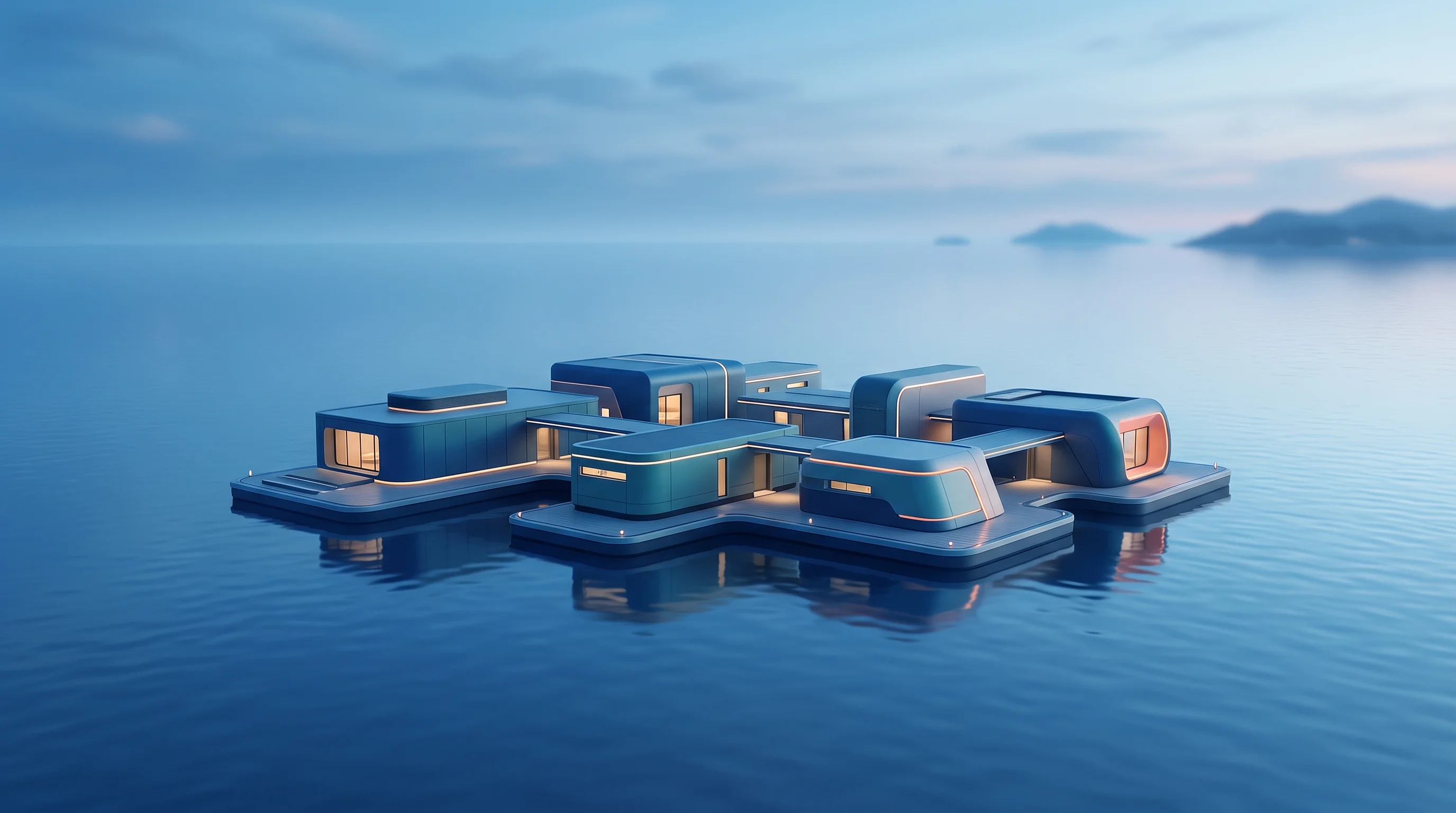
Offshore siting addresses more than just cooling. Singapore's policy framework, updated in May 2024, prioritizes data centers with power usage effectiveness of 1.3 or better and steers growth toward alternative locations to preserve scarce land. Water scarcity looms large elsewhere: a study projected U.S. data centers could require 697–1,451 million gallons per day of new water capacity by 2030 if current usage patterns persist. Seawater sidesteps that constraint entirely, though offshore U.S. deployments would still need to comply with Clean Water Act rules on cooling water intakes.
On the power side, several companies are pursuing what might be called "power-near-compute" models. Crusoe Energy, which bills itself as an "energy-first" AI data center developer, announced a 1.8-gigawatt campus in Wyoming in July 2025, co-located with on-site natural gas turbines. Oklo, the advanced fission startup, signed a 12-gigawatt master power agreement with Switch and a 1.2-gigawatt support agreement with Meta for nuclear development in southern Ohio. X-energy, which went public in April 2026, holds first-priority allocation options with Amazon across the early-to-mid 2030s for its Xe-100 small modular reactor.
TerraPower's Natrium reactor in Wyoming received an NRC construction permit in March 2026 and broke ground in April, targeting completion around 2030. These timelines underscore a central challenge: even fast-tracked advanced nuclear projects are half a decade or more from delivering electrons. Atomarine's staged approach—gas turbines now, reactors later—acknowledges that reality. The company's stated goal of having a gas-powered pilot ready by 2028 positions it to prove the floating-barge concept before the nuclear piece arrives.
If it arrives.
The obstacles are formidable
Port access for nuclear-powered vessels remains unresolved. While the IMO and domestic regulators are updating frameworks, site-specific approvals will hinge on local acceptance, liability insurance, and security protocols—none of which are straightforward. The NRC's proposed Part 57 rulemaking for microreactors could streamline licensing, but the agency has yet to approve a single commercial advanced reactor for construction beyond TerraPower's Natrium. Compact marine reactors suitable for Atomarine's power ships don't exist in commercial form; the Idaho National Laboratory is producing fuel salts for a molten chloride fast reactor experiment, but that R&D pipeline stretches years into the future.
Connectivity poses another constraint. Floating data centers must tie into terrestrial fiber infrastructure, ideally near submarine cable landing stations. The U.S. had 96 active cable landings as of early 2026, per TeleGeography testimony to Congress, but not all offer the low-latency, high-bandwidth backhaul that hyperscale AI workloads demand. Fiber introduces roughly 5 microseconds of latency per kilometer; a barge moored 10 kilometers offshore adds 100 microseconds round-trip. Trivial for many applications, potentially prohibitive for latency-sensitive inference at the edge.
Financial and operational risks loom large as well. A two-person startup, even one backed by Y Combinator, faces an uphill climb to deploy what Atomarine has projected as significant capacity. Shipyard availability, nuclear licensing timelines, customer contracts, and financing for billion-dollar floating infrastructure all present execution hurdles. The precedent of Nautilus listing its operational barge for sale after pivoting away from the floating model serves as a reminder that novel approaches don't always scale, even when the technology works.

What it all means
Yet the broader trend is undeniable. When BloombergNEF revised its U.S. data center forecast upward by 83% in seven months, it signaled that conventional planning assumptions no longer hold. NVIDIA CEO Jensen Huang has repeatedly described data centers as "AI factories" running 24/7, a framing that underscores the shift from intermittent enterprise workloads to always-on industrial compute. Digital Realty CEO Andy Power told investors in December 2025 that "power availability is the defining constraint" for growth, and the company is pivoting facility designs to accommodate higher densities.
For founders building AI-intensive applications, the message is clear: compute capacity will increasingly be dictated by access to power and cooling, not just chips. Offshore solutions—whether Atomarine's nuclear-ship-plus-barge model, Keppel's modular platforms, or as-yet-unimagined hybrids—represent one possible escape valve. Policy tailwinds in the U.S., where the Trump administration's executive order explicitly tied advanced nuclear deployment to AI infrastructure and authorized data centers on DOE sites, suggest the federal government sees unconventional siting as strategically necessary.
The unanswered question is whether the industry's appetite for radical solutions extends beyond power purchase agreements with existing nuclear plants to genuinely novel infrastructure. Atomarine's founders are betting it does. If they're right, the data centers powering the next wave of AI might be bobbing just beyond the horizon, drawing electricity from reactors built in shipyards rather than grid-connected substations.
If they're wrong, the venture will join a long list of promising ideas that couldn't bridge the gap between prototype and scale. Either way, the fact that a Y Combinator-backed team is seriously proposing nuclear-powered floating server farms tells you everything about how desperate the search for gigawatts has become. In an industry where four-year timelines now qualify as impossible, parking reactors on ships starts to look less like science fiction and more like the only option left on the table.


