

Orca Aerospace, a five-person San Francisco startup in Y Combinator's Fall 2026 batch, is building an AI spacecraft operator that runs on the satellite itself rather than in a ground control room, according to its YC directory entry. The company has not disclosed a funding round, and as of Oct. 28, 2026, the YC listing and a single job posting are the only public signals of its progress.
The timing is notable. The industry is arguing over how much decision-making to hand to software in orbit, and Via Satellite reported on Sept. 17, 2026 that space leaders see AI shifting from tool to autonomous decision-maker. "Now it is about trust," the publication wrote.
What Orca says it does
The YC entry describes "AI spacecraft operators that lives onboard the vehicle," in which "AI models control the satellite using deterministic tooling." The company's website tagline reads: "Mission Control, Onboard."
The architecture splits the mission "what" from the flight-safety "how," per the listing. AI models decide what the spacecraft should do, and deterministic tooling, meaning software that behaves identically every time it is given the same inputs, governs how it gets done. "At Orca, we are focused on creating the future of spacecraft operations by moving control onto the vehicle," the company said.
Orca's site also says it is registered for U.S. government and defense contracts under CAGE code 1YYL8. A CAGE code is the identifier the federal government assigns to suppliers.
The founders, and a grant that may or may not be theirs
CEO Jacob Ososke is a former Lockheed Martin Space guidance, navigation and control leader who, according to his YC profile, founded that unit's first AI-GNC team. He holds a master's in robotics from Santa Clara and a master's in computer science from Georgia Tech.
CTO Hakan Chunton earned a bachelor's degree in 2025 and a master of engineering in 2026 at MIT, in aerospace, computer science and data science, according to the page for MIT's Aerospace Controls Lab. His research covers reinforcement learning, optimal control and trajectory optimization.
Federal records add a wrinkle. USAspending shows a NASA Small Business Innovation Research Phase I award of $224,941, running from Sept. 30, 2026 to March 30, 2027, for "Resilient Onboard AI for Fault Detection, Diagnosis, and Recovery in Small Spacecraft Swarms." The recipient is listed as Otter Aerospace Inc. of Novato, California, under the same CAGE code Orca uses. A connection between the two seems likely, but no public filing confirms it, so the link should be treated as unverified.
The startup is also hiring a founding flight software engineer, with a posted salary range of $100,000 to $200,000 and equity of 0.25% to 2%.
Why autonomy is moving onboard
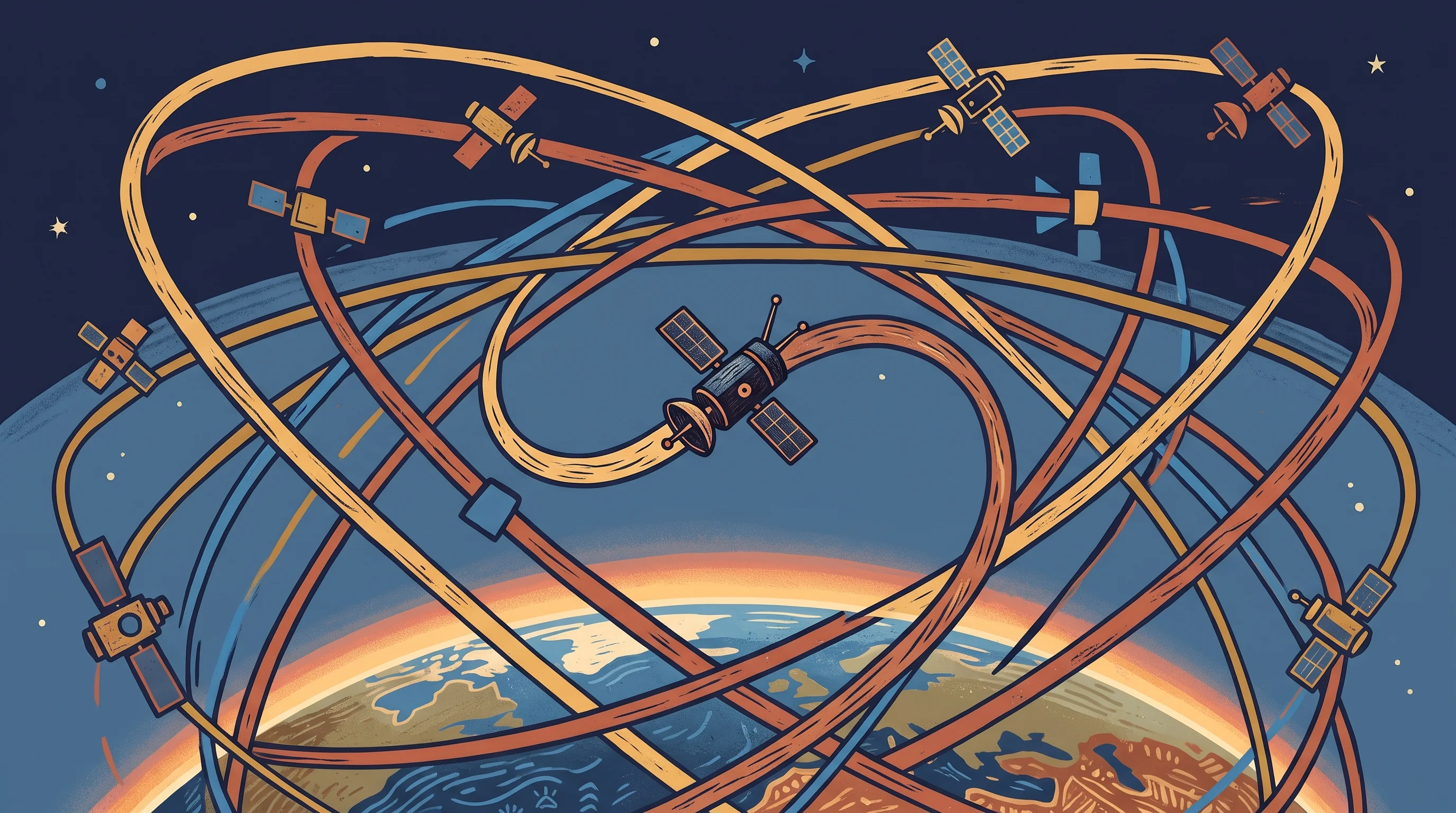
Crowding is one pressure. NASA's Conjunction Risk Assessment and Mitigation team, known as CARA, updated its screening volumes in March 2026 to capture 99% of collisions with a probability above 1e-4. BryceTech counted 4,544 spacecraft launched in 2025, 98% of them under 1,200 kilograms. That tally dates to April 2026, so it is more than six months old.
Precedent is accumulating, too. NASA's Starling mission, which ran from August 2023 to May 2024, demonstrated fully distributed autonomy across multiple spacecraft, and its Starling 1.5 extension coordinated with SpaceX's Starlink satellites. "A fully automated system that is flexible and adaptable between satellite constellations is ideal," said Lauri Newman of NASA CARA. Starling program manager Nathan Benz pointed to the payoff in speed: "Being able to react within a few hours can make new satellite observations possible."
On Jul. 28, 2026, the Air Force Research Laboratory said it had demonstrated a neural network controlling a satellite bus in orbit, calling it a step toward "trustworthy autonomous teammates."
Hardware is catching up. AMD has qualified its Versal XQR space-grade AI chips (Class B, March 17, 2025), with flight availability expected in 2027. Unibap flew three generations of its space computers on Transporter-18 on Oct. 1, 2026.
Trust is the bottleneck
On Aug. 24, 2026, Shield AI, Sedaro and NOVI announced that Shield AI's Hivemind autonomy software had run onboard a NOVI low-Earth-orbit satellite, with operators validating its decisions through Sedaro's SAFE framework. "The hardest part of autonomous space operations is trust," said Robbie Robertson, Sedaro's CEO.
Standards are beginning to form, though slowly. ISO approved a new work item, ISO/AWI TS 26776, on Sept. 23, 2026 to produce guidelines on managing AI use in space systems; it remains at an early draft stage. A 2025 policy brief from the UN Office for Outer Space Affairs urged red-teaming, configuration control, and rollback or safe modes for onboard AI.
Rogue Space Systems has said its Scalable Compute Platform isolates AI compute from flight-critical systems, a separation that echoes Orca's own split.
Competitors and adjacent players
Orca is entering a field with established names. Cognitive Space sells AI scheduling and operations software and won a $900,000 NOAA award in April 2024. Kayhan Space offers autonomous maneuver planning through Pathfinder 2.0. Both operate largely from the ground, whereas Shield AI and Sedaro have now shown autonomy in orbit.
Onboard compute vendors include Voyager Technologies, which announced its Space Edge portfolio on Aug. 24, 2026, as well as Spiral Blue and Unibap. Grand View Research projects the satellite edge computing market will grow from $4.5 billion in 2026 to $17.1 billion by 2033, a 20.9% compound annual growth rate.
Humans are not leaving the loop anytime soon. Kratos wrote in April 2026 that supervised autonomy, with people overseeing the software, would likely persist for 10 years.
What to watch
Orca's nearest tests are a priced funding round and a flight demonstration, and it has announced neither. Its website carries no blog or changelog, which leaves YC Demo Day as the next likely public checkpoint.


