

Amit Tandon spent years inside Sun Microsystems' labs, debugging the kind of silicon architectures that powered data centers across Silicon Valley. The problem that eventually pulled him back to India was messier, less elegant—and considerably more flammable: what to do with the mountains of grocery bags, food wrappers, and contaminated plastic film that pile up across the subcontinent, too degraded or mixed to recycle the conventional way.
Nearly a decade after he left California, Tandon's bet is starting to attract serious capital. In January 2026, Rainmatter—the climate-focused investment arm of Zerodha, India's dominant retail trading platform—poured ₹260 million into PolyCycl, the chemical recycling venture Tandon founded in Chandigarh in 2016. The Series A round lands at a moment when India's environmental mandates are tightening and the country's petrochemical giants are quietly hunting for alternatives to the naphtha they import by the shipload.
PolyCycl's core proposition is deceptively straightforward: take the polyolefin waste that mechanical recyclers won't touch, heat it in a sealed reactor until it liquefies, then clean the resulting hydrocarbon oil well enough that it can substitute for virgin naphtha in existing petrochemical plants. If the technology scales—always the operative question—it could chip away at India's reliance on imported feedstock while clearing some fraction of the 3.5 million tonnes of plastic waste the country generates annually.
A Different Kind of Cracker
The trick, as with most pyrolysis schemes, is preventing the system from choking on its own char.
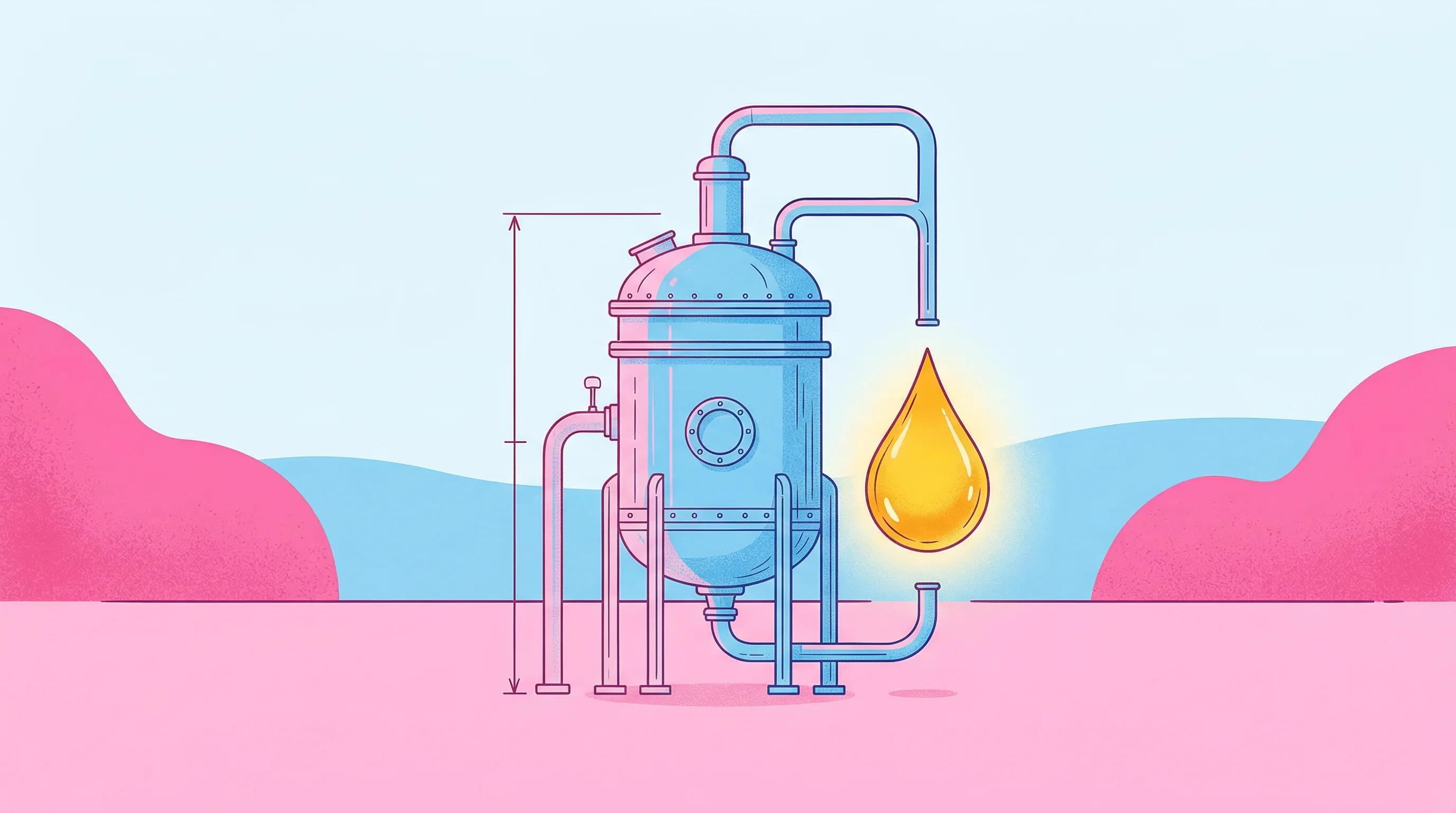
Tandon and his team secured U.S. patent number 10,093,864 B2 on October 9, 2018, for a continuous rotary retort designed to solve the fouling problem that plagues batch operations. At PolyCycl's demonstration facility outside Chandigarh—straddling the industrial corridor that runs toward Kalka—the company operates what it calls the Contiflow Cracker, a reactor that uses an AutoCharRemoval mechanism to expel solid byproducts on the fly. No stopping, no scraping, no downtime. At least in theory.
The second component, PyOilClean, handles purification. Traditional upgrading requires expensive hydrogenation to strip out halogens and other contaminants; PolyCycl claims its multi-stage process achieves similar purity without the added cost. According to company figures, the Gen VI platform converts 65 to 75 percent of incoming waste into usable oil and can be configured in modular lines processing anywhere from 15 to 100 tonnes daily.
Whether those yields hold up under industrial conditions, over months rather than weeks, remains an open question. PolyCycl pegs its technology at Readiness Level 7—a classification implying demonstration in an operational setting—but the company has been circumspect about naming commercial off-takers. Several industry sources report that the oil has been "qualified by multiple petrochemical companies globally," though specifics haven't surfaced publicly. Trade publications have also described PolyCycl as Unilever's "preferred partner for chemical recycling in India," a claim neither Unilever nor its Indian subsidiary, Hindustan Unilever, has confirmed on the record.
The Regulatory Squeeze
Part of what makes this bet interesting—perhaps more than Tandon or his backers initially expected—is timing.
India's Extended Producer Responsibility framework has grown teeth since 2022. Recycled-content mandates for rigid packaging are scheduled to climb from 30 percent this fiscal year to 60 percent by 2028–29. Flexible and multilayer packaging face similarly stepped targets. For brand owners and polymer producers, that regulatory escalator creates urgent demand for feedstock mechanical recycling simply cannot provide, especially when the material is contaminated or consists of mixed resins.
Enter pyrolysis oil. If it's clean enough and priced competitively, it slots into the same steam crackers that have run on imported naphtha for decades. Reliance Industries—the 800-pound gorilla of Indian petrochemicals—already processes waste-plastic pyrolysis oil under ISCC PLUS certification at its sprawling Jamnagar complex, proof that downstream acceptance isn't hypothetical. A recent analysis from December suggested that scaling advanced chemical recycling could ease India's dependence on naphtha imports, a narrative that resonates in New Delhi as the government pursues greater feedstock security.
PolyCycl's backers clearly see the same tailwinds. Spectrum Impact, the family office tied to Aarti Industries, came in early, joined by Milestone Gears, Supermorpheus, and a handful of high-net-worth individuals. Rainmatter's involvement adds a different dimension—Zerodha's founders, Nithin and Nikhil Kamath, have built a reputation for placing contrarian bets on climate infrastructure, and they tend to think in longer cycles than typical venture funds.
The Unglamorous Middle

What often gets glossed over in chemical recycling pitches is logistics. PolyCycl can't scale unless it solves the unglamorous problem of feedstock collection and preparation—gathering contaminated plastic from across India's fragmented waste streams, sorting it, baling it, and delivering it to reactors in consistent volumes and quality.
In 2023, the company signed an agreement with Re Sustainability (the entity formerly known as Ramky Enviro Engineers) to build feedstock prep facilities nationwide. The partnership is critical; without it, PolyCycl's reactors are just expensive machines waiting for material that may or may not arrive on schedule.
Engineering partners L&T Technology Services and Denmark's Topsoe are listed as collaborators on design work and platform evaluation, though neither firm has issued independent statements confirming the engagements. PolyCycl has also floated claims of achieving "greater than 50 percent" EBITDA margins and capex "50 to 75 percent lower" than comparable U.S. or European systems. Impressive, if true—but those figures come from company statements and lack third-party verification. Investors and potential customers will want audited proof before committing to large deployments.
Blueprint or Footnote?
The Series A capital—relatively modest by global climate tech standards—is earmarked for scaling deployments and expanding the team. What happens next depends on variables PolyCycl can only partly control: feedstock reliability, reactor uptime, oil quality consistency, and whether off-takers will commit to multi-year contracts at prices that make the economics work.
The Indian chemical recycling landscape is undeniably heating up. Regulatory pressure, feedstock availability, and downstream demand are aligning in ways that didn't exist even five years ago. But the graveyard of pyrolysis ventures is littered with technologies that worked brilliantly in pilot form and stumbled at scale. Whether PolyCycl's platform can deliver industrial reliability over quarters and years—not just weeks—will determine if Rainmatter's bet becomes a blueprint for India's circular economy or simply another well-intentioned footnote.
Tandon left Silicon Valley for a reason. The question now is whether he can engineer a second act that's as durable as the chips he used to debug.


