

For most researchers working with quantum computers, waiting has become part of the job description. Simulations crawl. Testing cycles stretch into days. The gap between imagining an algorithm and watching it run—even in emulation—can feel insurmountable.
That may be changing. On November 18, during the Supercomputing Conference in St. Louis, BTQ Technologies' QPerfect division unveiled something that's drawing quiet attention across the quantum development community: a GPU-accelerated quantum emulator delivering speedups exceeding 100× compared to traditional CPU execution. The upgrade to their QLEO platform isn't just incremental. It's the kind of leap that could fundamentally alter how developers build and refine quantum algorithms before they ever touch real quantum hardware.
The question isn't whether faster simulation matters—it obviously does. The question is whether this particular approach, tethered as it is to one hardware architecture, becomes a blueprint or a footnote.
CUDA-Q and the Art of Compatibility
QLEO—short for Quobly Logical Emulator Online—now supports NVIDIA's CUDA-Q framework natively. For developers already embedded in that ecosystem, the implications are straightforward: existing circuits run on QLEO without rewriting a line of code. No translation layer. No awkward conversions.
The platform was built atop QPerfect's MIMIQ engine and designed specifically to emulate quantum processors from Quobly, a quantum microelectronics firm focused on silicon-based neutral-atom architectures. NVIDIA's cuQuantum SDK powers the GPU acceleration, transforming what were once sluggish, CPU-bound workflows into something approaching real-time iteration.
"Native CUDA-Q provides a direct on-ramp to NVIDIA GPUs, enabling order-of-magnitude speedups," Guido Masella, CTO and co-founder of QPerfect, said in a statement. The architecture draws on cuQuantum's state-vector and tensor-network backends, allowing researchers to scale simulations across one GPU or many, depending on how complex their circuits get.
It's a practical consideration that matters more than it might sound. Quantum simulations have a nasty habit of hitting computational walls quickly.
Cloud, or Not
Deployment happens two ways. The emulator is now live on OVHcloud's Quantum Platform, which launched in mid-November as Europe's first Quantum-as-a-Service offering. Developers who prefer working locally can install QLEO with a simple pip install qleo command, giving them immediate access to GPU-accelerated simulation on their own machines.
This dual-access model isn't just about convenience—it's about trust. Pharmaceutical companies modeling molecular interactions, for instance, may balk at sending proprietary data to cloud servers, no matter how secure. Academic researchers, by contrast, might gladly trade local control for scalability and shared resources. QPerfect and Quobly seem to have anticipated both camps.
What It's Actually For

The companies position QLEO for domains where quantum computing might—might—deliver advantage sooner rather than later: quantum chemistry, optimization problems, materials discovery, quantitative finance, and certain AI workloads. The emulator's CUDA-Q compatibility means it fits neatly into hybrid quantum-classical workflows, where classical GPUs handle preprocessing and quantum circuits tackle specific subroutines that classical computers find intractable.
Maud Vinet, CEO of Quobly, emphasized that GPU and CUDA-Q support "enables hybrid workflows at scale," aligning with the company's broader industrialization timeline. Quobly closed a €21 million funding round in May 2025 for its Q100T project—a 100-physical-qubit silicon chip—and has tapped STMicroelectronics for 28nm FD-SOI manufacturing. The partnership signals confidence in leveraging existing semiconductor infrastructure, though whether that bet pays off remains an open question.
Silicon-based quantum computers promise advantages in manufacturability and integration with classical electronics. They also face their own set of physical challenges—coherence times, error rates, scalability beyond a few hundred qubits. Quobly's approach hinges on those challenges proving surmountable.
The Consolidation Play
The QLEO launch arrives as BTQ Technologies moves to acquire QPerfect outright. BTQ exercised its acquisition option on November 11, 2025, with the transaction expected to close before year-end. Olivier Roussy Newton, BTQ's CEO, framed the integration as "bridging simulation and hardware for scalable, real-world applications"—the kind of vertically integrated structure that venture capital loves and that actual customers judge more skeptically.
Whether vertical integration creates competitive advantage in quantum computing is still unclear. The field is young enough that specialization might matter more than breadth. Or perhaps not. Hardware vendors like IBM and Google already offer their own simulation tools; whether an independent emulator tied to a single hardware architecture gains traction depends on Quobly's success in delivering competitive processors.
A Crowded Field, a Narrow Focus
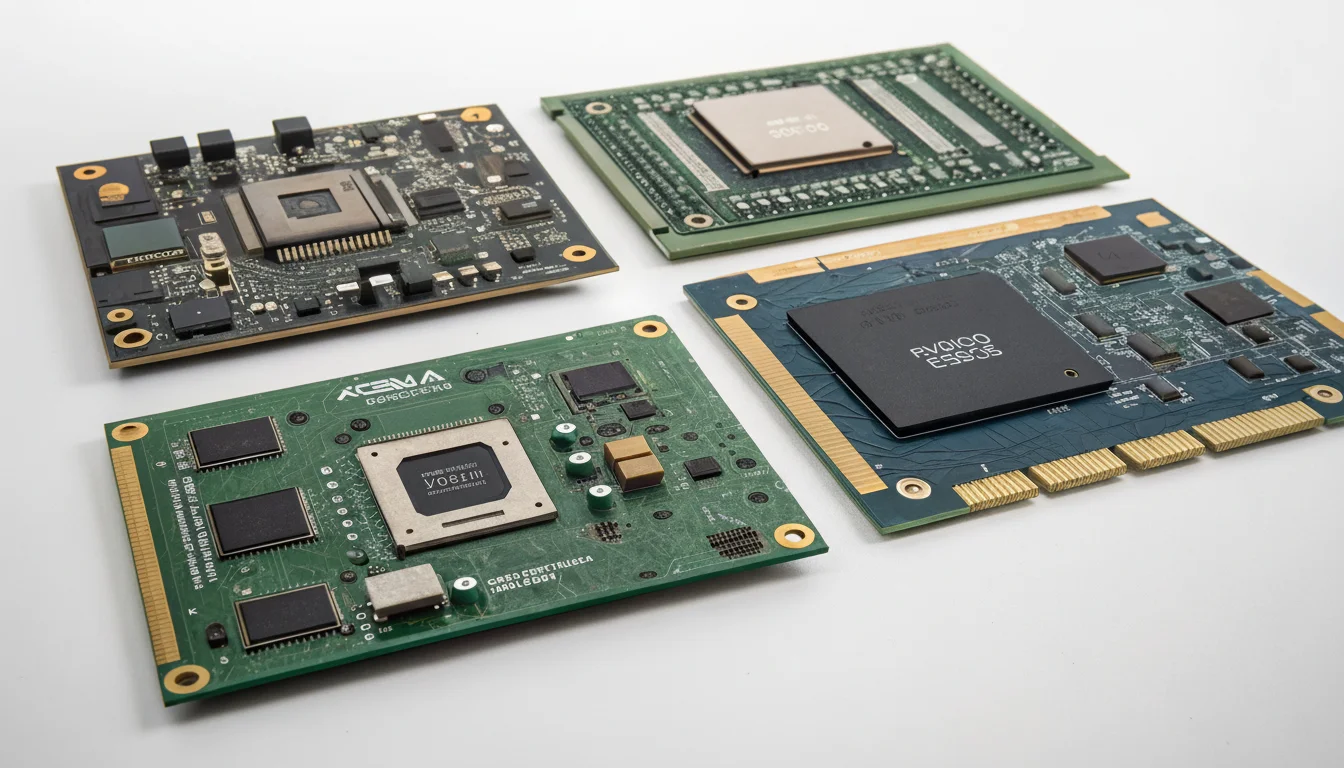
QLEO enters a landscape already populated by GPU-accelerated quantum simulators. IBM's Qiskit Aer leverages cuStateVec. Google has qsim. Pasqal offers GPU backends for its neutral-atom systems. QLEO differentiates itself through its focus on silicon spin qubits and tight integration with Quobly's hardware roadmap—a specialization that could prove either prescient or limiting.
For now, though, quantum researchers have another tool that runs fast enough to be useful. In a field where simulation often moves at a frustrating crawl, 100× faster might represent the difference between theoretical exercises and practical development cycles. Whether QLEO becomes the standard or merely an interesting alternative will depend less on its technical merits than on whether Quobly's silicon bet pays off.
Speed matters. But in quantum computing, the right architecture matters more.


