

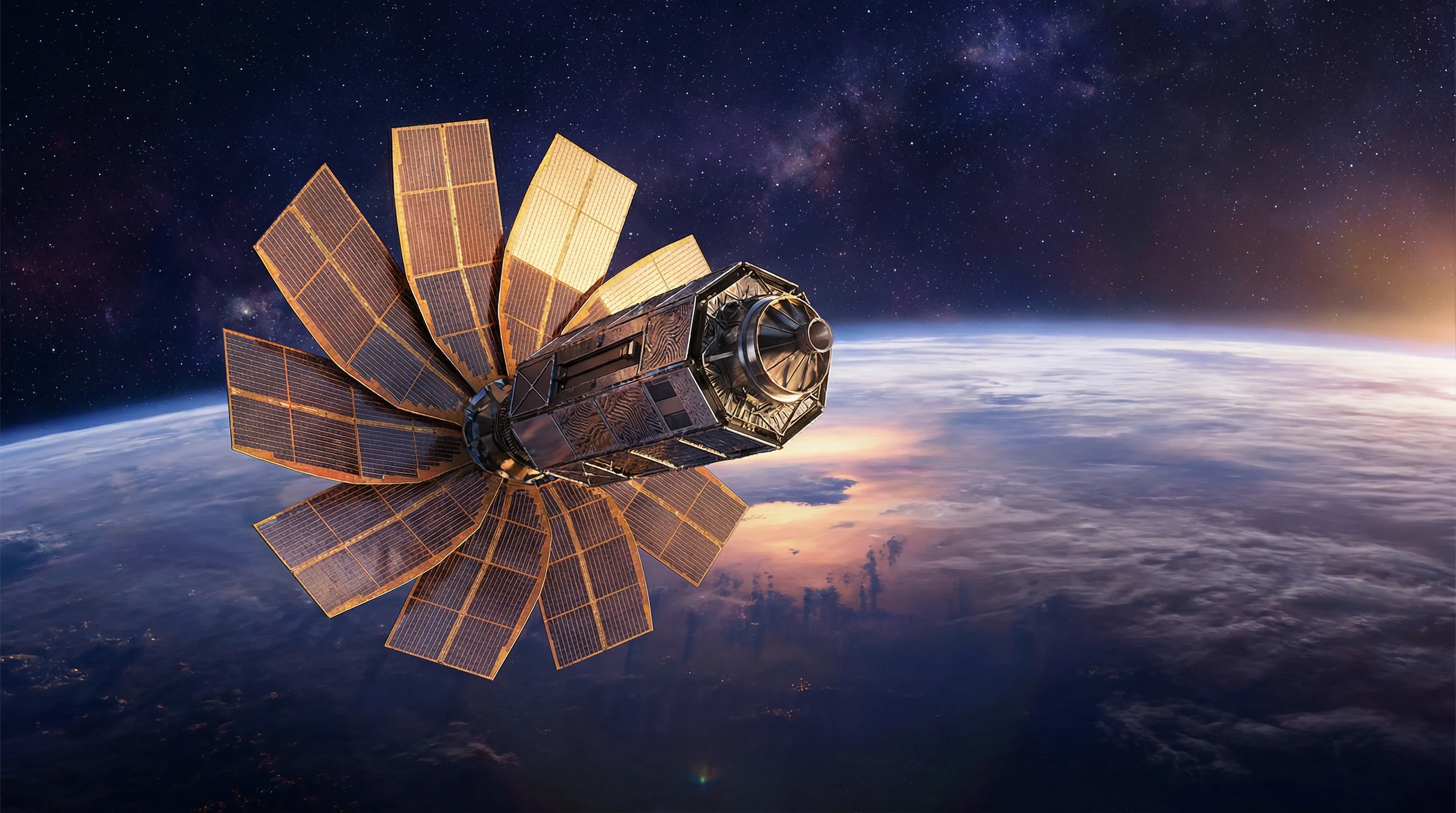
The dining table-sized prototype didn't look like much strapped into NASA's microgravity simulator. But when Mitchell Fogelson hit the release mechanism during that parabolic flight, the structure began to unfold—extending outward in a carefully choreographed mechanical ballet that hinted at something far more ambitious. His vision? Solar arrays that could expand to the size of a football field once in orbit, delivering ten times the power at the same launch weight.
What seemed like an academic curiosity just a few years ago has suddenly become urgent. Space, it turns out, has an energy crisis brewing.
Today's orbital infrastructure generates roughly 20 megawatts of power across all satellites, stations, and platforms combined. By 2030—just four years away—industry forecasts suggest demand could surge past 10 gigawatts. That's a 500-fold increase, driven by ambitions that once lived in science fiction: orbital data centers running cloud computing workloads, commercial space stations hosting dozens of crew members, and lunar bases extracting resources from regolith.
Fogelson's company, Beyond Reach Labs, fresh from Y Combinator's Winter 2026 cohort, is betting that conventional solar panel technology can't possibly keep pace. The startup is commercializing deployable structures that transform dramatically in the vacuum of space—maintaining structural rigidity across spans that would collapse under their own weight on Earth.
Whether they succeed may determine who controls the infrastructure of the next space economy. Or it could reveal that the orbital power shortage isn't quite the crisis some investors believe.
When Satellites Became Power Hungry
The numbers tell a striking story, though perhaps one that requires context. SpaceX filed paperwork with the FCC in early 2026 proposing a network of up to one million satellite data centers, each powered by solar arrays. The application highlighted what advocates see as space's killer advantage: sunlight is constant, cooling is essentially free (radiation takes care of that), and you're not competing for increasingly strained terrestrial electricity grids.
Down here, global data center consumption is expected to double to roughly 945 terawatt-hours by 2030. U.S. facilities alone could draw 134 gigawatts—more than the entire generating capacity of California and Texas combined. Moving even a fraction of that compute load to orbit would require power infrastructure that simply doesn't exist yet.
Skeptics surfaced immediately. Thermal management in space isn't actually "free"—it's a fiendish engineering problem when you can't rely on air convection. Debris mitigation becomes exponentially harder with each additional satellite. And the sheer economics of launching a million data centers? That particular math doesn't close, at least not at current launch costs.
Yet the regulatory filing marked a shift. What had been white papers and conference presentations suddenly had corporate backing and legal filings.
The existing supplier base is scaling fast, though from a modest baseline. Redwire's ROSA roll-out arrays have become something like an industry standard—six units installed on the International Space Station deliver 120 to 160 kilowatts of additional power, and the same architecture is now baseline for NASA's Gateway station orbiting the Moon. Airbus secured orders for more than 200 Sparkwing arrays for satellite constellations, while Rocket Lab's SolAero division announced a 50% expansion of space-grade solar cell production under CHIPS Act funding, adding more than 100 manufacturing jobs.
These are incremental advances. They're not enough.
Three Convergent Forces
Several trends are compressing the timeline for breakthrough solar designs, each reinforcing the others in ways that industry insiders find either exhilarating or deeply concerning depending on their investment positions.
First: the orbital data center concept migrated from academic papers to regulatory documents. Europe's ASCEND feasibility study, completed by Thales Alenia Space in mid-2024, concluded that deploying one gigawatt of space-based computing capacity before 2050 is technically feasible and could offer environmental benefits compared to terrestrial alternatives. The study didn't promise profitability—just possibility.
Second: commercial space stations and lunar infrastructure need 50 to 200 kilowatts per installation, far exceeding what traditional satellite buses require. Gateway's Power and Propulsion Element alone targets 60 to 70 kilowatts. Add in habitats, resource extraction facilities, and rover charging stations, and the math gets complicated fast. NASA roadmaps envision deploying these arrays alongside nuclear fission reactors for sustained operations—a belt-and-suspenders approach that reflects the criticality of uninterrupted power.
Third, and perhaps most important for near-term business models: regulation is tightening. The FCC's five-year deorbit rule for low Earth orbit satellites, which replaced the old 25-year guideline in mid-2024, puts a premium on robust systems that can be retracted or gracefully fail. Deployment itself remains a primary failure mode. Large arrays have to unfurl properly on the first try—there's no second chance in orbit—and gravity-offloaded ground tests don't reliably predict how structures behave in microgravity. That gap between testing and reality haunts mission planners.
The New Specialists

Beyond Reach Labs sits squarely in that gap. Co-founder Mitchell Fogelson holds a PhD from Carnegie Mellon and led NASA-funded work on kilometer-scale structures before starting the company in 2023. His technical partner, Pele Collins, engineered parachute systems for SpaceX's Dragon capsule and later worked on plasma-facing components at Commonwealth Fusion Systems—credentials that suggest someone who understands both deployment dynamics and extreme environments.
Their pitch to Y Combinator was direct: solar arrays that grow from dining-table scale to football-field dimensions, delivering dramatically more usable power without increasing launch volume. The company also sells simulation tools and engineering services for deployable structures, positioning itself as both hardware supplier and de-risking partner.
The technical lineage traces back to CMU's HERDS and PETS projects, which demonstrated expansion ratios of 50 to 150 times using hierarchical metamaterials, scissor mechanisms, and auxetic geometries that behave counterintuitively under stress. A paper on HERDS was accepted at IEEE Aerospace. Fogelson flight-tested prototypes aboard NASA's reduced-gravity aircraft—the so-called "vomit comet"—before commercialization.
Collins has emphasized, in company blog posts, that deployment often represents the highest-risk phase of any mission, and traditional verification methods leave dangerous blind spots. That's the problem Beyond Reach aims to solve, though proving it works will require successful on-orbit demonstrations, something they haven't yet achieved.
Established players are pursuing different vectors. Solestial and Opterus are developing radiation-tolerant silicon blanket arrays targeting 50-kilowatt class systems with around 200 watts per kilogram specific power—leveraging NASA Small Business Innovation Research funding to drive down cost per watt. Their bet: high-volume silicon manufacturing, adapted for space radiation environments, can undercut the traditional III-V multijunction cells that currently dominate.
Meanwhile, Airbus and Redwire continue refining roll-out boom architectures that have logged thousands of deployment cycles across the ISS, commercial geostationary satellites, and science missions like NASA's DART asteroid deflection test.
What Happens Next—And When
The near-term trajectory feels relatively certain. More roll-out arrays, higher production rates, incremental improvements in specific power and packaging efficiency. China announced plans for a 10-kilowatt space-based solar power demonstrator in low Earth orbit by 2028, followed by a roughly one-megawatt system in geostationary orbit by 2030, with a phased roadmap targeting two gigawatts by 2050 using on-orbit assembly. The U.S. Air Force Research Laboratory's SSPIDR program aims to fly ARACHNE, a sandwich-tile concept for beaming RF power from orbit. Caltech wrapped its SSPD-1 mission in early 2024 after successfully demonstrating wireless power beaming in space, though at scales far too small for commercial relevance.
The medium term—five to ten years—is where forecasts diverge sharply. If SpaceX or a competitor deploys even a small-scale orbital data center, the hardware demand could reshape supplier ecosystems overnight and accelerate adoption of kilometer-scale deployables. Europe's SOLARIS program and the UK's CASSIOPeiA initiative envision orbital demonstrators in the early-to-mid 2030s, with full geostationary systems potentially viable by the 2040s if costs, safety protocols, and spectrum regulation align.
NASA's Office of Technology, Policy, and Strategy offered a more measured assessment in 2024, concluding that space-based solar power remains more expensive than terrestrial alternatives under baseline assumptions. But—and this is where things get interesting—it could find nearer-term applications in lunar operations or specialized grid-adjacent use cases where alternatives don't exist.
The Uncertainty Premium

Market forecasts for space-based solar power vary by more than an order of magnitude, ranging from $1.05 billion by 2030 according to Grand View Research to $6.8 billion by 2040 per MarketsandMarkets. That spread tells you everything you need to know about how nascent this sector remains.
Regulatory frameworks for power beaming and orbital data centers barely exist. IEEE and ICNIRP exposure standards provide some guardrails for microwave transmission, but system-level safety cases—including retrodirective beam control and fail-safe shutoff mechanisms—remain works in progress. These are gating items for any gigawatt-scale concept, and they're not the kind of problems that get solved quickly.
What should founders, investors, and engineers watch? Validated expansion ratios at scale. Actual on-orbit demonstrations of "football field" class deployments, not just subscale prototypes. The accuracy of simulation toolchains for predicting deployment dynamics and post-deployment structural stiffness.
The companies that solve the mechanical risk problem and integrate seamlessly with leading cell suppliers will define the next chapter of space power infrastructure. Whether that future arrives in five years or twenty may depend less on the technology itself—which is largely proven in laboratory settings—than on how quickly the economics of launch, orbital assembly, and power beaming converge with regulatory realities and safety requirements.
Either way, the era of treating orbital power as a niche satellite subsystem appears to be ending. Space is about to need dramatically more energy than current systems can provide. The question now isn't whether someone will build that infrastructure.
It's who gets there first—and whether they can make the economics work before their capital runs out.


