

The pitch sounds almost too simple: show a robot one video of a task, and it learns to perform the work on a production line without additional programming or retraining. That's the promise from Shiraz AI, a San Francisco robotics startup backed by Y Combinator that has begun deploying its systems at customer sites.
The company is targeting a specific pain point in manufacturing—contract facilities and high-mix production lines where the product being assembled changes weekly or even more frequently. Traditional industrial robots excel at repetition but struggle with variety, often requiring expensive integrator services every time a new task needs to be programmed. Shiraz AI's full-stack approach bundles proprietary hardware, a robot foundation model, and on-site deployment into a single package designed to sidestep that bottleneck.
Co-founders Navid Aghasadeghi and Mojtaba Mozaffar bring substantial pedigrees to the venture. Aghasadeghi previously led manipulation work on Boston Dynamics' Spot robot and spent time at the now-defunct Rethink Robotics, an early pioneer in collaborative automation. Mozaffar comes from Amazon Robotics, where he ran whole-body control and bimanual manipulation projects, and previously taught at Northwestern University. In a LinkedIn post this summer, Aghasadeghi explained the mission plainly: "We're building robots that learn on the job, starting with manufacturing."
Whether that vision scales beyond pilot deployments remains an open question. The company has posted a two-minute launch demo on its website but declined to disclose funding details, customer names, or the number of units currently in the field.
An Industry Primed for Change
The robotics market has been growing steadily, if unevenly. Global industrial robot installations reached 542,000 units in 2024, the second-highest year on record, according to the International Federation of Robotics. The IFR projects 575,000 installations in 2025, a 6 percent uptick. North American manufacturers ordered 36,766 robots in 2025, valued at $2.25 billion—up 10.1 percent in units and 6.6 percent in revenue compared to the prior year, per the Association for Advancing Automation.
"The rebound in robot orders over the course of 2025 reflects renewed confidence in automation as a long-term solution to competitive pressures," Alex Shikany, A3's executive vice president, said earlier this year.
Yet beneath those growth figures lies a persistent challenge. Most industrial robots still rely on teach-pendant programming, a decades-old method that requires line-by-line instruction for every motion. High-variation operations remain difficult to automate economically. A 2024 report from the National Institute of Standards and Technology noted that such environments "are stymied by the inability to easily program robots to perform a new task," often demanding integrator involvement for every update. The upfront cost and time sink of reprogramming makes automation impractical when production runs shift frequently.
NVIDIA and Workr Labs underscored the issue in a recent case study: "When production runs change frequently in high-mix environments, that upfront effort outweighs the benefit."
The AI Inflection
Foundation models and improved simulation tools are beginning to reshape that calculus. Boston Consulting Group claimed in a report this spring that robot foundation models, combined with narrowing simulation-to-reality gaps, are "cutting robot training time by 70% while expanding automatable work by 50%." BCG estimates payback periods have compressed from five to seven years down to one to three years, though such projections often lean optimistic and hinge on specific use cases.
Gartner forecasts worldwide AI spending will hit $2.59 trillion in 2026, up 47 percent year-over-year. Bain wrote in April that "industrial automation has begun a structural shift as value moves away from control and toward intelligence," projecting nearly half of industrial automation revenue will be AI-enabled by 2030. A February survey by PwC found that the share of manufacturers planning to highly automate key processes by 2030 more than doubles—from 18 percent to 50 percent.
Collaborative robot shipments, a category that includes systems designed to work safely alongside humans, are forecast to nearly double to approximately 128,918 units by 2030, according to Interact Analysis. The research firm noted in June that China's revenue share in this segment will likely climb from 35 percent in 2025 to roughly 42.4 percent in 2030, reflecting the country's aggressive push into advanced manufacturing.
Shiraz AI's approach fits squarely into this emerging landscape. The company describes its workflow in three steps: "show" (record one video demonstration), "learn" (the system adapts in-context without retraining), and "work" (the robot executes the task on the production line). NIST has identified teaching generic tasks through demonstration, hand-guiding, and simulation as promising methods to reduce programming overhead—precisely the territory Shiraz AI is exploring.
A Crowded Field of Adaptable Machines
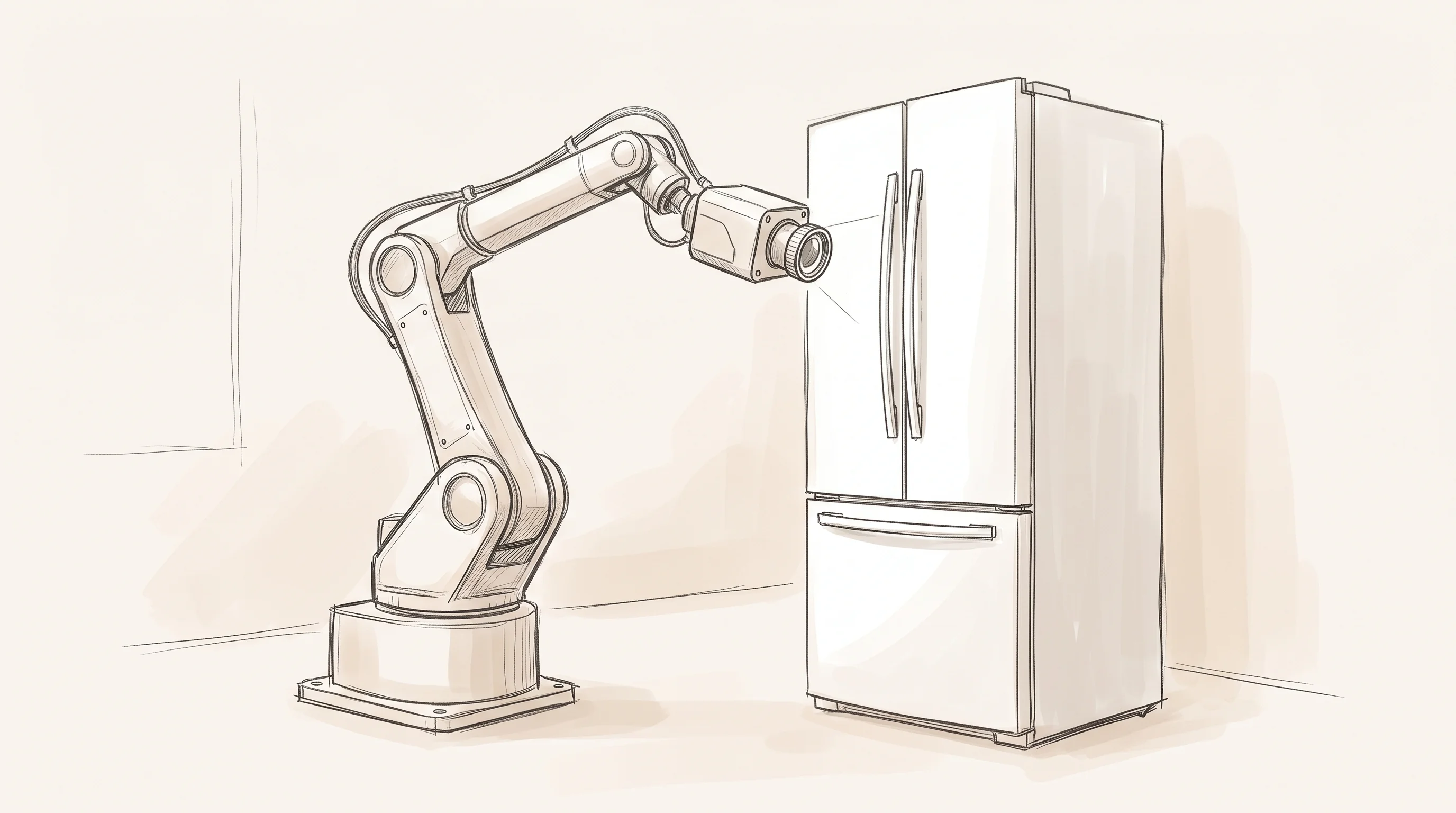
Shiraz AI is hardly alone in pursuing adaptability. Micropsi Industries, a Berlin-based firm, sells MIRAI, a vision-based AI control system trained through human demonstration and real-time corrections. The company lists deployments at BSH (Bosch Siemens Hausgeräte) for refrigerator leak testing and DEPRAG screwdriving operations, according to its website.
Alphabet's Intrinsic has integrated NVIDIA Isaac foundation models for grasping into its Flowstate platform, aiming at intelligent industrial workflows and CNC tending. Covariant announced RFM-1, a robotics foundation model for multi-industry applications, in March 2024. Figure AI deployed humanoid robots at BMW's Spartanburg plant; the company said in June that the machines "supported the production of more than 30,000 BMW X3" vehicles. Figure 03 units are now arriving to tackle more complex sequencing tasks in logistics.
GrayMatter Robotics signed an MOU with Huntington Ingalls Industries in April to integrate what it calls "Physical AI" into shipbuilding operations. HII announced performance-based production agreements in August worth up to $900 million across seven years, contingent on hitting milestones.
ABB partnered with NVIDIA to integrate Omniverse libraries into RobotStudio HyperReality, claiming simulation-to-reality accuracy rates as high as 99 percent. "The industrial sector needs high-fidelity simulation to bridge the gap between virtual training and real-world deployment of AI-driven robotics at scale," Deepu Talla, an NVIDIA vice president, said in a March blog post. ABB plans to release the product in the second half of this year, with pilots underway at Foxconn and Workr.
Smaller case studies point to tangible results. OnRobot published documentation showing that automating high-mix, low-volume CNC tending "made financial sense" for BS CNC after a proof-of-concept. Universal Robots documented a deployment at AIM Processing using a UR5e on a mobile platform, with payback clocked at less than 15 weeks.
What distinguishes Shiraz AI, at least in principle, is its full-stack delivery model. Rather than offering software that integrates with existing hardware, the company bundles the robot foundation model, the physical system, and on-site commissioning. The bet is that contract manufacturers and high-mix producers will pay a premium for a turnkey solution that promises one-demo adaptability instead of recurring integrator fees with every product changeover.
Infrastructure Playing Catch-Up
As deployment accelerates, evaluation and compliance frameworks are scrambling to keep pace. Instance, another Y Combinator startup from the Summer 2026 batch, launched what it calls success detectors—systems the company claims outperform frontier vision-language models on more than 10,000 labeled episodes across eight benchmarks and seven robot platforms. Y Combinator noted in an August LinkedIn post that "today evaluating a robot policy means humans watching thousands of hours of video," a bottleneck that Instance aims to automate.
Safety standards are evolving too, albeit slowly. ISO 10218-1 and 10218-2, the core industrial robot standards, were updated in 2025 from 2011 versions. Collaborative application requirements originally outlined in ISO/TS 15066:2016 are now reflected in the 2025 updates. The U.S. published ANSI/A3 R15.06-2025. OSHA maintains general guidance but no robot-specific standard, emphasizing hazards during non-routine operations such as programming, maintenance, and setup.
The EU AI Act entered force on August 1, 2024, with general-purpose AI obligations taking effect from August 2, 2025. Providers must publish training data summaries and maintain copyright compliance policies—potentially relevant if a robot's control system relies on foundation models placed on the EU market.
PitchBook flagged record activity in physical AI and robotics venture capital in the first quarter of this year. Y Combinator's Summer 2026 batch included Instance, One Robot (world models for robot evaluation and training), and Libra Robotics (autonomous robots for solar farm construction), alongside Shiraz AI. The cluster suggests investors are placing bets not just on the robots themselves but on the surrounding infrastructure: evaluation tools, simulation environments, field autonomy systems.
The Economics Question
For all the technical sophistication, the fundamental question facing Shiraz AI and its competitors is economic. Contract manufacturers and high-mix producers operate on thin margins. Convincing them to adopt a new automation platform requires demonstrating not just technical capability but a clear payback period that beats the status quo of manual labor or traditional robots plus integrators.
Shiraz AI is betting that the economics have flipped—that foundation models have matured enough and hardware costs have fallen enough that one-demo learning becomes viable at scale. Early deployments will test that hypothesis. The company's reticence to disclose customer details or unit volumes makes it difficult to assess traction, though the fact that systems are operational in the field, rather than merely under development, offers some signal.
The founders' backgrounds suggest they understand the pitfalls. Rethink Robotics, where Aghasadeghi worked, famously struggled to gain traction despite pioneering collaborative robots and eventually shut down in 2018. The lesson from that era was that technical elegance alone doesn't guarantee market adoption—pricing, ease of integration, and customer support matter just as much.
Whether Shiraz AI can navigate those challenges better than its predecessors remains to be seen. The market is certainly larger now, the technology more mature. But so too is the competition, and the expectations from customers who have watched previous waves of automation promises fall short. One video, one task, no retraining. Simple to describe. Much harder to deliver at scale.


