

On a drizzly afternoon last week, a technical post on Hacker News did what technical posts on Hacker News rarely do: it made agricultural robotics look almost affordable. The project, called Sowbot, isn't selling anything yet. Instead, it's releasing everything—circuit board layouts, firmware code, even the bill of materials for a field robot that its creators say could be built for less than the cost of a respectable used John Deere.
Maybe that sounds too good to be true. It probably is, at least for now. But the conversation the post sparked—160 upvotes and a sprawling technical debate about motor controllers and thermal management—suggests something's shifting in precision agriculture. The tools that could help small-scale growers compete have been priced like luxury goods. Sowbot wants to hand out the blueprint instead.
The economics are stark enough. Commercial autonomous field machines start around $20,000 and climb past $300,000, a range that neatly excludes the farmers who might benefit most. A UK-based team has been assembling an answer: a modular platform built around commodity hardware and open-source software, designed to be copied, modified, and improved by anyone with the technical chops to try.
What's Actually Under the Hood
Strip away the agricultural mission and Sowbot looks like a robotics enthusiast's fever dream—which, given its origins, makes sense. The "Open Core" brain splits processing across two compact modules, each running a Pine64 Avaota A1 board. These aren't household names. The Allwinner A527 chips inside pack eight ARM Cortex-A55 cores at 1.8 GHz with 4GB of RAM, adequate for the task but hardly cutting-edge. One board handles navigation, safety systems, and sensor fusion. The other tackles perception: camera feeds, object detection using YOLO models, the visual heavy lifting.
Beneath that Linux layer sits something more unusual—an ESP32-S3 microcontroller running Lizard, a domain-specific language the team built for real-time motor control. The choice of dual u-blox F9P RTK GPS receivers, configured in moving-base mode, delivers centimeter-level positioning and heading data. No compass required, which matters more than it might sound; magnetic interference in agricultural environments can wreak havoc on orientation systems.
Power comes from 32-volt sodium-ion batteries, a detail that raised eyebrows in the Hacker News thread. ODrive CAN bus motor drivers pair with 14.5-inch geared hub motors on the full-size variant, though the team mentioned exploring SimpleFOC controllers as an alternative. The chassis itself uses aluminum tube fittings or 1515 extrusion with suspension forks—unglamorous but practical for terrain that's rarely flat.
Everything connects over native CAN bus, housed in aluminum enclosures with M12 connectors rated for field conditions. It's the sort of engineering that telegraphs experience: overbuilt where it needs to be, cost-conscious everywhere else.
Three Ways to Drive It

Here's where Sowbot diverges from typical robotics projects. Rather than force users into a single software framework, the platform supports three distinct approaches.
The simplest, Lizard, runs entirely on the ESP32 microcontroller—lightweight, suitable for basic autonomous behaviors. Then there's RoSys and Field Friend, both from German robotics company Zauberzeug. This Python-based stack uses asyncio and a web interface built on NiceGUI. Zauberzeug has already fielded a commercial weeding robot using this software, lending it a credibility that purely experimental projects lack.
The third option, DevKit ROS, offers a containerized ROS 2 Jazzy environment tailored to Sowbot's hardware. The active development branch on GitHub reveals ambitions that exceed what's currently running: dual F9P heading fused with wheel odometry, rmw_zenoh_cpp middleware over dedicated gigabit Ethernet, integration with LCAS's topological navigation system. It's a roadmap disguised as a repository.
For agricultural robotics, topological navigation represents a conceptual shift. Instead of treating the field as continuous coordinate space, it becomes a graph—locations connected by paths. The approach handles semi-structured environments like crop rows more gracefully than pure grid-based planning. Whether Sowbot's implementation delivers on that promise remains theoretical.
The Part That Isn't Built Yet
In their Show HN post, the team described their mission as closing the "prototype gap" in agricultural robotics. That phrase does some work. The Open Core brain is largely fabricated, though the ESP32 carrier board still "needs some work," according to the project website. The full-size body has a detailed bill of materials. It hasn't been assembled.
Two smaller development platforms, dubbed Mini and Pico, exist in various states of completion. This isn't necessarily damning—hardware projects often move from concept to component testing to integration in stages. But it positions Sowbot closer to ambitious documentation than field-ready machine.
The project builds on earlier efforts from the Agroecology Lab, which noted in a 2023 post that their R&D field robot development had migrated under the Sowbot umbrella. Company records tell a less tidy story: the original SOWBOT LTD was incorporated in February 2019, then dissolved in August 2022. The current effort appears to operate as a project rather than a company, which may explain the open-source strategy. If you're not selling robots, you might as well give the design away.
The Competition That Exists
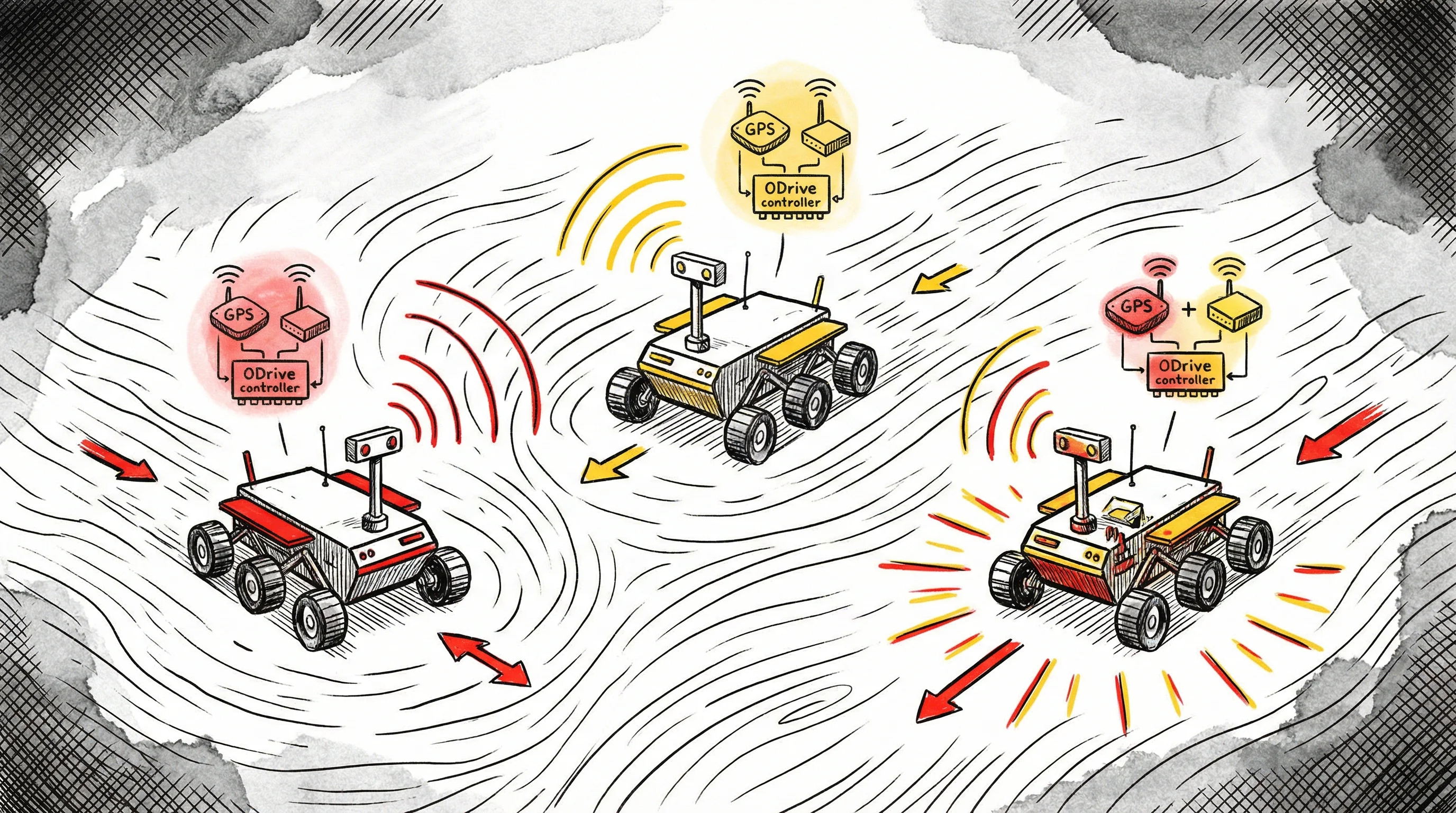
Sowbot enters a field that's small but no longer empty. Twisted Fields released documentation for their Acorn precision farming rover, which also uses ODrive controllers and dual-antenna RTK GPS. OpenMower demonstrated that a community audience exists for GPS-guided autonomy, even at the consumer level where the stakes involve lawn stripes rather than crop yields.
On the commercial side, the numbers get serious quickly. Zauberzeug's Field Friend reportedly sells for around €20,000—roughly $21,000—making it one of the more accessible options. Naïo Technologies' Orio tool carrier runs north of $300,000. The market has room for something cheaper, assuming it works.
The Hacker News discussion surfaced practical concerns that any engineer would recognize. Stacking ARM single-board computers in a sealed enclosure raises thermal questions. Will the system throttle under load? Can passive cooling handle peak processing demands in summer heat?
The Sowbot team responded that they favored openness over raw performance, noting that higher-end platforms like Jetson and Intel options are supported in software. They added that mainline Linux kernel support for the Avaota boards is "almost there" in version 6.20. Almost there. That qualifier matters when you're debugging hardware in a field two hours from the nearest computer repair shop.
What Openness Actually Means
Every aspect of Sowbot's design carries an open license. PCB Gerber files, firmware source code, mechanical drawings—all available. A Discord server and GitHub organization invite collaboration. The strategy echoes successful open hardware projects in other domains: RepRap 3D printers, Arduino, the ecosystem that grew around Raspberry Pi.
Agricultural robotics adds wrinkles. Field reliability matters more than it does for a hobby project. Regulatory compliance for autonomous machines operating outdoors isn't trivial. The gap between publishing designs and enabling true replication can be vast, especially when the knowledge required to source components, debug assembly issues, and tune control parameters remains tacit.
Will Sowbot attract meaningful community contributions? Open-source robotics projects often struggle here. Publishing schematics is the easy part. Building a machine that works reliably enough to trust with a crop—that's harder. The team hasn't published performance benchmarks yet. No data on YOLO inference frame rates on the Avaota hardware. No field test results showing navigation accuracy over extended runs.
Still. For agricultural technology entrepreneurs working on precision farming applications, Sowbot offers something rarer than a finished product: a reference design they can actually study, modify, build upon. The modular architecture permits selective adoption—use the navigation stack, swap in different manipulators. Or take the Open Core brain and mount it in an entirely different chassis.
That flexibility, backed by working code and detailed hardware specifications, might prove more valuable than any single product. The teams that can bridge the gap between documentation and deployment won't need Sowbot to work perfectly out of the box. They'll need it to work well enough to iterate on, which is a lower bar and perhaps an achievable one.
The dream of a farm robot that doesn't cost tractor money remains exactly that. But dreams require blueprints before they become products, and products require prototypes that someone, somewhere, can actually build. Sowbot won't revolutionize agriculture next season. The question is whether it might, eventually, give a few small-scale growers the tools to start.


