

Inside a metal capsule screaming through the atmosphere at Mach 25, shielded by materials engineered to withstand temperatures that would vaporize steel, sits a payload worth perhaps hundreds of thousands of dollars: protein crystals grown in the perfect stillness of orbit. The science is sound—microgravity really does produce larger, more uniform molecular structures. The capsule survives reentry. The crystals make it to the lab.
And then that multimillion-dollar heat shield, having done its job exactly once, gets tossed in a lanyard somewhere in the Utah desert.
This is what insiders call the downmass bottleneck, and it might be the most underappreciated constraint throttling the orbital manufacturing economy. Launch costs? Those have collapsed. You can get a payload to orbit on a rideshare mission for a few hundred thousand dollars now. But bringing manufactured goods home—reliably, repeatedly, economically—remains an unsolved logistics puzzle that's part physics, part regulation, and part stubborn economics.
Consider the math. Venture capital has channeled something in the neighborhood of $400 million into in-space manufacturing companies over the past few years, spread across a couple dozen funding rounds, per Tracxn's tracking. Yet the infrastructure to efficiently return products to market remains, well, incomplete. It's not that reentry is impossible—we've been doing it since the 1960s. It's that making it routine and affordable for commercial cargo has proven unexpectedly hard.
Beyond PowerPoint Presentations
The good news, perhaps the only unambiguous good news, is that in-space manufacturing has decisively graduated from the slideware stage.
Varda Space Industries marked a genuine milestone on February 21, 2024 when it completed the first commercial FAA Part 450-licensed reentry, landing its W-1 capsule at Utah Test and Training Range with crystals of the HIV drug ritonavir inside. Since then, the California company has notched four additional recoveries—all in Australia between March 2025 and May 2026, establishing what looks like an actual operational rhythm at Koonibba Test Range rather than a one-off publicity stunt.
Across the Atlantic, Space Forge reached its own proof point in December 2025, successfully generating plasma at 1,000 degrees Celsius aboard its ForgeStar-1 satellite. The UK-based startup called it a "world-first capability for orbital semiconductor manufacturing," which is the kind of claim that demands skepticism until independently verified, but the plasma generation itself appears legitimate. Meanwhile, Redwire continues running pharmaceutical crystallization experiments through its PIL-BOX program on the International Space Station, with about eleven active facilities as of late last year.
The business case, too, is starting to take shape—though "starting" is doing heavy lifting in that sentence. Market research firms project the in-space manufacturing services market could reach somewhere around $11.7 billion by 2035, according to Precedence Research's April 2026 modeling. The usual suspects dominate the forecasts: semiconductors, pharmaceuticals, exotic nanomaterials. A meta-analysis published in npj Microgravity in November 2024 found that semiconductor crystals grown in microgravity consistently show larger size, better uniformity, and structural improvements compared to terrestrial production. Consistently, though, doesn't mean dramatically or economically.
The Forces Converging (Maybe)
Three trends are colliding in ways that could—emphasis on could—move orbital manufacturing beyond ISS-tended experiments and into something resembling an industry.
First, launch costs have dropped enough that dedicated free-flying manufacturing satellites make at least theoretical economic sense. Second, regulatory frameworks for commercial reentry are actually maturing. The FAA's Part 450 licensing process and Australia's Space (Launches and Returns) Act 2018 have created navigable pathways for companies to bring hardware back without drowning in red tape. Third, the approaching retirement of the ISS around 2030 is forcing everyone to design for autonomous operations instead of human-tended facilities.
That last factor deserves more attention than it typically gets. Human-rated spacecraft impose staggering overhead: safety redundancies, life support, operational constraints that ripple through every design decision. Free-flying platforms eliminate those costs while potentially offering higher power budgets and better thermal management for industrial processes. It's the difference between building a laboratory and building a factory.
Dispatch Space, a San Francisco startup that emerged from stealth this spring, has explicitly built its architecture around that trade-off. "We want to have delivery trucks take things there and back," CEO Payton Case told Payload, describing a vision that deliberately cuts out human-rated infrastructure entirely.
Whether Dispatch executes on that vision is anyone's guess. But their existence speaks to a gap in the market.
Small Teams, Big Ambitions

Dispatch is targeting the middle ground between small demonstration capsules and the full-scale commercial stations envisioned under NASA's Commercial LEO Destinations program. The company's Phase 1 architecture centers on reentry vehicles that can operate either as independent free-flyers or as cargo ferries servicing larger platforms. The critical innovation, at least on paper: a replaceable heat shield that allows the spacecraft bus to fly multiple missions without complete refurbishment between flights.
The startup has raised $500,000 in initial funding—not much in aerospace terms—and aims to demonstrate a subscale reentry vehicle in 2027 carrying 30 kilograms of payload. By late 2029, Dispatch hopes to field a 100-kilowatt uncrewed industrial station capable of servicing 300-kilogram return vehicles. The team consists of just two founders: Case, formerly of Astranis and the Aerospace Corporation, and CTO Andrew Mello, who led avionics work at Astranis after stints at Zoox, Apple, and Amazon. Both are Y Combinator-backed and working from what is, by aerospace standards, an almost absurdly small engineering base.
It's the kind of plan that looks either visionary or delusional depending on what happens over the next 18 months.
But their timing does align with broader industry momentum, for what that's worth. Varda's multiple Australian landings in 2025 and 2026 demonstrate that commercial reentry operations can achieve reliable cadence outside U.S. territory. The Australian Space Agency has authorized Southern Launch and Varda for up to 20 returns through 2028—creating a regulatory and logistical foundation that didn't exist three years ago.
In Europe, the competitive landscape is diversifying in interesting ways. Atmos Space Cargo completed its Phoenix 1 orbital return demonstration in April 2025 using an inflatable decelerator, with Phoenix 2 targeting operational service sometime this year. The Exploration Company is developing its Nyx cargo capsule under ESA's LEO Cargo Return Service program. Even Sierra Space's Dream Chaser, trapped in development purgatory for what feels like a decade, is now targeting late 2026 for its first ISS resupply mission with runway landing capability. Believe it when you see it.
Each company is attacking the reentry problem with radically different thermal protection systems. Varda uses a carbon phenolic ablative material licensed from NASA—proven technology, but it burns away during reentry and must be replaced. Space Forge is developing "Pridwen," a non-ablative radiative shield designed to be captured mid-air by a net-equipped aircraft, which sounds like something from a Bond film but apparently has serious engineering behind it. Atmos employs an inflatable heat shield derived from NASA's successful LOFTID demonstration in 2022.
Different approaches, different risk profiles. Someone will eventually crack the economics.
The Market That Isn't (Yet)
Here's the inconvenient truth: The technical achievements are impressive, but they're not yet translating to commercial-scale production.
No FDA-approved therapy manufactured in space has reached the market as of mid-2026. None. ZBLAN optical fiber production on the ISS has demonstrated multi-kilometer draws, which is real progress, but rigorous performance validation against terrestrial benchmarks remains incomplete or unpublished. Space Forge's plasma milestone is a capability demonstration, not a manufacturing line. The gap between "we can do this" and "this is profitable at scale" remains stubbornly wide.
The infrastructure dependency is real and unresolved. NASA's Commercial LEO Destinations program is expected to award Phase 2 Space Act Agreements sometime soon, setting the timeline for post-ISS platforms. Private station operator Vast raised $500 million in March 2026 to develop Haven stations specifically for manufacturing and research—a serious capital commitment. But these facilities are multi-year programs with uncertain schedules and, frankly, uncertain demand curves.
Perhaps the most revealing trend is where capital is actually flowing. In 2025, Varda's $187 million Series C accounted for roughly 82 percent of all in-space manufacturing investment that year, according to Tracxn's data. This concentration suggests investors are backing execution and flight heritage rather than concepts or promises. Space Capital's quarterly reports have noted structural shifts toward orbital platforms as an investment theme, while Seraphim's Space Index highlights the growing share of capital directed toward the "in-space economy/manufacturing" category.
Follow the money, in other words. And the money is following companies that have actually flown hardware.
The Dragon in the Room
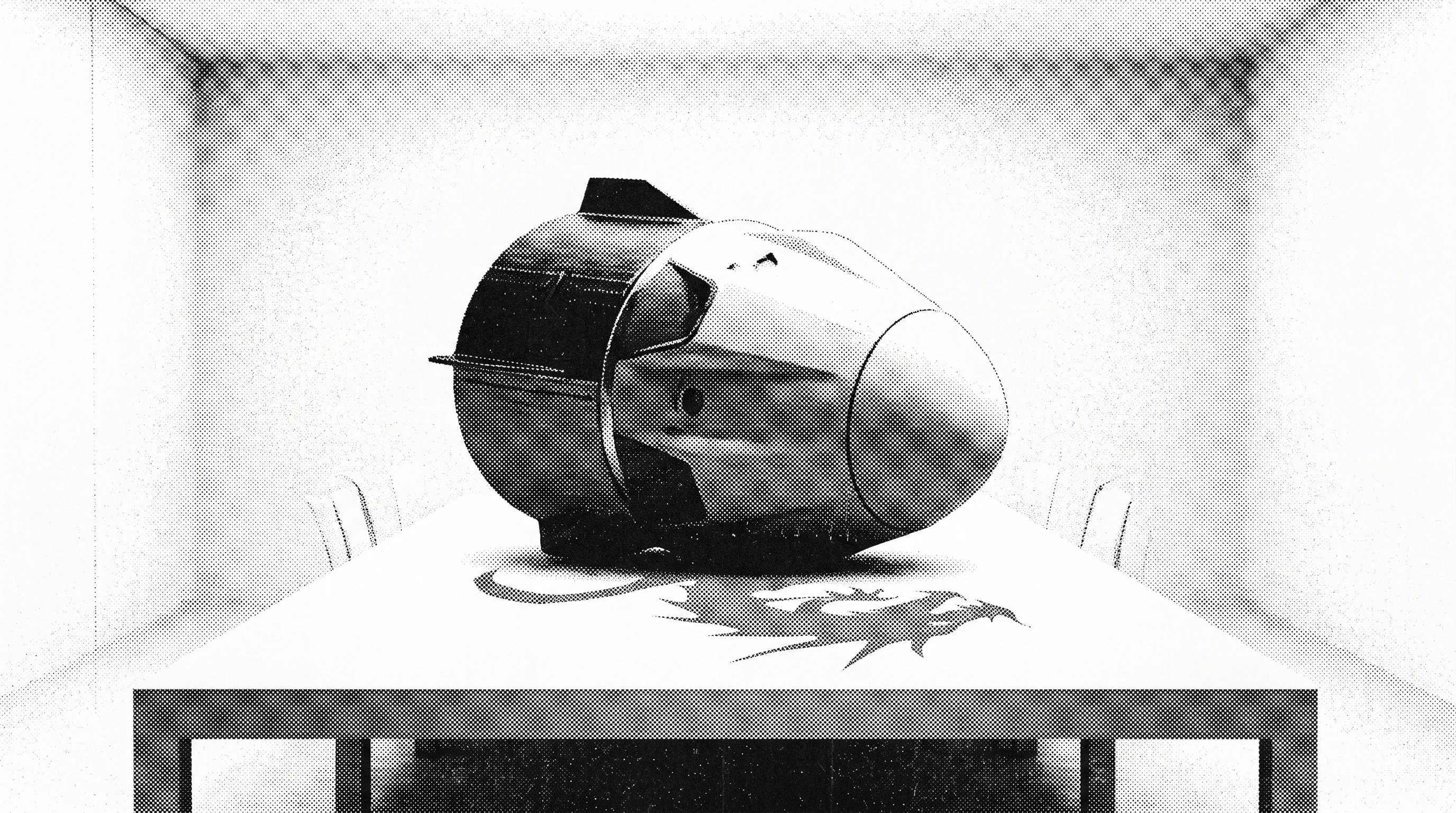
The question facing founders and investors—the one that doesn't get asked loudly enough in pitch meetings—is whether the downmass bottleneck represents a genuine market opportunity or simply a transitional constraint that existing players will solve through scale.
SpaceX's Cargo Dragon already returns roughly 3,000 kilograms of pressurized cargo per mission. The company flies multiple ISS resupply missions annually. Dream Chaser will add runway-landing capability if it ever flies. Do niche players like Dispatch have room to compete, or will established aerospace primes absorb this market as stations come online and flight rates increase?
The answer probably depends on cadence and specialization. High-value products like pharmaceutical formulations or semiconductor crystals don't need Dragon-scale capacity. They need frequent, reliable returns with validated chain-of-custody and minimal turnaround time between missions. A refurbishable capsule architecture optimized for 30 to 300 kilograms might serve that niche more cost-effectively than human-rated cargo vehicles designed to haul tons of equipment and supplies.
Or it might not. The economics remain opaque because the market barely exists yet.
Regulatory pathways, at least, are opening faster than manufacturing processes are maturing. FAA Part 450 reentry licensing is now a proven process with multiple operators. Australia has demonstrated that international cooperation on repeated commercial recoveries is workable. The technical risk is shifting from "can we bring things back safely" to "can we manufacture products in orbit that are economically superior to terrestrial alternatives."
That last question—the only one that really matters—remains unanswered.
But the pace of flight demonstrations over the past year or so suggests the industry is moving from PowerPoint to plasma, from concept studies to actual capsule recoveries dropping into the Australian outback. The missing link in the orbital manufacturing supply chain isn't missing anymore.
Whether it's profitable is the next question. And perhaps more importantly: profitable for whom?


