

Astronauts aboard the International Space Station spent a March afternoon prepping hardware for the station's seventh roll-out solar array—routine work, by ISS standards. But down in Pittsburgh, something less routine was taking shape: a two-person startup had just been admitted to Y Combinator's latest cohort, armed with SpaceX pedigree, Carnegie Mellon research roots, and a conviction that the market for truly massive deployable solar structures might, at last, be ready.
Beyond Reach Labs isn't the first outfit to promise football-field-scale power systems from compact launch volumes. Plenty have made that pitch. What's different now is the backdrop. Commercial space stations are moving from PowerPoint to metal bending. Lunar outposts need power architectures that work in environments where the sun barely sets but shadows run deep. And the long-debated vision of beaming gigawatts from orbit—once the domain of science fiction and government feasibility studies—has edged closer to hardware, if not quite to reality.
The timing, in other words, might actually matter.
When the Market Catches Up
By mid-2025, roughly 11,700 active satellites were circling Earth. Nearly 3,000 spacecraft launched in 2024 alone, according to tracking data. BryceTech's latest assessment pegged the average smallsat mass at a record 223 kilograms. That's not just more metal in orbit—it's more hunger for power. Legacy rigid panels, the workhorses of the satellite era, haven't kept pace.
Enter the roll-out array. Redwire Space has become the bellwether here, perhaps more than the company expected when it started augmenting the ISS aging power grid in 2021. Each iROSA (ISS Roll-Out Solar Array) wing uses a spring-driven mechanism—no motors, minimal fuss—to unfold in orbit and overlay the station's existing panels. Once the eighth wing is installed, the combined system should maintain roughly 95 kilowatts alongside the legacy hardware. Astronauts have been methodically bolting these things on through a series of spacewalks; the seventh array's mount was readied in mid-March.
But Redwire hasn't stopped at life extension for a 25-year-old orbital laboratory. Last July, the company completed deployment testing for ROSA wings bound for NASA's lunar Gateway, designed to deliver 60 kilowatts at the Power and Propulsion Element. Delivery to Maxar was expected by late 2025. Then Axiom Space—building what it hopes will become the first commercial successor to ISS—awarded Redwire a contract for ROSA wings on its initial Payload Power Thermal Module. That deal, announced last September, marked the first large-scale use of roll-out arrays outside NASA's direct oversight.
Three months ago, Redwire unveiled ELSA, a new product line targeting high-volume constellation operators and standardized satellite platforms. The pitch: stack 50 percent more frames in the same stowed volume, simplifying integration and enabling parallelized production. Within weeks, investor materials surfaced on Reddit claiming Redwire had secured a $12.8 million contract to deliver ELSA wings to Moog for an unspecified national security program. Pent-up demand, or savvy positioning? Likely both.
Rocket Lab's SolAero division has taken a different tack—vertical integration. By controlling the supply chain from solar cells (manufactured in Albuquerque) through assembled arrays, the company can tailor products quickly and respond to design changes mid-stream. Last April, SolAero introduced customizable STARRAY wings spanning 100 watts to over 2 kilowatts, using quadruple-junction cells in modular configurations. A few weeks earlier, Rocket Lab had locked in $23.9 million in CHIPS Act funding—plus state incentives—to double production capacity over roughly three years. Constellation-scale orders, the company hopes, are coming.
Northrop Grumman still fields its UltraFlex heritage on Cygnus resupply missions. Smaller players like MMA Design and EU-based Hemeria populate NASA's 2024 Small Spacecraft State-of-the-Art tables. Even Solestial, a startup working on radiation-self-annealing silicon cells, closed a $17 million Series A in May and signed a Space Act Agreement with NASA Glenn by year's end.
And then there's Beyond Reach Labs, the Pittsburgh newcomer. Co-founded by Mitchell Fogelson—a Carnegie Mellon PhD who spent years on metamaterials and deployable mechanisms—and Pele Collins, who led SpaceX's Dragon parachute systems team for seven years, the company spun out of research on high-expansion-ratio structures. A March 2024 paper delivered at the IEEE Aerospace Conference described prototypes achieving a 50-times expansion ratio using hierarchical pop-up extending trusses. The company's website positions its arrays for "orders-of-magnitude more energy per launch," targeting orbital data centers, commercial stations, and lunar vertical towers.
Advisors include Tom Cooley, former Chief Scientist of the Air Force Research Laboratory's Space Vehicles Directorate, and Zac Manchester, who runs MIT's Robotic Exploration Lab. Beyond Reach won $10,000 at Invent Penn State's Tech Tournament last spring and recently announced selection as a "preferred supplier" for EMF Space, a startup chasing space-based solar power—though that detail emerged only via a LinkedIn repost, with no contractual specifics disclosed. The company's Y Combinator Demo Day is set for late March.
Whether Beyond Reach can turn lab prototypes into flight-qualified hardware remains an open question. But Y Combinator's willingness to back a deployable-structures startup suggests that even early-stage venture sees an opening.
Three Forces Converging

First, commercial space stations are transitioning from concept to construction. Axiom is assembling modules. Vast has announced plans. NASA's Commercial Destinations program has vendors under contract. Each station needs kilowatts to tens of kilowatts of reliable power, and the ISS roll-out legacy provides a proven deployment model. Redwire's backlog at year-end 2025 stood at $411.2 million, according to investor materials accessed in early March.
Second, lunar infrastructure has graduated from speculation. NASA's Vertical Solar Array Technology (VSAT) program selected Astrobotic, Honeybee Robotics (now part of Blue Origin), and Lockheed Martin back in 2022 to develop tall, deployable arrays for continuous power at the lunar poles. Astrobotic's VSAT-XL studies, funded through SBIR awards in mid-2024, explored towers up to 34 meters tall. Lockheed Martin published an explainer last April outlining the engineering challenges: polar peaks see near-constant sunlight, but traditional horizontal arrays can't capture it efficiently. Vertical mast architectures solve that problem—assuming deployment mechanisms survive thermal cycles and dust. Prototypes from Astrobotic and Honeybee underwent thermal-vacuum testing at NASA's Johnson Space Center in summer 2024.
Beyond Reach's website explicitly references lunar vertical towers alongside orbital applications. The overlap isn't subtle.
Third, space-based solar power research is accelerating, though timelines remain stubbornly long. Caltech's SSPD-1 mission concluded in early 2024 after successfully testing wireless power transmission in space using the MAPLE experiment—a lightweight, flexible coherent microwave array. Results appeared in a 2024 Acta Astronautica paper. The European Space Agency's SOLARIS feasibility program, launched in 2022, was supposed to inform a decision by last year on whether to proceed with full development. As of this writing, no public go/no-go announcement has surfaced.
The UK's Space Solar completed a Phase 2 design study for its CASSIOPeiA satellite concept last April, funded by the UK Space Agency and the Department for Energy Security and Net Zero. Japan's NTT and Mitsubishi Heavy Industries demonstrated 1-kilometer laser-based wireless power transmission at 15 percent efficiency under atmospheric turbulence last September—optical, not microwave, but a signal that multiple approaches are under serious development. China outlined a concept for a 1-kilowatt laser transmission demonstrator targeting a window later this decade, per a mid-2025 report in pv magazine International.
If space-based solar power ever moves from R&D to demonstration scale, it will demand arrays orders of magnitude larger than anything currently in orbit. That's where companies like Beyond Reach—and perhaps Redwire's next-generation products—might find traction. Might.
Proof Points and Prototypes
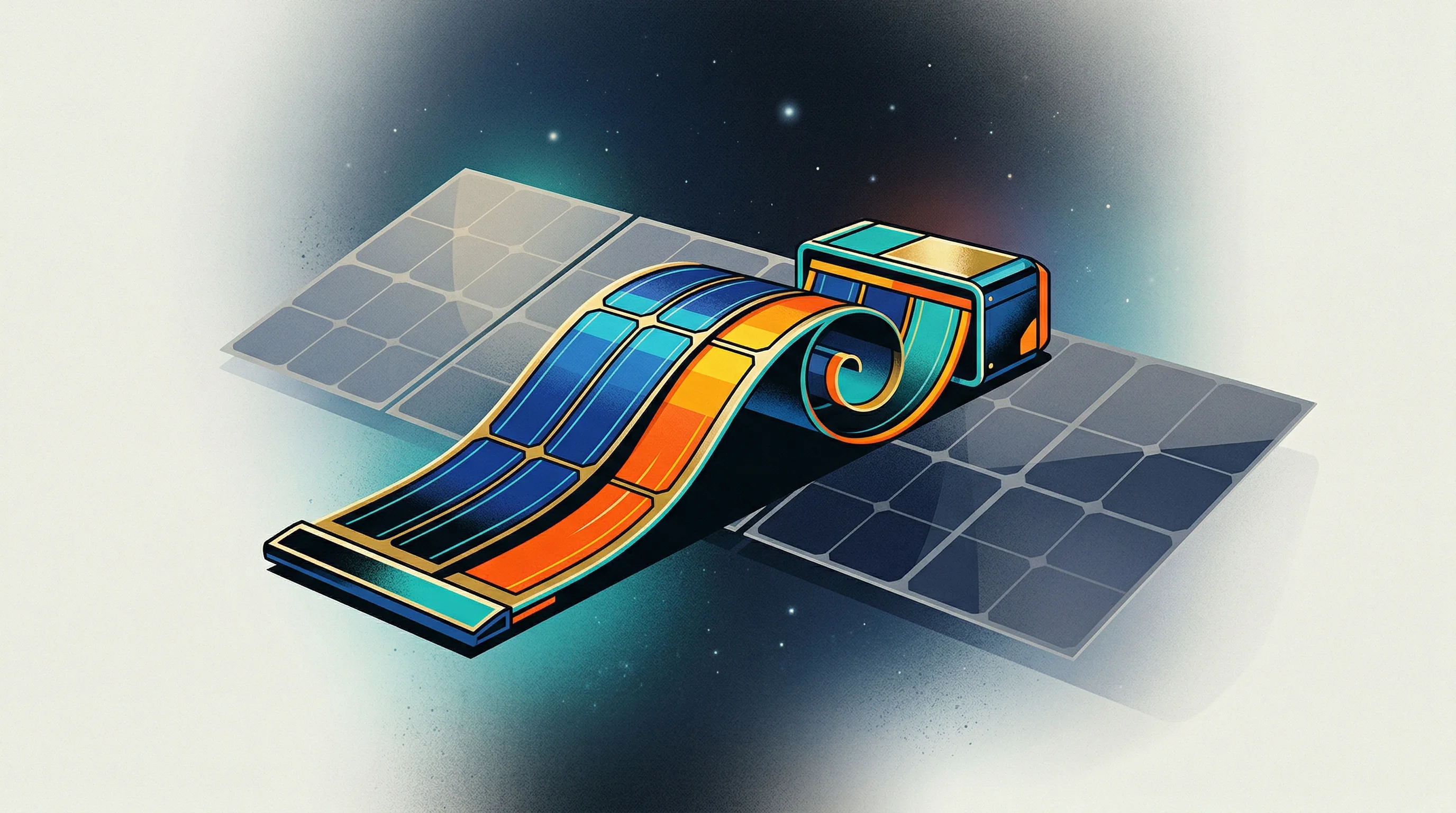
Redwire's trajectory illustrates how quickly the market has matured. The company delivered its fourth pair of iROSA wings to NASA in January of last year. By this March, astronauts were prepping the mount for the seventh. Each wing augments legacy panels without replacing them, a design choice that minimized risk and cost during the ISS final operational decade.
But the real shift came with Gateway and Axiom. Gateway's Power and Propulsion Element requires 60 kilowatts in cislunar space—an environment with different thermal and radiation profiles than low Earth orbit. Redwire's ROSA wings for PPE completed deployment testing last July; the company claimed they were "the most powerful roll-out solar arrays ever built." Axiom's commercial station contract, announced last September, validated that roll-out architectures are now the baseline for new crewed infrastructure, not a specialized ISS workaround.
Then came ELSA. Unveiled three months back, the product targets a different segment: high-volume LEO constellations and GEO satellites where standardization and rapid integration matter more than bespoke optimization. The claim of 50 percent more frames per stowed volume suggests Redwire is chasing the same efficiency gains that made iROSA viable in the first place—more power per kilogram of launch mass. The reported $12.8 million Moog contract, surfacing just weeks after ELSA's unveiling, hints at demand that had been quietly building.
Rocket Lab's approach relies on vertical integration. By controlling the supply chain from solar cells through assembled arrays, the company can tailor products to specific mission profiles and respond faster to design changes. The CHIPS Act funding announced in mid-2024 aimed to double cell production capacity within roughly three years, positioning Rocket Lab to meet constellation-scale orders. The STARRAY product line, introduced last April, offers configurations from 100 watts to more than 2 kilowatts using quadruple-junction cells—essentially off-the-shelf wings for small-to-medium satellites.
Beyond Reach Labs, by contrast, is betting on a technology leap rather than incremental refinement. The company's hierarchical high-expansion-ratio deployable structures promise 50-times or greater expansion from stowed to deployed state, according to that March 2024 IEEE paper. Traditional mechanisms face structural dynamics constraints at very large scales: the longer the deployed boom or blanket, the lower the first-mode frequency, which complicates attitude control and pointing stability. Beyond Reach's website includes an interactive first-bending-mode simulator, underscoring the engineering challenge. If the company can deliver structures with better stiffness-to-mass ratios at football-field scales, applications in orbital data centers, space-based solar power transmitters, and lunar towers might become feasible.
The EMF Space selection suggests at least one early customer believes in the approach. But without independent test data or hardware flown in space, Beyond Reach remains unproven. Y Combinator provides capital and network, not validation. The real test will be whether the company can move from 50-times lab prototypes to hardware qualified for launch environments—and whether the market for truly massive arrays materializes before the capital runs out.
What Comes Next

The near-term outlook is incremental expansion. Axiom's Payload Power Thermal Module will fly with Redwire arrays. Gateway's PPE wings are likely already delivered or close to it, given Redwire's late-2025 target. ELSA's first national security contract, if confirmed, could open a pipeline to other classified payloads. Rocket Lab's Albuquerque expansion will come online by 2027 or 2028, enabling higher-volume production just as constellation operators refresh first-generation spacecraft.
Lunar vertical arrays face a longer development arc. NASA's VSAT program has funded prototypes through thermal-vacuum testing, but flight demonstrations haven't been announced. Astrobotic's VSAT-XL work, supported by SBIR Phase II awards in 2024, is likely still at the breadth-boarding stage. Lockheed Martin's explainer last April emphasized the engineering unknowns: deployment reliability in lunar dust, structural dynamics under low gravity, power routing for very tall masts. None of these are showstoppers, but they require iterative testing. Late 2020s, realistically.
Space-based solar power remains stubbornly difficult. Caltech proved that wireless power transfer works in space, but at lab scales. ESA's SOLARIS decision—if it ever comes—will hinge on cost models that assume dramatic reductions in launch prices and in-space assembly costs. The UK's Space Solar and Japan's NTT/MHI experiments are encouraging, but neither has announced a path to gigawatt-scale infrastructure. China's demonstrator timeline is ambitious; whether it materializes will depend on policy priorities that shift year to year.
What founders and investors should watch: First, whether Redwire or a competitor announces a commercial station contract outside Axiom, signaling that the business case for deployable arrays has widened beyond NASA-adjacent customers. Second, whether Beyond Reach or another startup demonstrates a qualification-ready prototype with expansion ratios meaningfully beyond what Redwire and Rocket Lab offer. If hierarchical mechanisms work as advertised, incumbents will adapt quickly. Third, whether any government commits serious capital to space-based solar power beyond feasibility studies. ESA, the UK, Japan, and China have all funded design work. The first to move into hardware development will set the pace.
The inflection point isn't about any single technology. It's about the confluence of commercial stations, lunar infrastructure, and SBSP R&D creating sustained demand for larger, lighter, more reliable arrays. Roll-out blankets proved themselves on ISS. Modular products like ELSA are addressing constellation-scale markets. Vertical lunar towers are in active development.
Whether Beyond Reach captures that opportunity or becomes a footnote depends on execution. But the market—finally—is no longer hypothetical. Perhaps that's the story.


