

SuperLight Photonics has a name problem. So does the investor community trying to track European deep-tech deals.
The Dutch laser technology company—a University of Twente spin-out tucked away in Enschede—recently emerged from bankruptcy restructuring with new investors and a revamped product line. But around the same time, a similarly named startup focused on electric delivery trucks announced it had closed a $21 million Series A. The confusion? Both companies share nearly identical names, and neither has been particularly forthcoming about where their money comes from.
For SuperLight Photonics, the funding picture remains decidedly murky. The company's investor page lists a seed round with DeepTechXL and Oost NL, alongside a strategic investment from Hamamatsu Ventures. Neither disclosed dollar amounts, which is common enough in early-stage European deals. What hasn't been announced publicly is any Series A round—despite the noise generated by the EV company's recent fundraise.
Starting Over, Without the Founder
What the photonics firm has confirmed is something arguably more significant: a full restart following financial collapse. Industry publication Bits&Chips reported last fall that SuperLight had "attracted new investors" after restructuring, though the outlet didn't name names or cite figures. Perhaps more striking is who isn't part of the reboot—Dr. Haider Zia, the founder whose University of Twente research on on-chip supercontinuum generation provided the company's technical DNA.
In Zia's place stands Cees Links, a Netherlands tech veteran whose previous company, GreenPeak Technologies, developed Wi-Fi chips before being acquired by Qorvo in 2016. Links has been rebuilding the executive suite over the past two years, bringing in CFO Paul de Wit and CMO Elly Schietse among others. It's a familiar playbook: swap out the academic founder for commercial leadership when things need stabilizing.
The question, naturally, is what those undisclosed investors saw in a recently bankrupt photonics company with a crowded competitive landscape ahead of it.
Lasers That Fit in Your Hand
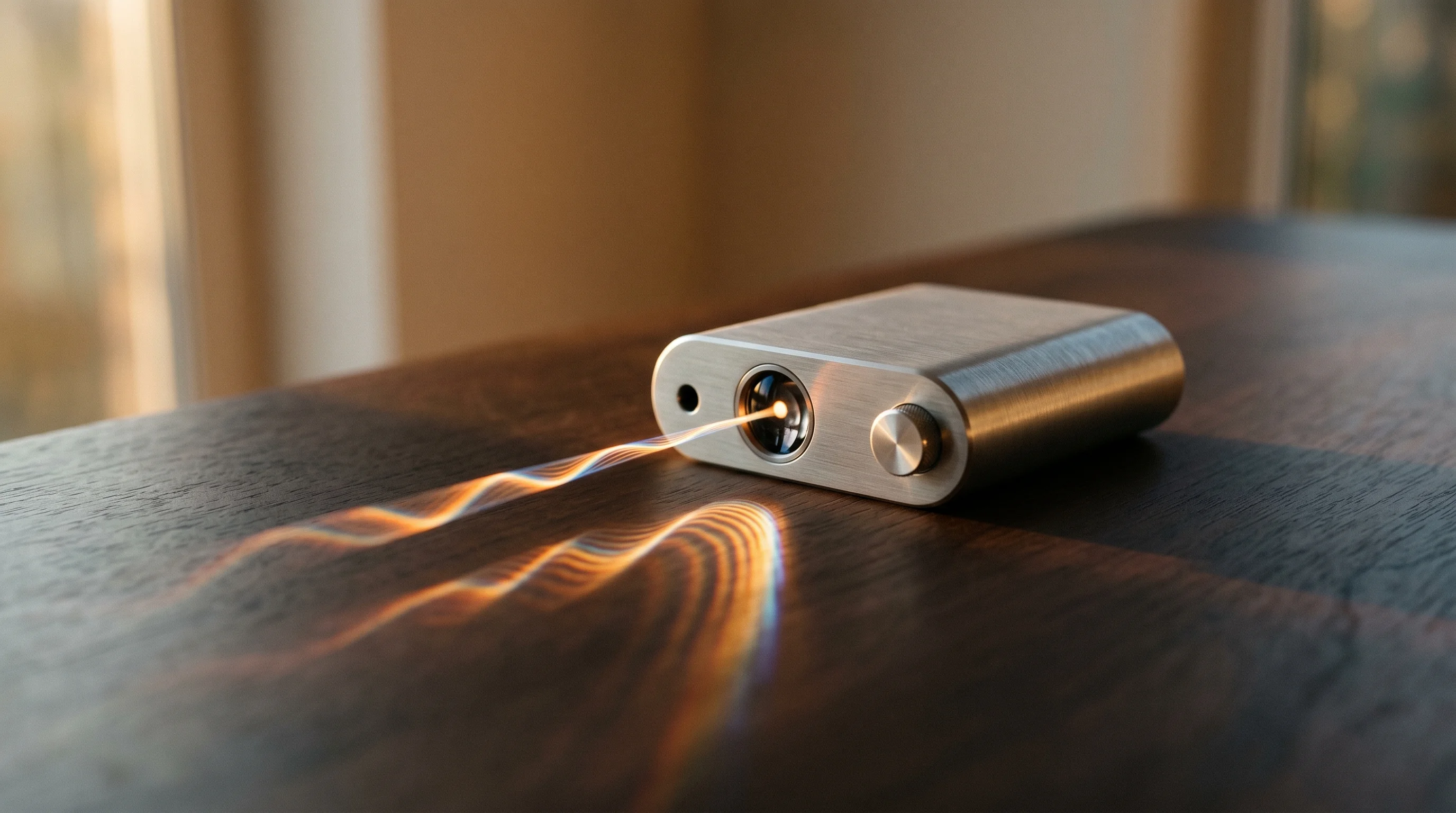
SuperLight Photonics builds something genuinely compact—portable supercontinuum laser sources using photonic integrated circuits. The underlying technology relies on what the company calls Patterned Alternating Dispersion, a mechanism that alternates between normal and anomalous dispersion along integrated waveguides. The result: spectral broadening at lower power levels than the bulkier fiber-based systems that have dominated the market.
The product lineup now includes four commercial offerings. There's the SLP-1000, marketed as the first battery-powered portable wideband laser for short-wave infrared applications. The SLP-1050 variant pushes amplified supercontinuum output above 40 milliwatts. A model targeting optical coherence tomography and biomedical uses delivers full-spectrum SWIR output between 950 and 1,350 nanometers. And the SLP-0280 compresses nonlinear pulses down to 25 femtoseconds using chip-based technology.
Applications run from OCT imaging and spectroscopy to environmental monitoring—crop health assessment, pollution detection, that sort of thing. The company positions its lasers as more compact and portable alternatives to traditional fiber-based systems, though direct technical comparisons with competitors like NKT Photonics, Thorlabs, or Leukos remain largely unquantified in public materials.
Whether that's enough to carve out sustainable market share is another matter entirely.
Distribution Deals and Strategic Silence

SuperLight has assembled a distributor network spanning Benelux and Western Europe through Laser 2000, Japan via KLV, Southeast Asia with Precision Technologies, Spain and Portugal, and the US market. Earlier this year, the company announced a packaging collaboration with PhotonFirst, another Dutch photonics player. LinkedIn suggests a headcount somewhere between 11 and 50 employees—a range that could mean almost anything.
The advisory board includes David Castrillo from Hamamatsu Ventures, Professor Martijn Heck from TU Eindhoven, and Pieter Kramer from Laser 2000 Benelux. Solid names, though advisory boards don't pay the bills.
And therein lies the puzzle for anyone trying to understand SuperLight's trajectory. The company has shipped multiple products, established distribution channels across three continents, and attracted reinvestment after financial restructuring. All while keeping its cap table entirely opaque.
The Superlight That Isn't
Meanwhile, that other Superlight—the one building purpose-built electric trucks for middle-mile logistics—announced its own funding milestone recently. The EV startup has zero connection to the laser company beyond unfortunate naming overlap. But in an already niche corner of technology news, the similar names have created genuine confusion about which company raised what.
It's an almost comical wrinkle in what is otherwise a fairly serious story about European deep-tech resilience.
What Comes Next

The Dutch government has continued expanding support for deep-tech ventures, with the Deep Tech Fund reaching €610 million in recent policy moves. European investors, spooked by years of underwhelming returns in consumer tech, have been rotating toward harder science bets—photonics, quantum, advanced materials.
SuperLight Photonics sits squarely in that sweet spot. Post-bankruptcy, commercially oriented, shipping actual hardware. The kind of company that could theoretically attract patient capital willing to fund the long slog toward profitability in industrial markets.
Whether that's actually happening behind closed doors remains anyone's guess. For now, SuperLight keeps manufacturing lasers while its backers—whoever they are—stay carefully out of sight. Maybe that's strategic discretion. Or maybe it's a company still figuring out how to tell its story without reminding everyone it recently went broke.
Either way, in a sector where funding announcements typically generate breathless press releases and carefully staged photo ops, SuperLight Photonics has chosen a different path: ship products, say little, and let the work speak for itself. It's refreshingly old-fashioned. It's also increasingly rare.


