

Payton Case still remembers the moment the math clicked. Sitting in the Office of the CTO at Astranis, working on thermal systems for satellites that would never come home, she realized the real bottleneck in space manufacturing wasn't the making—it was the returning.
"Everyone's obsessed with what you can grow in microgravity," Case says now, as CEO of Dispatch, a San Francisco startup building reentry capsules for cargo. "But if you can't get it back to Earth quickly, repeatedly, and intact, you don't have a business. You have a very expensive lab experiment."
That unglamorous logistics problem—how to shuttle high-value materials from orbit to the lab bench without incinerating them—has become suddenly urgent. The International Space Station, after decades proving that microgravity can work wonders on crystals, proteins, and alloys, is hurtling toward a retirement date no earlier than 2030. NASA handed SpaceX an $843 million contract in June 2024 to build the vehicle that will bring it down. Commercial replacements like Starlab are advancing, but there's a gap. And in that gap, a market opportunity has materialized.
Research firm Precedence Research projects the in-space manufacturing sector will balloon from roughly $3.6 billion in 2025 to nearly $11.7 billion by 2035. A wave of startups is racing to claim a piece of it, building autonomous reentry capsules purpose-built not for astronauts but for payloads—semiconductors, pharmaceuticals, bioengineered tissues—that might actually turn a profit.
Whether they succeed depends less on the science (which largely works) than on whether entrepreneurs can make orbital logistics boring enough that a pharmaceutical executive treats space as just another manufacturing site.
What Microgravity Can Do (When It Works)
The ISS has served, somewhat improbably, as a proving ground for commercial manufacturing. Merck flew experiments in 2017 that crystallized Keytruda—pembrolizumab, the blockbuster cancer immunotherapy—producing more uniform protein structures that informed a refined injectable formulation back on Earth. Redwire's BioFabrication Facility 3D-printed the first human knee meniscus in space in 2023, then the first live cardiac tissue sample the following May. NASA's optical fiber program demonstrated multi-mile draws of ZBLAN fiber with lower signal loss than silica, the terrestrial standard.
A meta-analysis published in npj Microgravity this past April synthesized evidence that semiconductor crystals grown in microgravity often show improved size, uniformity, and performance. The physics are straightforward: eliminate gravity, and you eliminate buoyancy-driven convection that causes defects in high-value materials like silicon carbide and gallium arsenide.
But—and this is the catch—the ISS was never designed as a factory. Its downmass capacity, the amount of mass you can return to Earth, is constrained by whichever cargo vehicle happens to be docked. SpaceX's Dragon can bring back some payload; Russia's Progress burns up on reentry. There's no on-demand return service, no predictable cadence. If you want to run experiments, sure. If you want to run a business? That's trickier.
Three Forces Converging
Three things have changed in the past couple of years, making autonomous reentry capsules suddenly viable.
First: regulatory maturation. The FAA's Part 450 rules consolidated launch and reentry into a single vehicle operator license, allowing companies to plan multi-mission operations rather than seeking approval every time. Varda Space Industries, the most visible player in the field, secured the FAA's first-ever Part 450 reentry vehicle operator license in June 2025—authorization that runs through 2029, representing a shift, however incremental, from one-off experimental approvals to something approaching operational routine.
Australia has opened Koonibba Test Range in South Australia to multiple reentries; three Varda capsules landed there between December and late January. (The third, W-5, touched down on January 30 using an ablative heat shield called C-PICA.) Regulatory pathways are still constrained—environmental assessments take time, weather windows are narrow, range scheduling is complicated—but the infrastructure is starting to exist.
Second: launch costs have dropped enough that rideshare slots make experimental missions affordable. Space Forge, a UK startup, hitched a ride on a SpaceX Transporter mission last June for its ForgeStar-1 satellite. By mid-January, the company reported lighting its onboard micro-furnace for the first time—plasma generation, a precursor to processing semiconductor materials in orbit. The mission is still underway; timelines for return and material characterization remain undisclosed.
Third: proof-of-concept missions are demonstrating both scientific and economic validity, or at least the beginnings of it. Investment is accelerating. A Tracxn report published in April 2026 pegged all-time equity funding for in-space manufacturing at roughly $397 million across 22 rounds, with 2025 alone accounting for about $227 million. Varda's $187 million Series C, announced last July, was the big headline.
NASA's In-Space Production Applications portfolio had invested at least $60 million as of spring 2023 to transition decades of ISS research toward sustainable, scalable production. The broader space economy, according to a McKinsey report from spring 2024, might reach $1.8 trillion by 2035. In-space manufacturing is positioned as a high-margin wedge within that. Maybe.
Varda's Bet: Make It Boring
Varda is the startup everyone's watching. The company flew its first W-series capsule in 2024, crystallizing the antiretroviral drug ritonavir in orbit and returning it to Utah after a protracted wait for FAA reentry approval (granted in February 2024). A ChemRxiv preprint documented stability of the material processed in orbit—peer review is ongoing, as these things go.
Since then, Varda has flown multiple W-series missions. The fourth, W-4, launched in late June 2025 and debuted the company's in-house satellite bus alongside that inaugural Part 450 operator license. CEO Will Bruey told TechCrunch last November that Varda's goal is to "make it boring"—to operationalize space manufacturing with the kind of cadence that turns scientific curiosity into industrial routine.
The $187 million Series C brings Varda's total raise to $329 million. Delian Asparouhov, a partner at Founders Fund and Varda investor, has repeatedly emphasized that the business model hinges on cost-competitiveness, not just technical feasibility. For pharmaceuticals, that means proving microgravity-crystallized proteins deliver clinical or manufacturing advantages worth the expense of orbital processing and return. For semiconductors, it means producing crystals that outperform terrestrial alternatives at a price point that makes sense. That's the hard part.
Dispatch's Refurbishable Vision
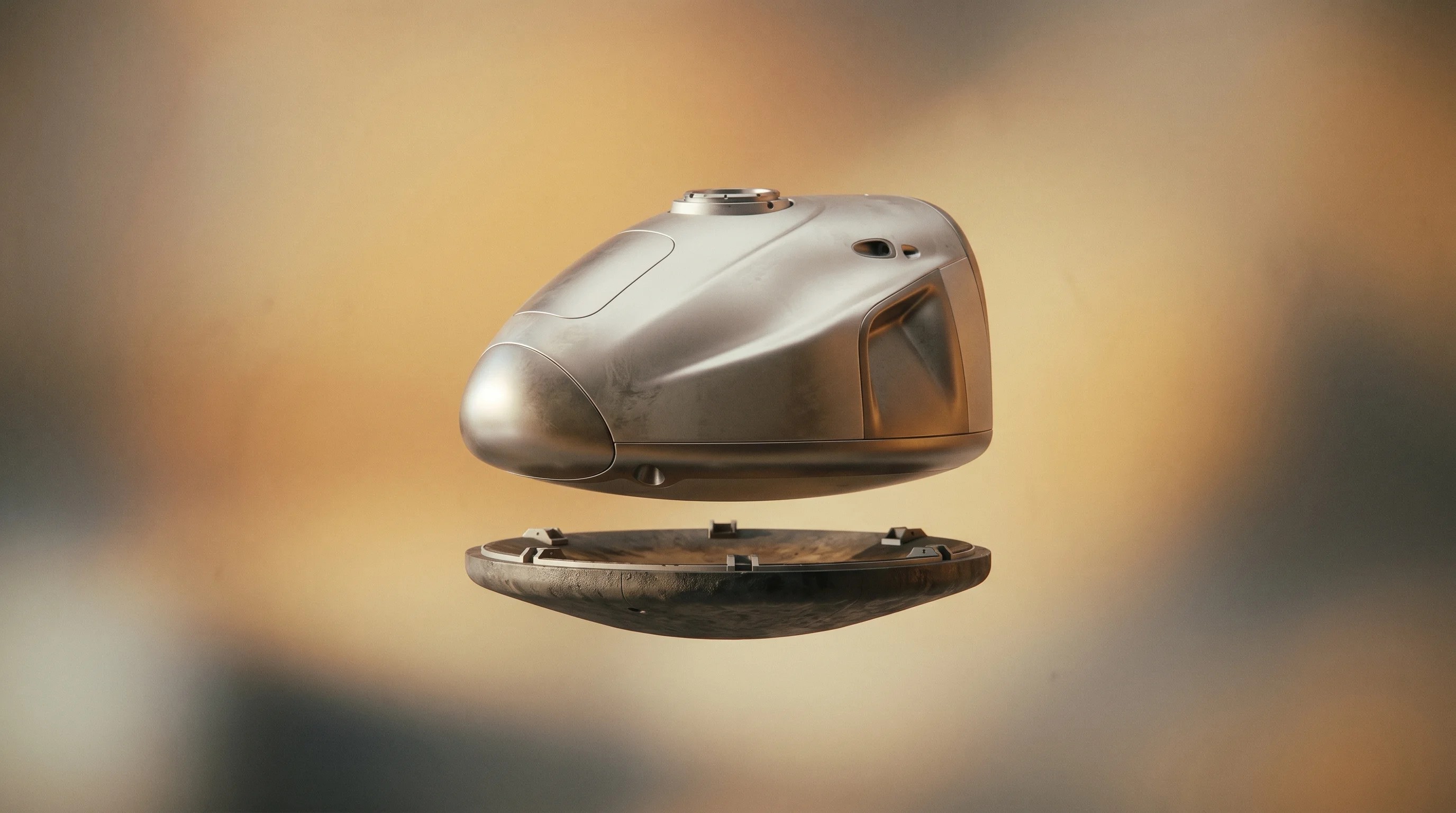
Dispatch, a YC-backed startup founded in 2025 by Case and CTO Andrew Mello (formerly of Astranis, Zoox, Apple, and Amazon), is positioning itself as a logistics company for the in-space manufacturing era. The pitch: refurbishable, autonomous reentry vehicles with swappable heat shields, aiming for airline-like cadence. Mid-2027 is the target for the first flight.
The company's public specs for its Free Flyer 1—published in a Payload User's Guide—outline a payload envelope up to 50 by 30 by 60 centimeters, mass up to 30 kilograms, up to 180 days on-orbit, continuous payload power of 100 watts, and recovery within six hours of landing. Peak reentry deceleration is listed at roughly 7 g, with payload interface temperature during reentry at or below 40°C for about 15 minutes.
The business model hinges on driving down per-kilogram return costs by swapping heat shields and reflying vehicles, much like SpaceX did with Falcon 9 boosters. Dispatch's longer-term vision includes 25-kilowatt uncrewed "lights-out" space stations operating as a shared utility grid for industrial manufacturing—essentially, orbital industrial parks without the astronauts.
Case and Mello are building heat shields in-house, claiming they're considerably cheaper than traditional ablative designs—though independent verification of these cost claims is pending. The company has conducted rocket-exhaust heat-shield tests in Mojave. Whether the cost claims hold up under operational conditions remains to be seen, but the ambition is clear: treat space return as a commodity logistics problem, not a bespoke engineering challenge.
Dispatch's applications page namechecks the usual suspects—Merck's Keytruda crystallization, semiconductor defect reduction, Redwire's bioprinted meniscus and cardiac tissue. The subtext: we're not doing the science, we're providing the FedEx.
The Crowded Field
Varda and Dispatch aren't alone. Outpost secured a $33.2 million AFWERX STRATFI award in August 2024 to develop a precision reentry vehicle with a scalable heat shield and paraglider, targeting a late-2026 first launch. Inversion Space is developing Ray and Arc capsules marketed as autonomous, reusable, and low-cost—details remain sparse, but the company's been vocal about aiming for commercial cadence.
The Exploration Company, a European outfit, raised approximately €160 million in a Series B last November. Its Nyx cargo capsule received Phase 1 ISS safety approval in August 2025 and is targeting regular ISS cargo runs by 2028—assuming the ISS is still operational. Lux Aeterna raised $10 million this past March to develop fully reusable satellites with return capability.
Heat-shield architectures are diversifying alongside vehicle designs. Varda uses ablative shields that burn away on reentry. Space Forge and Stoke Space are pursuing radiative, reusable metallic or alloy shields. NASA's LOFTID mission in late 2022 demonstrated a large-diameter inflatable decelerator—a potentially lower-g reentry option that could matter for delicate biological payloads.
Everyone's chasing the same prize, but the technical approaches vary enough that it's not yet clear which architecture will win. Or whether the market is large enough for multiple winners.
The Scientific Validation Problem
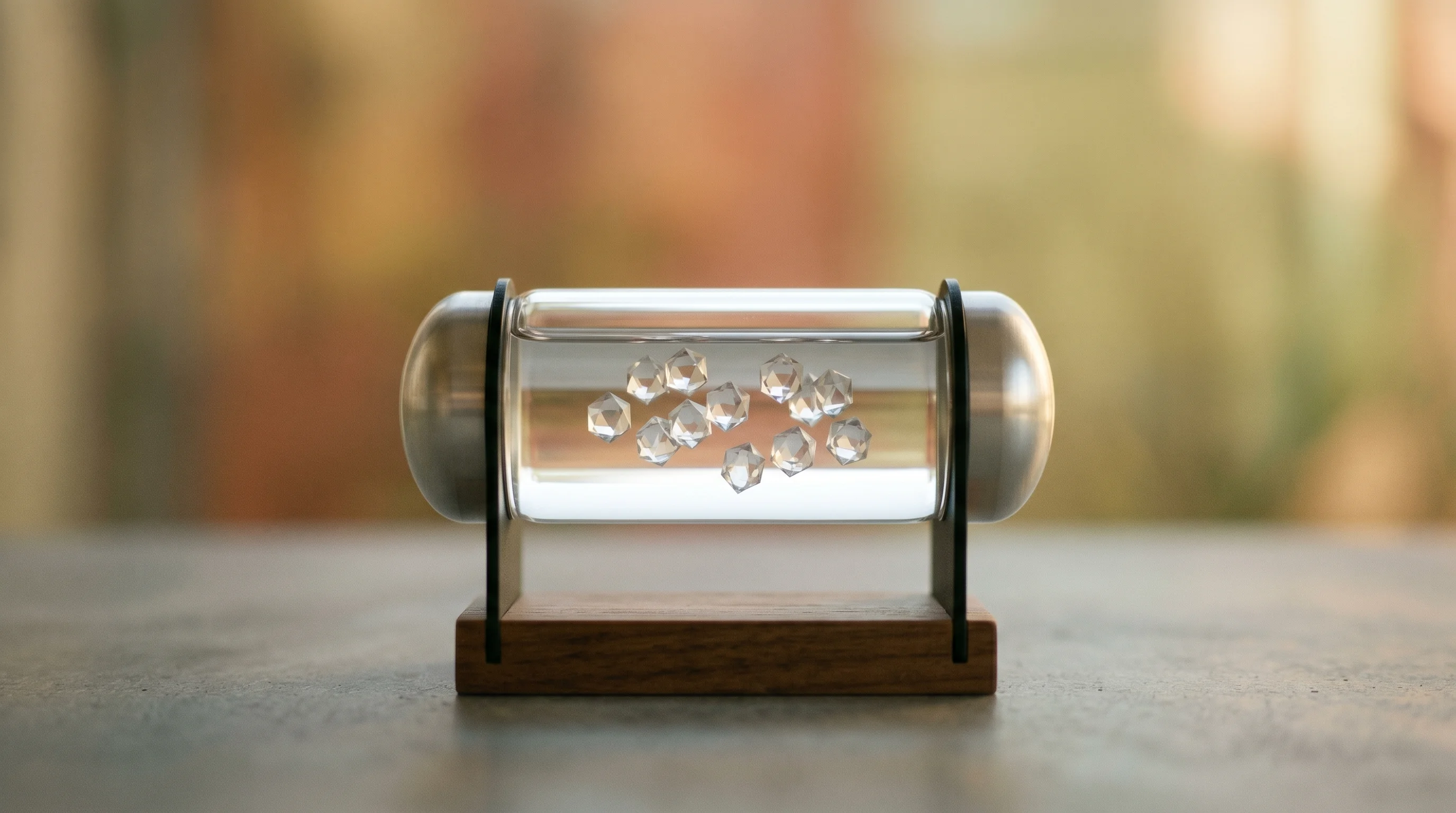
Redwire announced on February 25 that it had returned a fourth batch of pharmaceutical crystals via its PIL-BOX system, including a study for Bristol Myers Squibb. The company launched a venture called SpaceMD last August, structuring royalty agreements around space-grown seed crystals—an attempt to financialize the research before therapies reach market.
Space Forge's semiconductor furnace is still being commissioned. Until peer-reviewed results tie microgravity processing directly to approved therapies or marketable semiconductor wafers, a degree of skepticism is warranted. Investors and customers want to see not just improved crystalline structures but actual commercial products that justify the orbital detour.
The pharmaceutical industry is notoriously conservative. Convincing a biotech executive to route a drug candidate through orbit—even if the crystallization is superior—requires not just scientific proof but regulatory clarity, supply chain reliability, and cost predictability. None of those exist yet, not really.
Infrastructure Beyond Reentry
Infrastructure investments are multiplying beyond reentry vehicles themselves. Axiom Space announced a partnership with Spacebilt in October to deploy an orbital data center node on the ISS—a signal that compute and power infrastructure may co-locate with manufacturing payloads. Starlab's design review milestone in February suggests commercial stations are progressing, but the gap between ISS retirement and full operational capability creates both risk and opportunity.
Purpose-built free-flyers like Dispatch's planned vehicles or Varda's W-series may fill that gap, offering dedicated manufacturing environments without the constraints of shared crewed infrastructure. There's a logic to that—astronauts are expensive, and most manufacturing processes don't need them. But it also means building an entirely new ecosystem: power, thermal management, communications, command and control. Not trivial.
NASA's InSPA portfolio has been funding research toward this transition for years, focusing on optical fiber, pharmaceuticals, and tissue engineering. The agency is trying to shepherd decades of ISS research toward sustainable, scalable production for Earth markets—essentially, to avoid the perception that the station was just a science project with no commercial legacy.
Unit Economics Will Decide

Varda's investors have been blunt: in-space manufacturing must prove not just technical feasibility but cost-competitiveness. For pharmaceuticals, that means demonstrating that microgravity-crystallized proteins deliver clinical or manufacturing advantages worth the expense. For semiconductors, it means producing crystals that outperform terrestrial alternatives at a price that makes economic sense. For optical fibers like ZBLAN, it means scaling production beyond ISS demonstration runs to multi-kilometer commercial volumes.
Dispatch's mid-2027 launch target places it in a cohort racing to operationalize before the ISS transition fully unfolds. The company's emphasis on refurbishability and rapid turnaround—swapping heat shields and reflying within weeks—echoes the logic that made SpaceX's Falcon 9 economically transformative. If Dispatch and its peers can achieve airline-like cadence for cargo return, they'll unlock a manufacturing ecosystem that has lingered on the edge of feasibility for decades.
But "airline-like cadence" is easier said than done. Weather delays, range availability, payload integration timelines, and regulatory approvals all conspire against predictability. SpaceX took years to make booster reuse routine. Reentry capsule reuse may prove even harder—heat shields degrade, avionics need refurbishment, and the consequences of failure are high. One incinerated payload could set the industry back years, reputationally if not technically.
The next 24 months will clarify whether in-space manufacturing can transition from scientific proof-of-concept to sustainable industrial cadence, or whether it remains a niche capability reserved for ultra-high-value applications. Several trends bear watching.
Regulatory pathways are maturing but remain geographically constrained. Reentry approvals require environmental assessments; the FAA published a final assessment for Varda reentries at Utah Test and Training Range in early 2024. Australia's Koonibba range has emerged as an alternate corridor, but weather windows, range scheduling, and international coordination still limit operational flexibility. As more companies file for Part 450 operator licenses, the FAA's ability to process applications quickly will matter—bureaucratic bottlenecks could strangle the industry before it really starts.
Scientific validation is advancing but commercial translation remains early-stage. Until Merck or Bristol Myers Squibb or another major pharmaceutical company announces a drug candidate formulated using space-grown seed crystals and moving toward approval, skepticism will linger. Until a semiconductor fab produces wafers from microgravity-grown boules and ships them to customers, the technology remains speculative.
The question isn't whether microgravity can produce superior materials. Decades of ISS research have answered that, more or less. The question is whether entrepreneurs can build the logistics backbone to make orbital production boring, predictable, and profitable enough that biotech executives, semiconductor fabs, and pharmaceutical companies treat space as just another facility in the supply chain.
Case, for her part, is betting they can. Dispatch's vision of lights-out space stations and swappable heat shields is either prescient or hubristic, depending on whether the unit economics work. The company has conducted heat-shield tests in Mojave. It has published payload specs. It has a mid-2027 target.
What it doesn't have yet—what none of these companies have—is proof that the market will actually materialize at scale. That will require not just successful reentries but successful businesses on the other end: customers who come back, payloads that generate revenue, processes that pencil out.
The ISS proved microgravity manufacturing was possible. The next chapter will determine whether it was also worth it.


