

The pronunciation alone trips people up. Vision-language-action models. VLAs, for short. Yet a Beijing startup barely past its second birthday just staked its entire future—and $300 million in fresh capital—on the technology.
Galbot closed that funding round last month, vaulting its valuation to $3 billion. It's the kind of number that makes sense only if you believe we're witnessing something fundamental shift in how machines interact with the physical world. Goldman Sachs apparently does. The investment bank recently revised its forecast for the humanoid robotics market to $38 billion by 2035, up from a prior estimate of just $6 billion. That's not a tweak. That's a wholesale recalibration based on one stubborn fact: robots are finally starting to learn.
Or more precisely, they're learning to bridge the gap between seeing something and knowing what to do about it. That capability—connecting visual perception with language understanding and physical action—is what VLA models promise to unlock. And the race to master it is playing out across two continents, with stakes that extend well beyond factory floors and warehouse aisles.
The question facing the industry isn't whether robots will reshape retail, logistics, and manufacturing. Most everyone accepts that as inevitable. The real question is who builds the intelligence layer that makes it all work, and whether that advantage belongs to companies in Mountain View or Shenzhen.
Where Things Stand
Start with the basics. The robotics industry installed 542,000 industrial robots worldwide in 2024, pushing the global operational stock to 4.66 million units. Asia now accounts for 74% of new installations, with China leading by a wide margin. But most of those machines represent the old paradigm: programmed to perform specific tasks, rigid in their capabilities, excellent at repetition but helpless when confronted with anything novel.
What's emerging now looks fundamentally different.
Google DeepMind unveiled Gemini Robotics in March 2025, a VLA framework that translates visual scenes and spoken commands into robot actions in real time. NVIDIA countered with Isaac GR00T N1, positioning it as the first open foundation model for humanoid robots. Figure AI, which raised $675 million in 2024, deployed its humanoids on BMW's production line in Spartanburg, South Carolina. Over 11 months, those robots logged more than 1,250 hours of operation and contributed to assembling 30,000 vehicles.
Amazon crossed the million-robot threshold in its fleet by mid-2025. Its newest system, a tactile robot called Vulcan, can handle roughly 75% of the items flowing through its warehouses. Morgan Stanley pegs the annual savings from Amazon's robotics push at $10 billion by 2030. Walmart isn't far behind. The retailer is automating all 42 of its regional distribution centers through a partnership with Symbotic, while building out 400 accelerated pickup and delivery centers. The robotics investment there tops $520 million.
The technical substrate beneath these deployments has shifted dramatically in just two years. Google's RT-2, introduced in 2023, pioneered the VLA approach by adapting knowledge from web-scale language models to control robot actions. The Open X-Embodiment project pooled data from 22 different robot types to enable what researchers call cross-embodiment learning—essentially teaching robots to generalize skills across different hardware configurations. AutoRT demonstrated how to scale data collection in unstructured environments, generating 77,000 real-world episodes across more than 20 robots. By last year, models like dVLA were hitting state-of-the-art benchmarks while successfully controlling physical Franka robot arms.
That progression matters because it suggests the field is past the pure research phase and into something that resembles engineering.
Three Converging Forces

The momentum comes from multiple directions at once, though three stand out.
First, economics. The bill-of-materials cost for humanoid robots dropped roughly 40% year-over-year between 2023 and 2024 for certain configurations, according to Goldman Sachs. Prices that ranged from $50,000 to $250,000 per unit are falling toward $30,000 to $150,000. The bank's base case projects 250,000 humanoid units shipping by 2030, concentrated heavily in industrial applications where the economics close fastest.
Second, synthetic data is solving what had been an intractable training problem. Collecting real-world robot data is slow and expensive—you need physical robots, controlled environments, human supervision. Galbot claims it generates what it calls "hundred-billion-level" embodied datasets, with 90% coming from simulation. The company built a dedicated data collection and training facility in Suzhou to support that pipeline. GraspVLA, an open-source project, demonstrates the concept in action: billion-frame synthetic datasets trained in simulation, then transferred to real robots for manipulation tasks. The results aren't perfect, but they're good enough to iterate on.
Third, multimodal AI is maturing fast enough to handle the messiness of physical reality. VLA models fuse visual perception, language comprehension, and action prediction into a single framework, enabling robots to reason about their environment and make decisions in response. Carolina Parada, who heads robotics at Google DeepMind, describes the challenge as building systems that are general, interactive, and dexterous while learning across different embodiments. It's a tall order. But the research velocity suggests achievability within years rather than decades.
Policy is accelerating the timeline, at least in China. The Ministry of Industry and Information Technology issued guidelines in November 2023 targeting a preliminary innovation system by 2025 and mass production capacity by 2027. The National Development and Reform Commission warned late last year about a potential humanoid robotics "bubble," but funding hasn't slowed. Beijing views this as strategically essential.
How It's Playing Out
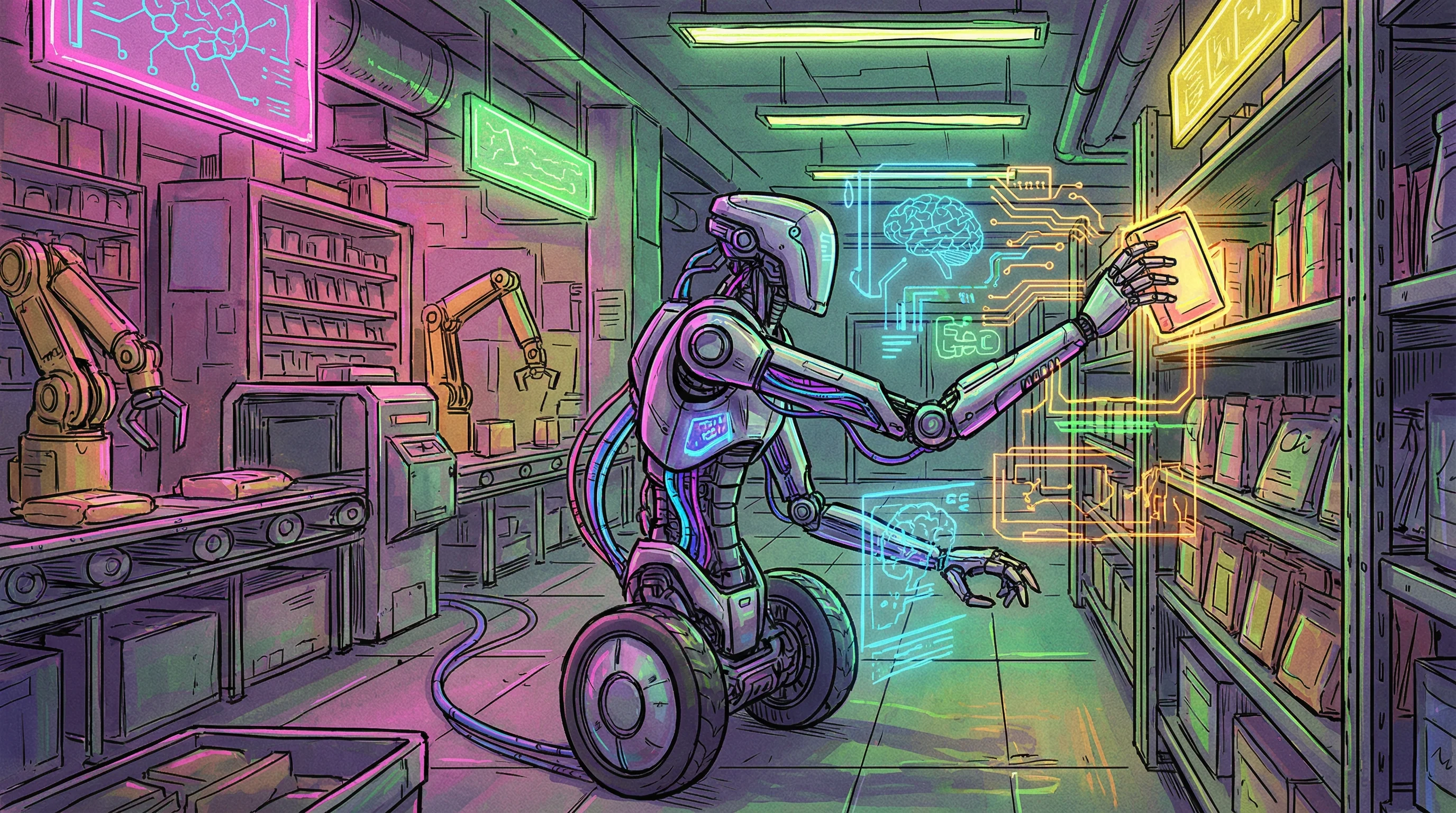
Galbot offers perhaps the clearest window into the VLA-driven strategy. Founded in May 2023, the company developed the G1—a dual-arm wheeled robot aimed at retail and light manufacturing. The architecture relies on a stack of specialized VLA models: GraspVLA for object manipulation, GroceryVLA for retail environments, TrackVLA for dynamic tracking and navigation. Galbot has deployed robots in more than 10 unmanned pharmacies around Beijing and says it plans to reach 100 robot-operated stores by year-end. The company formed a joint venture with Bosch and Boyuan focused on industrial applications, and signed an order plan with Baida for more than 1,000 units.
The funding trajectory tells its own story. Galbot raised 700 million yuan (roughly $96 million) in an angel round in June 2024, backed by Meituan, Qiming Venture Partners, Matrix Partners, and IDG Capital. A 500 million yuan strategic round followed in November. Then came a roughly 1.1 billion yuan ($153 million) round in June 2025 led by CATL, the battery giant. The December round brings total capital raised past $800 million in under two years.
Figure AI is pursuing a different path, though with similarly ambitious goals. The company built Figure 01 and integrated it with OpenAI's language models, showcasing real-time conversational capabilities in demonstrations last year. Figure signed a commercial agreement with BMW and reports that its robots contributed to 30,000 vehicles over 11 months at Spartanburg. Lessons from that deployment are being incorporated into the next-generation platform, though specifics remain scarce.
Apptronik raised $350 million in February 2025 to scale production of Apollo, its humanoid robot. The company is running pilot programs with Mercedes-Benz and Jabil, and partnered with Google DeepMind on VLA integration. Agility Robotics built RoboFab, a factory in Oregon designed for potential annual output of 10,000 units. The company's Digit robot is in logistics pilots with GXO, which hit a milestone of 100,000 totes handled.
Boston Dynamics, now under Hyundai ownership, continues developing Atlas with manufacturing ambitions that reportedly target 2028. Tesla's Optimus remains the wildcard in the deck. Elon Musk has suggested that Optimus could represent roughly 80% of Tesla's future value, though the company is starting with internal factory deployments before any broader commercialization.
In China, the landscape is crowded and competitive. UBTECH deployed its Walker S humanoids on manufacturing lines for NIO and Zeekr. Unitree is pushing affordability with its H1 model. Fourier Intelligence, Deep Robotics, AgiBot, EngineAI—all are in various stages of development and early deployment. Government policy tailwinds are real, even as regulators express concern about overheating.
What Happens Next

Gartner issued a reality check in January: fewer than 20 companies will successfully scale humanoid robots to production stage in supply chain and manufacturing by 2028. The research firm expects many current pilots to stall, and believes polyfunctional robots—wheeled platforms with arms—will outpace full bipedal humanoids in near-term adoption. That prediction aligns with what's actually being deployed. Galbot's G1 is wheeled. Many of the robots entering service today prioritize function over form.
Still, the market projections are staggering if you believe the trajectory holds. Goldman Sachs forecasts 1.4 million humanoid units shipping in 2035, creating that $38 billion market. UBS projects 2 million humanoids within a decade, then 300 million by 2050, driving addressable markets from $30-50 billion by 2035 to $1.4-1.7 trillion by midcentury. Morgan Stanley goes further, envisioning a potential $5 trillion market by 2050 with roughly one billion humanoids deployed, 90% of them in industrial or commercial settings.
Those numbers require squinting pretty hard. The technical challenges alone are substantial. VLA models still struggle with edge cases, long-horizon tasks, and the kind of common-sense reasoning humans barely think about. A 2025 survey on embodied AI robustness cataloged attack vectors including sensor spoofing, adversarial scene manipulation, and planning failures. Real-world deployment metrics—uptime, mean time between failures, cycle times—remain closely guarded secrets. The gap between what works in a lab demo and what survives 24/7 production environments is measured in years of grinding iteration.
Regulation is tightening on multiple fronts. The EU AI Act entered force in August 2024, with prohibitions and transparency requirements phasing in through 2027. High-risk AI systems embedded in regulated products face compliance deadlines by August 2027. In the United States, ANSI/A3 R15.06-2025 was published last October, updating national adoption of ISO robot safety standards. OSHA maintains separate references for collaborative robots and industrial mobile robots. The standardization infrastructure is racing to keep pace with the technology.
Then there's the geopolitical dimension. China's advantages—lower costs, policy support, manufacturing scale—suggest faster deployment trajectories. Some voices, including analysts on a16z podcasts, argue that the US must embrace what they call a "factory-first" physical AI mindset and rebuild domestic manufacturing capacity to avoid dependence on Chinese-made robots. NVIDIA CEO Jensen Huang has framed "physical AI" as systems that understand the physical world, enabling broad robotic deployment in manufacturing and beyond. The competition isn't just about who builds better robots. It's about who controls the foundational models and infrastructure that power them.
The embodied AI market, defined broadly, was estimated at $3.02 billion in 2024 and is projected to reach $9.34 billion by 2032. Vision-language models are expected to hit $41.75 billion by 2035 as hyperscale infrastructure investments accelerate multimodal AI development. Professional service robots saw roughly 200,000 units sold last year, up 9% year-over-year, driven largely by labor shortages.
What seems increasingly certain is that the era of purely programmed robots is ending. The machines coming next will learn from data, adapt to unfamiliar tasks, and reason about what they observe. They'll work in warehouses and pharmacies and factories. Eventually, homes. The companies building the VLA models that power these systems are placing trillion-dollar bets on a future that may arrive within five years.
Galbot's $3 billion valuation, achieved in less than two years, suggests that investors think it might be even closer than that.


