

Every weekday morning at pharmaceutical plants from New Jersey to Singapore, senior quality control scientists settle into what amounts to industrial-scale pattern recognition. Chromatograms scroll across monitors—jagged peaks and valleys representing molecular signatures. Mass spectra bloom in technicolor. The instruments spit out data in minutes. The humans? They can spend hours.
It's meticulous work by design. Regulatory agencies demand it. But the inefficiency gnaws at an industry obsessed with precision and speed. A single analyst might scrutinize hundreds of chromatograms daily, hunting for anomalies that surface maybe once in fifty runs. The final human review—that last quality gate before a batch ships—remains pharma's stubborn bottleneck.
Expert Intelligence, a U.S. startup barely two years old, believes it has found a way through.
On February 4, 2026, the company announced $5.8 million in seed funding led by Sierra Ventures. The pitch is bracingly direct: software that delivers 50-times-faster reviews and cuts errors by a factor of six in regulated analytical labs. If those numbers survive contact with production environments—and that's a meaningful if—they represent something closer to revolution than evolution in pharmaceutical quality control.
The core innovation? What founder Lalin Theverapperuma calls a Limited Sample Model: AI trained not on thousands of batches but on tens of representative ones. It's a counterintuitive approach in an era when large language models gorge on internet-scale data. But in highly regulated labs where every batch looks similar by design, Theverapperuma argues, you don't need vast training sets. You need to codify expert judgment.
Whether the industry is ready to hand over that judgment—even partially—is another question entirely.
When Digital Transformation Gets Messy
Pharma's quality control labs have been digitizing for years, though the transformation has been anything but smooth.
Walk into most facilities and you'll find a technological patchwork: chromatography data systems from one vendor, laboratory information management platforms from another, electronic notebooks from a third. They rarely speak the same language. Waters' Empower platform dominates regulatory filings. Thermo Fisher's Chromeleon 7.4, launched last year, touts enterprise-scale compliance controls. Agilent has embedded what it calls "AI Peak Integration" into MassHunter.
Each promises to streamline workflows. Yet the final call—pass or fail, release or investigate—still lands on a human reviewer's desk.
A 2025 Deloitte survey of 103 biopharma executives captures the industry's appetite for change: 56 percent expect more automated and predictive quality control within two to three years. Half reported fewer errors after modernization efforts; 45 percent saw compliance improvements. The drivers are obvious enough—shorter time-to-market, tighter margins, relentless regulatory scrutiny of data integrity. FDA warning letters continue to cite incomplete QC records and mishandled out-of-specification results.
But modernization has hit friction. Those same Deloitte respondents flagged interoperability gaps as the top obstacle—45 percent—alongside competing priorities and uncertain leadership buy-in. The promise of 20 to 50 percent reductions in compliance issues and 15 to 30 percent cost savings hinges on systems that can actually communicate. Too often, they can't.
Which creates an opening for companies like Expert Intelligence that position themselves as vendor-agnostic—software that plugs into existing infrastructure rather than replacing it. The setup, EI claims, takes minutes instead of months.
Bold claim. This is an industry where software validation cycles often stretch into quarters.
The Regulatory Winds Shift
Timing, in business as in comedy, can be everything. Expert Intelligence's technology arrives as three forces converge: evolving regulatory guidance, a wave of lab infrastructure upgrades, and mounting commercial pressure to accelerate release testing without sacrificing compliance.
Start with the regulators. ICH Q14—the international guideline on analytical procedure development—became effective June 14, 2024. Paired with the updated Q2(R2) validation standard, Q14 introduces what regulators call a "science- and risk-based approach" to analytical methods. Translation: there's now explicit room for multivariate and data-rich techniques, including AI models, provided they meet transparency and auditability requirements.
In January 2025, the FDA released draft guidance on using AI to support regulatory decision-making. The European Medicines Agency finalized its reflection paper on AI last September. The EU AI Act entered force in August. Industry group ISPE published its GAMP Guide on Artificial Intelligence in July. The message from regulators is remarkably consistent: AI is acceptable if it's risk-appropriate, explainable, and governed.
That's not carte blanche. But it's a meaningful shift from the regulatory caution of even five years ago.
The market numbers tell their own story. Laboratory information management systems are projected to grow from roughly $2.9 billion in 2025 to $5.2 billion by 2030—a compound annual growth rate near 12.5 percent. Laboratory automation overall is pegged at $5.6 billion this year, headed toward $10 billion by 2035. Process Analytical Technology, which enables real-time monitoring and control, is seeing double-digit growth as continuous manufacturing gains traction.
The appetite for AI specifically is unmistakable. A 2025 industry survey found that 95 percent of manufacturers are investing in AI, with quality control ranking as the top use case. Half plan to deploy AI or machine learning for product quality this year. McKinsey research from 2021—still cited widely in industry circles—suggested that "smart quality" approaches could deliver 50 to 200 percent productivity improvements in QC labs and reduce deviations by more than 65 percent in documented cases.
What's driving this isn't just efficiency. It's drowning in data.
High-throughput instruments generate thousands of data points per batch. Process analytical sensors stream real-time signals. Quality systems capture deviations, out-of-spec events, corrective actions. The bottleneck is no longer data collection. It's interpretation and decision-making at scale—precisely where human reviewers now spend their days.
The Decision Layer
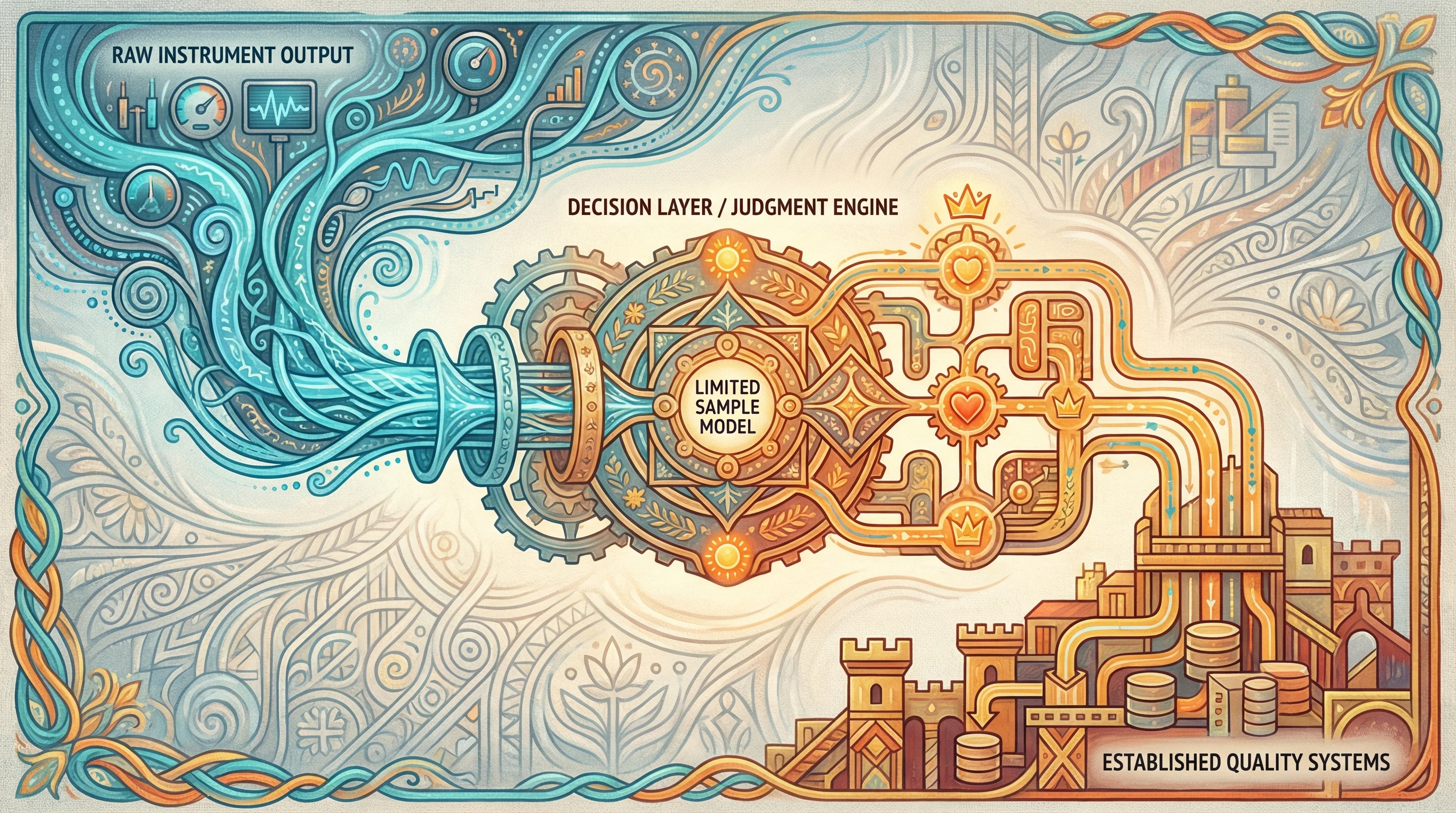
Expert Intelligence positions its technology in what Theverapperuma calls the "decision layer"—software that sits between raw instrument output and existing quality systems. Think of it as a judgment engine.
The Limited Sample Model is the technical core. Unlike deep learning networks that require vast training datasets, EI's LSM learns expert judgment from tens of representative batches. It operates on raw chromatograms, mass spectra, or other instrument signals, applies standard operating procedure logic, and generates auditable reports complete with electronic signatures.
The company offers two modules: EI Flow for in-batch decisions—flagging anomalies, validating integrations, recommending pass/fail determinations—and EI Signal for cross-instrument and multi-site trending. The business model is "review by exception": routine batches that meet all criteria get auto-signed. Only outliers require human intervention.
Theverapperuma, who holds a PhD and logged time at Apple, Meta, Intel, and Bosch before founding EI, has been active in regulated AI discussions through ISPE. In statements around the funding announcement, he emphasized transparency and auditability as non-negotiable in pharma contexts. "You can't black-box this," he said—a recognition that regulators and quality directors won't accept decisions they can't explain.
Sierra Ventures partner Ben Yu, announcing the investment, highlighted EI's ability to "operate at the instrument level" and "learn from limited data" as key differentiators in regulated environments.
Commercial deployments began in early 2025 across pharmaceutical manufacturing, drug development, and—perhaps surprisingly—food safety. One disclosed proof-of-concept involves Nestlé R&D, where EI is automating MOSH/MOAH mineral-oil contaminant analysis to improve inter-lab consistency. MOSH/MOAH testing, a chromatographic method tracking potential packaging migration, is notoriously operator-dependent. Different analysts can look at the same chromatogram and reach different conclusions.
If EI can standardize those calls across multiple Nestlé labs, it validates the model's core promise: codifying expert judgment in a reproducible, auditable way.
The broader ecosystem is moving, too. In December, Organon selected TetraScience's Scientific Data Foundry to modernize QC data workflows—part of a trend toward cloud-based data layers that harmonize multi-vendor instrument output. Scitara's DLX platform has inked partnerships with Waters and Agilent to provide lab connectivity with compliance features baked in. IDBS, owned by Danaher, announced "Agentic AI" proofs-of-concept last year to accelerate lab decision loops.
Meanwhile, traditional chromatography vendors are embedding their own AI features. Agilent's MassHunter includes AI-assisted peak integration. Thermo Fisher promotes automation aids in Chromeleon. Waters has integrated multi-angle light scattering detectors into Empower, claiming up to 40 percent error reduction with its Alliance iS traceability software.
These vendor-native tools address narrow tasks—peak picking, reflex reinjections—but remain locked within proprietary ecosystems. Expert Intelligence's vendor-agnostic approach may be its strongest card. The challenge, of course, is proving it works across different customer procedures, instrument types, and regulatory contexts.
Trust, but Validate

The central question isn't whether AI can speed up quality reviews. It's whether regulated labs are ready to trust algorithmic decisions at scale.
Validation remains the highest hurdle. Proving an AI model meets ICH Q14 and Q2(R2) standards requires documented evidence of accuracy, robustness, and lifecycle management. The FDA's draft AI credibility guidance outlines what that documentation should include: model provenance, versioning, performance monitoring, explainability. Expert Intelligence will need to demonstrate not just that its LSM works, but that it can be validated consistently across different customer SOPs and instrument types.
That's not a trivial ask in an industry where validation is its own specialized discipline.
Data integrity expectations add complexity. Regulators demand what's known as ALCOA+ compliance—attributable, legible, contemporaneous, original, accurate, plus complete, consistent, enduring, and available. AI-generated decisions must enhance traceability, not obscure it. That means audit trails linking every auto-signed batch back to the raw instrument file, the SOP version, the model weights, the deviation history.
One bad audit finding, one unexplained model decision, could torpedo adoption.
Interoperability is another watch point. Deloitte's survey identified integration challenges as the top barrier to lab modernization. Expert Intelligence's ability to work seamlessly with Waters, Thermo, Agilent, and smaller instrument vendors—without brittle point-to-point connections—will determine whether the technology scales or stalls. Architectures that align with emerging data standards like Allotrope models, or integrate through platforms like TetraScience and Scitara, may have an edge.
The market opportunity extends well beyond pharma. Food safety labs grappling with PFAS, pesticide residues, and authenticity testing face similar review bottlenecks. Environmental monitoring—metals, organics, contaminants—relies on the same chromatographic and spectroscopic techniques. Materials characterization labs in chemicals and polymers process high volumes of routine QC.
If EI's Limited Sample Model generalizes across these domains, the addressable market multiplies considerably.
Real-time release testing is the longer horizon. As continuous manufacturing matures, the industry vision is to release product based on process data rather than traditional end-product testing. Process Analytical Technology tools—near-infrared, Raman, process mass spectrometry—feed real-time control loops. Expert Intelligence's cross-instrument trending module, EI Signal, positions the company to support these programs, though adoption timelines remain uncertain. EY analysis suggests real-time release will accelerate through 2030, particularly in continuous tablet and biologics manufacturing.
Competition will intensify, naturally. Aizon announced "agentic AI" for pharma manufacturing last year, targeting upstream bioprocess control but with stated ambitions in quality. Seeq, recognized as a leader in industrial AI analytics by Verdantix, offers validated tools for pharma deviation investigations. LIMS vendors like LabWare and STARLIMS are expanding cloud offerings with prebuilt QA/QC templates that could incorporate AI features over time.
The line between chromatography data system add-ons, LIMS modules, and standalone decision layers will blur.
The Execution Question

For quality directors evaluating Expert Intelligence or similar tools, the calculus is straightforward: Does the technology reduce review cycles and errors without adding regulatory risk?
If the answer is yes, adoption follows. If validation overhead or integration complexity negate the efficiency gains, the technology stalls in proof-of-concept purgatory—a fate that's befallen more than a few promising lab innovations.
The 50x speed claim is compelling, even startling. Whether it survives production environments, legacy systems, and auditor scrutiny is the $5.8 million question Sierra Ventures is betting on.
The convergence of regulatory guidance, infrastructure modernization, and market pressure has created a genuine opening. Whether Expert Intelligence captures it depends on the unglamorous work of execution: customer references that hold up, validation packages that satisfy both internal quality teams and external auditors, proof that limited-sample learning translates across labs, methods, and molecules.
Theverapperuma is circumspect about timelines. "We're not replacing judgment," he said in a recent interview. "We're codifying it." The distinction matters. Quality directors who've spent careers building expertise in method development and analytical troubleshooting won't hand over decisions to a black box, no matter how fast it operates.
But a transparent tool that handles routine reviews and flags true anomalies for human attention? That's a different proposition.
The decision layer, it seems, is about to get crowded. For now, Expert Intelligence has momentum, funding, and—perhaps most valuable in a cautious industry—early customers willing to test the proposition that AI can learn from dozens of batches rather than thousands.
Whether that's enough to crack pharma's final quality bottleneck will become clear soon enough. The instruments keep churning out data. The humans keep reviewing it. And somewhere between those two realities, a market opportunity is taking shape.


