

The announcement came just before Christmas 2024, buried in the chaos of year-end news cycles. Federal prosecutors had indicted Kenneth Newcombe and Tridip Goswami—two executives from C-Quest Capital—on fraud charges. The first criminal case of its kind against voluntary carbon market operators.
It wasn't methodological disagreement. Not the usual squabbles over baselines or additionality tests. This was fraud, allegedly: manipulated monitoring data, inflated credit values, cookstove projects in developing countries that may have existed more vividly on spreadsheets than in actual kitchens. The CFTC, DOJ, and SEC moved in parallel formation. The company's former COO had already pleaded guilty and was cooperating.
The market had suspected something like this was possible. Just... no one wanted to say it out loud until federal prosecutors did.
A $700 Million Crater
By 2023, the voluntary carbon market wasn't just contracting—it was collapsing. Transaction values dropped 61% to roughly $723 million, according to Ecosystem Marketplace. Trading volumes fell 56%. Corporate buyers, the ones who'd once treated offsets like insurance policies for their climate pledges, went quiet.
They were waiting. Waiting for clarity from the newly formed integrity bodies. Waiting to see which credits would survive scrutiny and which would be exposed as, well, less than advertised. Waiting to figure out whether their net-zero claims could withstand the legal challenges that were starting to pile up in courtrooms across Europe and the United States.
The wait felt prudent. In August 2024, the Integrity Council for the Voluntary Carbon Market delivered its verdict on renewable energy methodologies: eight existing approaches—covering some 236 million unretired credits, roughly a third of available supply—failed basic additionality requirements. No CCP integrity label. No stamp of approval. Just... no.
REDD+ forest projects faced similar reckoning, though perhaps even more brutal because they'd been the flagship of corporate offset portfolios for years. Investigations kept finding the same pattern: overstated baselines, inflated deforestation threats designed to generate more credits. Legacy REDD+ credits didn't qualify for the new standards either.
And then there were the cookstoves—the projects that had seemed so appealingly straightforward. Replace smoky traditional stoves in developing countries, reduce emissions, save lives, generate credits. A UC Berkeley study published in Nature Sustainability in January 2024 found that cookstove offsets were over-credited by roughly an order of magnitude. Ten times their actual emissions reductions, give or take.
The problem wasn't technically complex. Inflated usage assumptions. Unrealistic baseline scenarios. Data that relied on self-reported surveys rather than actual measurements. When you're generating revenue from carbon credits worth millions, apparently, the temptation to make the numbers work is considerable.
Ghost Stoves and Other Illusions
The C-Quest Capital indictment exposed what might be called a playbook, though that makes it sound more sophisticated than it was. Manipulated usage data. "Ghost stoves"—the kind that existed on paper but couldn't be located in actual households when investigators went looking. Understated "stacking," the inconvenient reality that families often kept using traditional cooking methods alongside the supposedly cleaner alternatives.
But cookstoves weren't an isolated category of concern. Verra, the world's largest carbon registry, rejected 37 rice methane projects from China in August 2024 after discovering overstated project sizes and emission reductions. By March 2025, the registry had suspended four verification bodies—CCSC, CQC, CTI, and TÜV Nord—from specified scopes. These were the auditors who'd signed off on questionable projects in the first place.
The conflict of interest was, frankly, hard to miss once you looked for it. A Penn Carey Law analysis in 2025 laid out the fundamental problem: third-party auditors are selected and paid by the very project developers they're supposed to scrutinize. Many validation and verification bodies had approved projects that later proved... problematic. It's a bit like asking a company to choose and pay for its own financial auditor, except without the regulatory oversight or professional licensing requirements that make financial audits mostly work.
When Permanence Turns Out to Be Temporary
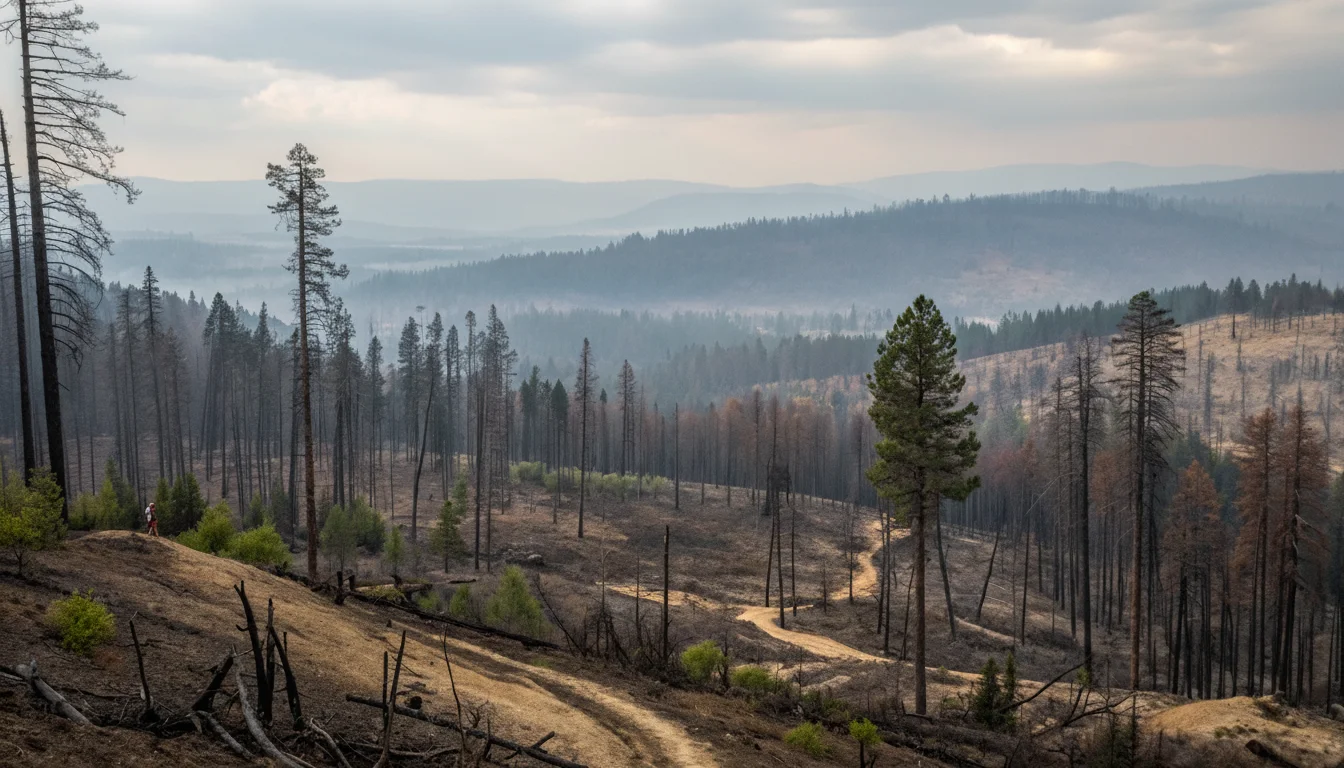
California's compliance forest offset buffer pool—designed as insurance against natural disasters—offers what may be the clearest preview of permanence risk at scale. Research published in Frontiers showed that wildfire losses had already consumed or exceeded the wildfire-dedicated reserves intended to last a century. The 2024 Park Fire burned through projects linked to major corporate buyers. The buffer was undercapitalized by design, it seems, though whether by accident or optimism remains unclear.
Meanwhile, Human Rights Watch documented violations of Indigenous Chong rights in a Cambodia forest project: evictions, lack of free, prior, and informed consent. Verra placed the project on hold in 2023, then reinstated it in September 2024 after requiring corrective actions. Scrutiny continues. In Zimbabwe, communities reportedly saw minimal benefits from conservation projects that raised over €100 million. The Guardian's coverage raised uncomfortable questions about transparency and benefit-sharing arrangements that look better in project documents than on the ground.
The Legal Noose Tightens
Corporate legal teams are taking notes. The European Union voted in early 2024 to ban "climate neutral" and "carbon neutral" claims that rely on offsetting by 2026, as part of its Green Claims Directive. A Dutch court ruled that KLM's "Fly Responsibly" advertising and offset claims were misleading. Britain's Advertising Standards Authority banned multiple airline green ads. Delta faces an ongoing U.S. class action over its carbon neutrality claims.
U.S. regulators have moved more cautiously—this is, after all, America—but signals of intent are multiplying. The Treasury and White House issued voluntary carbon market principles in May 2024, focusing on supply integrity, demand transparency, and market oversight. The CFTC launched an Environmental Fraud Task Force and proposed guidance for voluntary carbon credit derivatives in December 2023. The SEC's climate disclosure rule remains tangled in litigation, but the directional arrow points toward greater scrutiny of offset claims.
Carbon Market Watch analysis found that roughly 90% of intermediaries—brokers, resellers, crypto vendors—don't disclose their fees or markups. Good luck tracking how much money actually reaches projects and communities. When credits trade through multiple intermediaries, each taking a cut, the opacity doesn't just compound—it becomes almost deliberate.
Rebuilding on Firmer Ground (Maybe)

The market hasn't collapsed entirely, though it's had what venture capitalists might euphemistically call a "reset." Efforts to rebuild on firmer ground are underway. The ICVCM approved its first CCP-labeled credits in 2024: methane destruction, ozone-depleting substances, landfill gas. In November 2024, it approved three new REDD+ methodologies (VM0048, JNR v4.1, ART TREES v2.0) that use jurisdictional baselines rather than project-level reference regions. The goal is to cap over-crediting by anchoring claims to government deforestation data—assuming, of course, that government data proves more reliable than project developer data.
By March 2025, ICVCM had approved three cookstove methodologies with stricter baseline and usage monitoring requirements. Gold Standard launched a multi-year digital MRV pilot in October 2024, testing metered approaches. The Voluntary Carbon Markets Integrity Initiative released its Claims Code in November 2023, offering Silver, Gold, and Platinum labels based on how companies use credits alongside actual emissions reductions.
Price and liquidity are concentrating in these higher-integrity segments. Demand for renewable energy avoidance credits—the kind that failed ICVCM review—remains muted in 2025, according to S&P Global. Meanwhile, CCP-eligible categories and CORSIA-approved credits for the aviation offsetting scheme command premiums. The market is bifurcating: high-quality credits for corporations with rigorous due diligence, and everything else for... well, it's not entirely clear who's buying the everything else anymore.
The Reckoning for Corporate Climate Strategy
For sustainability officers building net-zero roadmaps, the message has become uncomfortable in its clarity: carbon credits are no substitute for actual emissions reductions. The legal and reputational risks of low-quality credits now outweigh their convenience, their affordability, their political palatability.
The Science-Based Targets initiative faced internal revolt in 2024 when its board suggested allowing offsets for Scope 3 abatement. The CEO resigned not long after. The debate over offsets in target-setting remains unresolved, which tells you something about where the consensus stands—or doesn't.
Companies that bought legacy REDD+ or renewable energy credits are holding assets that may be worthless. Worse, they may be liabilities if those companies have already made public claims based on those retirements. The double-counting problem persists: without corresponding adjustments from host countries, the same emission reduction can be claimed by both a nation's NDC and a corporation's net-zero accounting. Article 6 rules from COP29 don't automatically extend to voluntary markets, despite some wishful thinking.
What Credibility Looks Like Now

The voluntary carbon market was supposed to be a bridge. A mechanism to channel private capital to climate solutions while companies worked on the harder decarbonization challenges in their own operations.
But when a Reuters investigation in July 2025 found illegal loggers linked to Amazon conservation projects, it underscored what can only be called a due diligence failure at the registry level. When UK financial regulators issue warnings about boiler-room carbon credit scams alongside legitimate market activity, the reputational damage doesn't discriminate—it spreads to everyone operating in the space.
The market isn't dead. But it's learning, slowly and painfully, that credibility cannot be assumed. It has to be measured, monitored, and verified with tools and standards that didn't exist when many of today's problematic credits were issued.
For executives making climate commitments, the lesson is uncomfortably clear, perhaps even obvious: if you're relying on offsets, you'd better be able to defend every ton. In court, if necessary. Because increasingly, that's where these questions are being settled.


