

On a Saturday morning in early March 2024, more than 200,000 high school students across the United States sat down in 3,000 test centers and did something unprecedented: they took the SAT entirely on a laptop.
The digital rollout had been in the works internationally since March 2023, but March 9 marked the moment College Board's Bluebook app finally landed in American testing rooms. What nobody anticipated—or perhaps more than the founders expected—was the timing. Just weeks earlier, Dartmouth had shocked the higher-ed world by announcing it would reinstate testing requirements for applicants to the Class of 2029. Yale unveiled a test-flexible policy on February 22. Brown followed suit on March 5.
After four years of test-optional admissions, the Ivies were suddenly demanding scores again. And dozens of edtech startups, some barely past incorporation, saw their moment.
A Market That Suddenly Mattered Again
The numbers tell part of the story. The global exam preparation and tutoring market hovers around $68 billion in 2024, with projections climbing to $86 billion by 2030. Online private tutoring in the U.S. alone accounts for $4.3 billion. Test prep remains one of the fastest-growing segments within that. Drill down further, and you'll find AI-powered test prep tutors occupying a niche estimated at $528 million globally, expanding at a 31.7% annual clip toward the end of the decade.
But raw market size doesn't explain the frenzy. What created the opening was the confluence: schools requiring tests again, and the test format itself being brand new. Students needed prep tools that mirrored an exam experience no one had a decade of data on. Not even Khan Academy, with its free official prep partnership, had built up years of digital adaptive content.
For founders and venture investors, the pitch practically wrote itself.
The Technical Wrinkle
The digital SAT isn't just a PDF of the paper test slapped onto a screen. College Board implemented something called multistage adaptive testing, or MST for the acronym-inclined. The structure: two sections—Reading & Writing, then Math—each divided into two modules. Module 1 presents a mixed bag of difficulty. Module 2's difficulty routes based on how you did in module 1.
Perform well on the first math module? You're routed to harder questions in module 2. Stumble through it, and module 2 stays easier, with what amounts to an implicit score ceiling. College Board hasn't published the precise thresholds—naturally—but several startups have reverse-engineered approximate routing logic and built their own adaptive engines to simulate it.
Reading & Writing delivers 27 questions per module over 32 minutes each. Math offers 22 questions per module over 35 minutes. The whole test runs about two hours, shorter than the old paper marathon, with more breathing room per question.
Then there's Bluebook itself. The official testing app includes an embedded Desmos calculator (graphing and scientific modes), built-in timers, question-flagging features. Replicating that interface became table stakes for any startup hoping students would take their practice tests seriously.
The Race Was On

UWorld saw it coming early. The Dallas-based company, founded by physician Chandra S. Pemmasani and better known for medical licensure prep, launched its digital SAT product in July 2023—months ahead of the U.S. rollout. Its Bluebook-style interface and adaptive difficulty routing gave it a head start most competitors couldn't match.
Magoosh, the Berkeley test-prep stalwart founded back in 2009 by Bhavin Parikh, Hansoo Lee, and Pejman Pour-Moezzi, updated its SAT course for the digital format in 2024. The company rolled out adaptive practice tests and what it calls an "AI Tutor" feature. Premium pricing typically hovers around $129 for 12 months—a nod to Magoosh's longstanding strategy of undercutting pricier competitors while still charging enough to matter.
Piqosity, a Houston startup from 2015, released 12 adaptive practice tests and made some content free in early 2024 while the full course was still under construction. The company even published blog posts explaining—claiming, really—to decode how College Board's MST works. By September, Piqosity added a video course and started marketing "Virtual Tutor 2.0" and "Intelligent Remediation," buzzwords that investors either love or roll their eyes at depending on the day.
PrepScholar, founded in 2013 by Allen Cheng and Fred Zhang, had already built an adaptive SAT program for the paper test. Pivoting to digital wasn't a reinvention, just an update. The company offers both consumer and school district packages, with pricing in the $397-and-up range for full courses.
And then came the wave.
MentoMind, led by CEO Amit Jain in Warrington, Pennsylvania, raised a $1.5 million seed round in 2023 and launched an AI-driven platform claiming more than 3,500 questions. TeachTap, operating under the brand LearnWith.ai, markets an "AI-First" Digital SAT Bootcamp priced around $199. PeakSAT positions itself as consumer SaaS with 20 full-length digital SAT simulations—$60 per month, $150 for three months, or $400 for lifetime access.
AptivPrep, founded by Stephen A. Johnson (who goes by "The SAT Guy" online), launched an AI-powered adaptive system in 2025. DigiTest appeared on Product Hunt in 2024. BlueLibro, Examinax, and a handful of others entered with various claims about adaptive routing and Bluebook compatibility.
The market, in other words, got crowded fast.
The B2B Angle Nobody Talks About
While consumer-facing startups chased individual students and their anxious parents, a quieter race emerged in B2B tooling. Many tutoring companies and small test-prep firms lack the resources to build adaptive engines from scratch. So platforms like EdisonOS stepped in, enabling tutoring firms to administer Bluebook-style mocks and analyze results. HighScores.ai claims 12 full-length adaptive tests plus tutor and institute management features. PrepSharp offers a tutor-oriented platform where instructors can assign adaptive or fixed-difficulty practice.
The B2B angle matters because it's infrastructure. These plays let tutoring firms white-label or integrate adaptive content without reinventing the wheel—or, more accurately, without hiring a team of engineers to decode College Board's routing logic.
Academy Technologies provides digital adaptive test options for classroom review. For investors, the B2B layer represents a different risk profile: steadier revenue, longer sales cycles, fewer viral consumer wins, but also less dependence on fickle student retention metrics.
The Official Moat
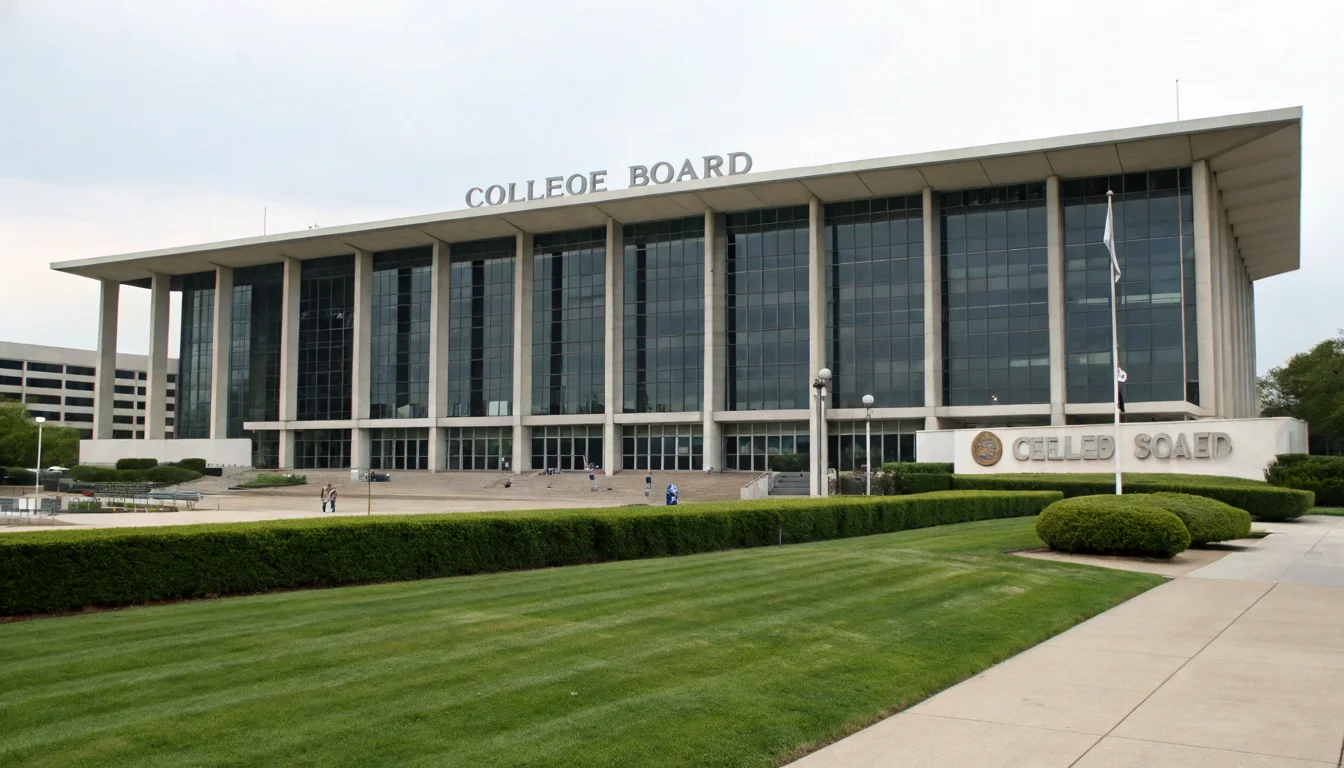
College Board still holds the strongest hand, and it's not close.
Its partnership with Khan Academy delivers free official prep—thousands of practice questions, video walkthroughs, skill-level lessons. Students can take full-length practice tests in Bluebook (10 tests available as of February 2025, after the organization retired tests 1 through 3 and added 7 through 10), then funnel into Khan Academy's skill modules based on their results. The workflow is seamless. And it's free.
That free official channel creates a ceiling for paid products. Startups must justify premium pricing by offering something College Board and Khan Academy don't: more practice volume, better explanations, real-time AI tutoring, superior analytics. It's the classic innovator's dilemma, playing out in test prep. The official content is authoritative but constrained by College Board's conservative product release cycle. Third-party vendors can move faster, experiment with AI features, build slicker interfaces.
But they're always one update away from being obsoleted if College Board decides to build those same tools in-house.
The Problem Nobody Wants to Say Out Loud
Here's the catch, and it's a big one: none of these startups can actually prove their adaptive algorithms mirror College Board's MST.
Vendors reverse-engineer routing thresholds. They publish approximate score caps. Piqosity, for instance, describes how students might need certain module 1 accuracy rates to unlock higher module 2 ranges. But these are interpretations, educated guesses. College Board hasn't published its exact difficulty tiers, score tables, or routing logic. And it probably won't.
For investors evaluating these companies, empirical score correlation becomes the key diligence question. Does a student who scores 1450 on a startup's adaptive practice test actually score near 1450 on the real digital SAT? Some vendors claim their tests are "Bluebook-compatible" or "Bluebook-style," but only College Board's practice exams in the actual Bluebook app are official.
Marketing language can get assertive. Due diligence requires caution. And maybe a little skepticism about claims that sound too precise.
The AI Tutor Gold Rush
Nearly every new entrant layers in some form of AI tutoring now. Magoosh has an "AI Tutor." TeachTap advertises "AI tutors with historical personas" (Socrates helps you with geometry, presumably). MentoMind built a chatbot for student questions.
The proliferation makes sense. Large language models can generate explanations, answer follow-up questions, simulate one-on-one instruction at scale. The technology is table stakes, not a differentiator anymore.
The real differentiation—if it exists—will come from content quality, adaptive accuracy, and distribution. Does the platform have enough high-quality practice questions to avoid repetition? Do students using it actually improve their scores? Can the company reach students through schools, tutoring centers, or viral consumer adoption?
Those are harder questions to answer in a pitch deck.
What Comes Next

The market is still sorting itself out, and the next 12 to 18 months will reveal who survives.
College Board released new practice tests in February 2025, a signal that the organization is actively refining official prep content. Elite schools continue to debate—sometimes defensively—the equity implications of reinstated testing requirements. Brown, Dartmouth, and Yale faced criticism throughout 2024 that high test scores correlate with family income, and that the reversal could harm under-resourced applicants. The Guardian and other outlets covered those concerns. The pressure hasn't abated.
The students who took that first digital SAT on March 9, 2024? They're already in college. The Class of 2029—the cohort for whom Dartmouth, Yale, and Brown reinstated requirements—will apply this fall. By then, patterns will emerge. Score correlations between third-party practice platforms and actual SAT results will become clearer, or at least harder to obscure. Districts and tutoring companies will have picked their vendor partners. Some startups will have secured Series A rounds. Others will quietly shut down.
The companies that survive will be the ones that cracked not just the adaptive algorithm, but the distribution problem. Because in a market where Khan Academy offers thousands of official questions for free, and College Board controls the actual exam, the edge isn't just building a better mousetrap.
It's convincing students, parents, tutors, and schools that your mousetrap is worth paying for. And in test prep, that's always been the hardest part.


