

In a nondescript lab in Berkeley, robotic arms worked through the night last year, mixing compounds, heating samples, and validating predictions spit out by an algorithm. Seventeen days later, the system—called A-Lab—had synthesized 41 novel materials that had never existed before. No grad students pulling all-nighters. No principal investigator hovering over benches. Just machines, following instructions from other machines.
It's the kind of demonstration that gets venture capitalists salivating and skeptics sharpening their pencils.
The world's collective R&D budget hit roughly $2.87 trillion in 2024, according to the World Intellectual Property Organization—nearly 2% of global GDP. For all that spending, research remains stubbornly artisanal: human-intensive, inconsistent, slow to replicate. A cottage industry, scaled up with bigger cottages. Now a clutch of startups, tech giants, and academic labs are making a different wager: that you can automate not just pieces of the research process, but the entire cycle. Hypothesis to experiment. Data to manuscript. Lab bench to publication.
The pitch is ambitious. Maybe too ambitious.
Promise Meets Reality (and Reality Blinks First)
McKinsey's analysts have crunched the numbers and concluded that generative AI could unlock 10% to 15% productivity gains in R&D, part of a broader economic windfall they peg between $2.6 trillion and $4.4 trillion annually. Three-quarters of that value, they argue, concentrates in customer operations, marketing, software engineering—and research and development. On spreadsheets, at least, the opportunity looks staggering.
Reality has been less cooperative.
A survey by Boston Consulting Group spanning 2024 and 2025 found that only about 5% of companies are materially realizing value from AI initiatives. Nearly three-quarters are stuck in pilot purgatory, unable to scale beyond proof-of-concept. The Wall Street Journal, never one to miss a good contradiction, dubbed it the AI "productivity paradox"—billions invested, modest returns harvested. The gap feels especially acute in R&D-heavy industries, where even the optimists in biopharma and medtech remain largely in exploratory mode.
There's a structural reason this stuff is hard. Research is messy in ways that confound automation. A widely cited estimate puts the annual cost of irreproducible U.S. preclinical research at $28 billion. Inconsistent protocols, sloppy documentation, datasets that speak different dialects—or don't speak at all. AI evangelists argue that automation could standardize workflows and generate what they call "AI-ready" data at scale, taming the chaos. But first, the infrastructure has to exist. And it has to work. And scientists have to trust it.
That's a lot of "haves."
Closed Loops and Real Compounds
Google made a splash earlier this year unveiling an AI "co-scientist" system built atop Gemini 2.0. The multi-agent architecture tackled biomedical puzzles end-to-end: identifying drug repurposing candidates, proposing novel targets for liver fibrosis, exploring antimicrobial resistance. TechCrunch, predictably skeptical, questioned whether the system was ready for prime time. Fair point. But the underlying technical work—published on arXiv, peer review pending—shows genuine progress. Not hype. Progress.
The Berkeley demonstration mentioned earlier stems from DeepMind's GNoME project, launched in 2023. The system predicted 2.2 million crystal structures. Roughly 380,000 were deemed stable enough to add to the Materials Project database, a repository researchers actually use. Then A-Lab—autonomous, tireless—synthesized 41 of those predicted compounds in just over two weeks. That's the feedback loop scientists dream about: computation generating predictions, robots validating them in the physical world, results feeding back into the model.
Elsewhere, a system called "Robin" proposed ripasudil, an existing glaucoma drug, as a candidate for dry age-related macular degeneration. Then it helped validate the hypothesis in a lab-in-the-loop workflow. Sakana AI's "AI Scientist," published last year, demonstrated end-to-end automation in machine learning research itself—generating ideas, running experiments, drafting papers. Cost per paper? Under $15. The quality was uneven, the errors real. But the point was made: even the meta-task of doing research could be formalized and, at least partially, automated.
These aren't vaporware demos. They're working prototypes. Imperfect, yes. But working.
The Plumbing Gets Interesting
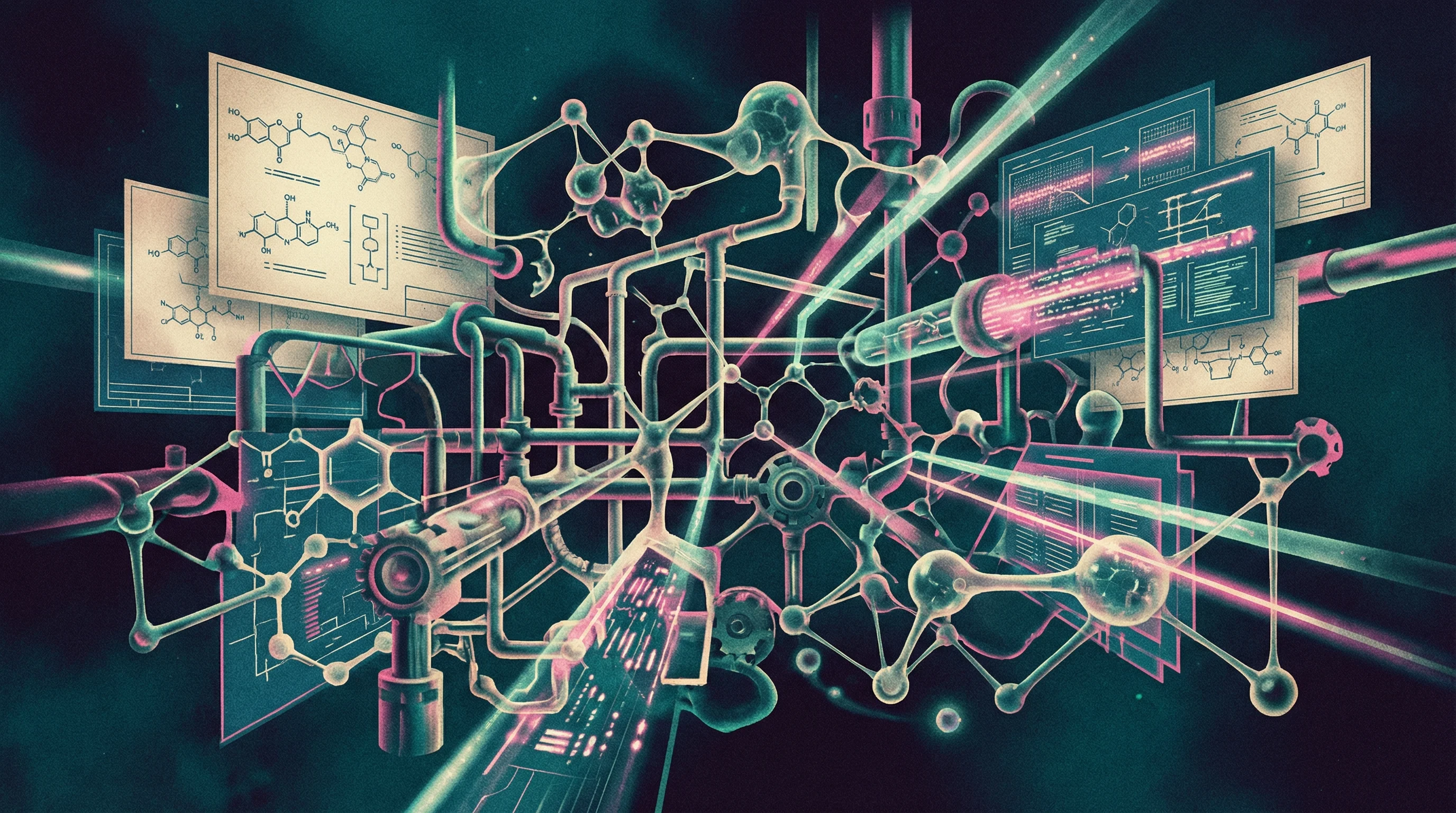
Behind the flashy demonstrations, a less glamorous but perhaps more consequential infrastructure layer is taking shape. NVIDIA's BioNeMo platform has evolved from a research curiosity into an end-to-end drug discovery system—foundation models, architectural blueprints, microservices, the works. The company announced partnerships with Eli Lilly, including a co-innovation lab, and Thermo Fisher for autonomous lab infrastructure. Kimberly Powell, who leads NVIDIA's healthcare push, has taken to calling this biology's "transformer moment," positioning BioNeMo as a continuous-learning engine bridging computational and wet-lab research.
Emerald Cloud Lab operates a fully remote, automated facility with unified command-and-control systems and ALCOA+ metadata standards—compliance jargon for "data you can actually trust." They market it explicitly as "AI-driven lab research." Not a research project. A commercial operation. Arctoris, another player, doubled its capacity last year by acquiring assets from Lilly's Life Science Studio, positioning itself as an "AI-ready" data factory. Thousands of experiments. Standardized, machine-readable outputs. The kind of infrastructure AI actually needs to learn from.
Startups are proliferating like fruit flies. Yoneda Labs, backed by Khosla Ventures with a $4 million seed round, is building a foundation model for chemists alongside robotics designed to run 200 experiments daily. ReactWise aims to compress drug manufacturing process development into "one-shot predictions"—a claim that would have sounded absurd five years ago. iollo's "Quinn" AI scientist is already embedded with Fortune 500 pharma companies, generating hypotheses. The Synthesis Company, a Y Combinator alum from the summer 2024 batch, promises "100x faster evidence synthesis" for large-scale literature reviews.
Even academia is moving fast, perhaps uncomfortably so. Stanford launched Agents4Science, a venue that requires AI authorship and AI-driven peer review. Papers have been accepted. A schedule's been published for October 2025. The message is clear: the community isn't waiting for permission.
Notebooks Get Smarter (Whether You Asked or Not)
Much of the infrastructure action is happening in the daily tools scientists actually use. Jupyter AI version 3, released this year, introduced personas, agents, and "%%ai" magic commands—integrating over a thousand models via LiteLLM. Google Colab deployed Gemini-based data-science agents directly into notebooks. The trend? Making computational assistants ambient, embedded in the environments where experiments are designed and data analyzed.
This matters because the bottleneck isn't always lab throughput. It's the iterative, creative work of deciding what to test next, interpreting ambiguous results, connecting dots across literature. Tools like Consensus GPT—covering 200 million papers and deployed in research libraries—and Scite's "smart citations" database (1.3 to 1.4 billion contextualized citations as of 2025) are reshaping how researchers navigate knowledge and generate hypotheses.
Behind the scenes, frameworks like ToolUniverse, released this year, standardize tool-calling for AI agents, offering over 600 tools, datasets, and APIs to compose agentic workflows. AutoLabs demonstrates multi-agent translation of natural-language protocols into liquid-handler code with self-correction loops, achieving near-expert accuracy on challenging syntheses. These are scaffolding layers, unglamorous but essential. The plumbing that could make "AI co-scientists" practical rather than purely aspirational.
When Fast Meets Careful (Spoiler: It's Complicated)
The promise of automation runs headlong into a thicket of regulatory and ethical questions that make venture capitalists nervous and compliance officers reach for antacids.
The EU AI Act's general-purpose AI obligations took effect August 2, 2025, complete with a voluntary Code of Practice and detailed guidelines. Research prototypes get carve-outs until commercialization, but transparency, copyright, and documentation requirements loom large. The U.S. has taken a lighter touch—NIST's AI Risk Management Framework offers voluntary best practices—but federal agencies are watching. The FDA even launched "Elsa," an internal generative AI tool to accelerate scientific reviews, signaling that regulators are adopting the technology themselves. Which is either reassuring or terrifying, depending on your priors.
Publishing norms are evolving in real time, sometimes awkwardly. The International Committee of Medical Journal Editors and major journals now mandate that AI tools cannot be listed as authors. Any AI use in writing or analysis must be disclosed. Confidentiality constraints apply for editors and reviewers using AI. The rules are clear: transparency is non-negotiable, authorship remains human. For now.
Pushmeet Kohli, who leads AI for science at DeepMind, has been vocal about the need for trustworthy outputs and uncertainty quantification. In a January interview, he emphasized that "move fast and break things" doesn't work in science. Domains like genomics demand rigorous validation and confidence metrics—think AlphaFold's reliability scores, not startup MVPs. Ross King, the pioneer behind early robot scientists, argues AI could surpass the best human researchers by mid-century if developed responsibly. But he cautions against underestimating the challenge. Breaking science is not an acceptable outcome.
Not everyone is convinced this is even close to ready. Gary Marcus, a persistent critic of AI hype, and experts interviewed by TechCrunch have warned that "co-scientist" claims are premature. Hallucinations, unverifiable reasoning chains, reliability gaps—the concerns are significant and not easily dismissed. Frameworks like SafeScientist and its SciSafetyBench benchmarks are emerging to evaluate risk-aware scientific agents, but the evaluation infrastructure lags embarrassingly behind deployment enthusiasm.
So What Happens Next?

The infrastructure is real. The demonstrations are tangible. The commercial interest undeniable. What's less clear is how quickly reliability, governance, and cultural acceptance will catch up. McKinsey's optimistic 10% to 15% productivity gains assume workflows are fundamentally re-engineered around agents and automation—not bolted on as digital assistants to unchanged processes. BCG's finding that 74% of companies struggle to scale suggests the organizational challenge may dwarf the technical one.
The NIH's Data Management and Sharing Policy, effective January 2023, mandates FAIR-compliant data and public access to federally funded research by 2026. These pressures are creating both demand for AI-ready datasets and friction around attribution, access control, compliance. Startups that solve the boring problems—lineage, provenance, audit trails, NIST AI RMF mappings—may matter as much as the flashy co-scientist demos. Perhaps more.
Over the next 12 to 24 months, watch for closed-loop wins beyond big-tech pilots. Pharma and materials partnerships announcing validated discoveries from AI-to-lab cycles, similar to the DeepMind–A-Lab collaboration or NVIDIA's partnerships with Thermo Fisher and Lilly, will signal real traction. Academic "science factory" self-driving labs expanding from single-site proofs to multi-institution networks would be another marker. And if the EU's GPAI Code of Practice and NIST's frameworks start appearing in vendor contracts and procurement language, that's a sign the regulatory layer is hardening into something resembling permanence.
The race to build AI co-scientists capable of running research end-to-end is underway, whether the world is ready or not. Whether it delivers on the promise depends not just on better models, but on whether infrastructure, governance, and human organizations can keep pace.
The $2.87 trillion question remains: Can automation finally bend the productivity curve in research, or will it join the long list of technologies that dazzled in demos but stumbled in deployment?
Ask again in 24 months. The robots will still be working. The answer might finally be clear.


