

Pele Collins remembers the engineers huddled around monitors at SpaceX, watching telemetry streams during deployment sequences. Heart rates elevated. Radio chatter tightened. The Dragon parachute team she worked on understood something visceral about spaceflight: You can survive launch. You can weather radiation. But that moment when a tightly packed structure unfurls in orbit? That's where missions live or die.
"Deployment events are the highest-risk moments in missions," Collins said in one interview, and after years watching hardware either bloom perfectly or crumple catastrophically, she decided to do something about it. Now she's co-founder of Beyond Reach Labs, a Pittsburgh startup that just emerged from Y Combinator's Winter 2026 batch with a sweeping claim: solar arrays that expand from dining-table compactness to football-field sprawl, delivering ten times more usable power without adding launch mass or volume.
It's the kind of pitch that sounds almost too clean. And Beyond Reach is wading into a field that's already crowded with established players and ambitious newcomers, all chasing a market that appears ready to explode—though exactly how fast remains a matter of some debate. The company cites projections showing satellites consuming roughly 20 megawatts today, vaulting to more than 10 gigawatts by 2030. Independent verification of those specific figures proves elusive, but the directional thrust aligns with what industry watchers are seeing: orbital power demand is climbing, steeply.
A Sky Getting More Crowded, and Hungrier
Start with the basics. ESA's 2024 Space Environment Report tallied more than 9,100 active payloads orbiting Earth, with the densest concentration between 500 and 600 kilometers altitude in low Earth orbit. The Union of Concerned Scientists' database, last updated through May 2023, counted 7,560 operational spacecraft. Either way you slice it, constellation deployment has accelerated sharply in recent years.
Those satellites need electricity. Lots of it. The space solar panel market—depending on whether you count cells, full arrays, or entire power subsystems—sits somewhere between $300 million and $1.3 billion today, with compound annual growth rates projected between 6% and 18% through the mid-2030s. Satellite solar cell materials alone are expected to grow at nearly 14% annually from 2025 to 2032, driven largely by gallium arsenide multi-junction cells that have become the industry standard for their efficiency in harsh radiation environments.
But market size obscures a more important shift: power requirements per spacecraft are climbing. NASA's Gateway Power and Propulsion Element, outfitted with Redwire's roll-out solar arrays, generates roughly 60 kilowatts to drive a dozen-kilowatt Hall effect thrusters. The International Space Station, after installing six iROSA wings between 2021 and 2023, boosted its power generation by 20 to 30 percent—adding more than 120 kilowatts combined. Each wing delivers 20 to 28 kilowatts depending on cell generation, a far cry from the kilowatt-class arrays that once sufficed for satellite buses.
Three Converging Forces

Several trends are converging to supercharge demand for orbital power, and they're happening almost simultaneously—which is either excellent timing for Beyond Reach or terrible, depending on how quickly they can prove their technology works.
First: mega-constellations. Airbus recently secured a contract to supply more than 200 Sparkwing arrays for MDA's AURORA program, part of the Telesat Lightspeed build. Beyond Gravity, a Swiss mechanism supplier, scaled its solar array drive mechanism production capacity fivefold—from 36 to 200 units annually—just to meet constellation orders. These aren't flagship science missions with multi-year integration timelines. They're serial manufacturing runs for LEO infrastructure that needs to launch on predictable schedules.
Second, the AI data center surge is spilling into increasingly speculative orbital scenarios. Global data center electricity consumption is expected to roughly double by 2030, hitting 945 to 980 terawatt-hours according to S&P Global projections. In early 2026, SpaceX formalized an FCC filing to create what it called an Orbital Data Center system—potentially up to one million satellites. The concept remains nascent, and feasibility studies highlight steep cost and debris hurdles. But the fact that such proposals have entered regulatory discourse at all signals how industry thinking about where compute happens is shifting, perhaps faster than many expected.
Third, electric propulsion is maturing beyond niche applications. Solar electric propulsion missions once operated in the 1 to 10 kilowatt range; now they're trending toward tens of kilowatts or higher. NASA's Advanced Electric Propulsion System thrusters, orbital transfer vehicles, and high-duty-cycle payloads like synthetic aperture radar all demand more watts per kilogram. Launch economics are easing some constraints—Falcon 9 reusability and the promise of Starship's 1,000-plus cubic meter fairing reduce the tyranny of stowage volume. But deployable structures still offer unmatched power density when fully extended, which is why they remain attractive even as fairings grow larger.
The Startup and the Incumbents
Beyond Reach Labs sits at the intersection of these trends, though it's far from alone. Co-founder Mitch Fogelson holds a Carnegie Mellon PhD focused on kilometer-scale deployables and led research on hierarchical, self-expanding truss structures—work funded by NASA's Innovative Advanced Concepts grants and tested in microgravity. The company's bet is that geometry-changing, patented deployables can unlock order-of-magnitude improvements in power-to-mass ratios. Collins, who also worked on plasma-facing components at Commonwealth Fusion Systems before joining Beyond Reach, brings a manufacturing and risk-mitigation perspective. Their target customers aren't smallsat operators scrambling for a few hundred watts. They're the entities building orbital stations, mega-payloads, and future infrastructure that will need hundreds of kilowatts or more.
But the incumbents aren't sitting still. Redwire's Roll-Out Solar Array technology has become something close to an industry standard. Deployed on the ISS, NASA's DART asteroid-redirect mission, and baselined for Gateway, ROSA wings boast stowed power densities around 40 kilowatts per cubic meter and configurations ranging from 3.3 to 37 kilowatts per wing. Redwire publicly lists product SKUs with masses spanning 36 to 521 kilograms, making the technology modular and mission-adaptable—a key advantage when customers have wildly different power budgets and launch constraints.
Northrop Grumman offers its UltraFlex and MegaFlex architectures, proven on missions like Lucy and OSIRIS-REx. (Worth noting: Lucy's partial solar array latch issue, which required months of remediation before mission teams accepted the risk at 98 percent deployment, underscores exactly the kind of deployment challenges Collins flagged at SpaceX.) Airbus's Sparkwing line targets the commercial-off-the-shelf market—standardized, fast-turnaround arrays for constellation operators who need 200 units on predictable schedules, not bespoke science instruments. Rocket Lab's STARRAY product, vertically integrated with SolAero cells, spans seven standardized sizes from roughly 100 watts to over 2 kilowatts.
Then there's DCUBED, a startup pursuing origami-inspired rigid deployables and in-space-manufactured flexible blanket arrays, with a roadmap to kilowatt-class demonstrations by 2027. In-space manufacturing lost momentum when NASA concluded its OSAM-2 program in 2023, but DCUBED's ARAQYS missions suggest the concept hasn't died—it's just pivoted to smaller, more incremental steps.
On the component side, efficiency gains are material. Spectrolab's XTJ Prime cells deliver roughly 30.7 percent beginning-of-life efficiency and are widely used on iROSA. SolAero, now owned by Rocket Lab, announced its IMM-β cell at 33.3 percent BOL efficiency. AZUR SPACE expanded capacity 35 percent in 2024 and plans another 30 percent increase by the end of 2025, responding to what the company describes as surging demand from both constellation and deep-space customers.
The Most Speculative Bet: Space-Based Solar Power
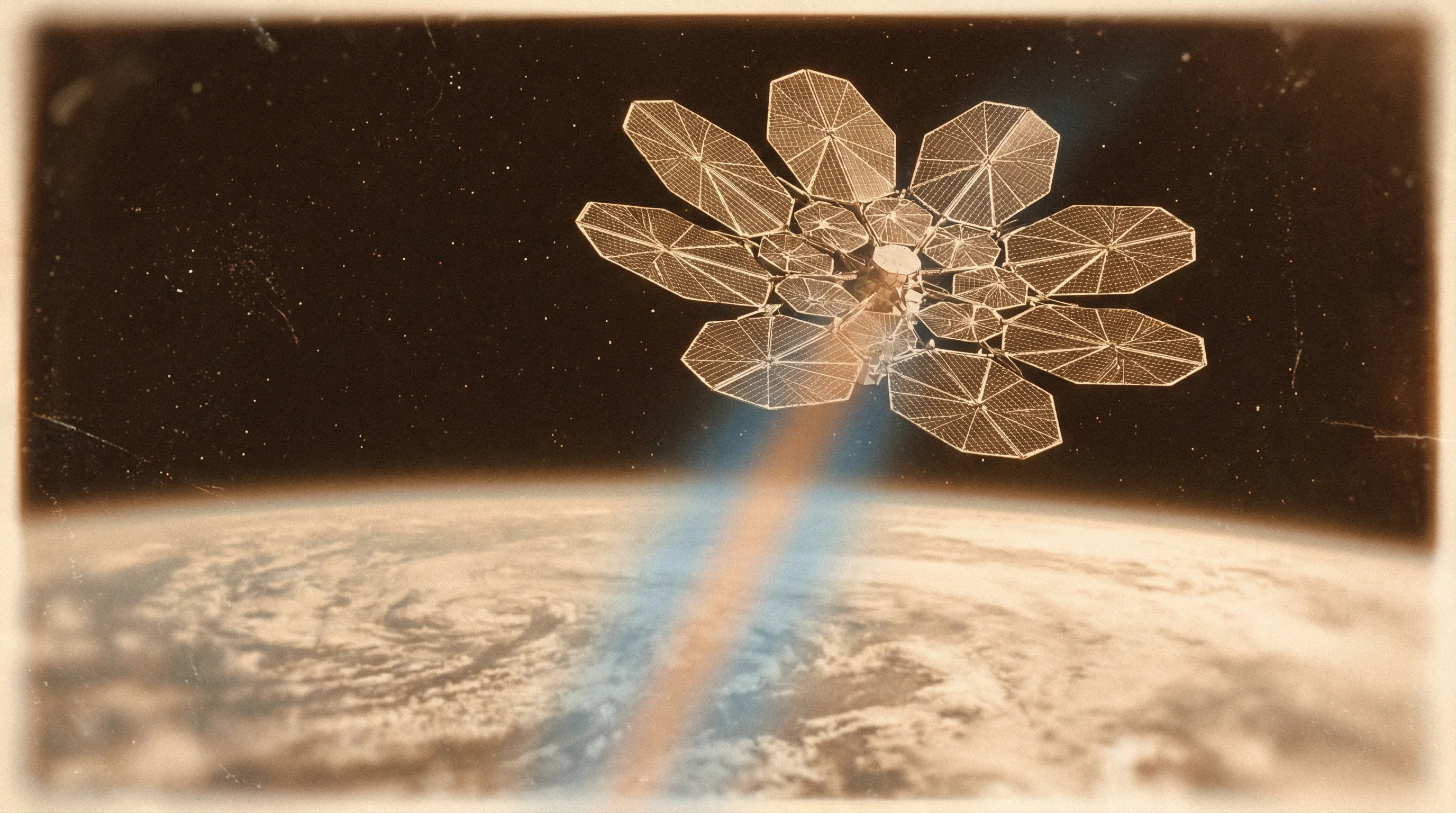
The most speculative driver—and potentially the most transformative, if it ever materializes—is space-based solar power. Caltech's SSPD-1 mission in 2023 and 2024 completed the first in-space demonstration of wireless power transmission and lightweight deployable structures, proving at least some foundational concepts. ESA's SOLARIS initiative is working through concept studies ahead of a 2025 ministerial reassessment. The UK government, through Frazer-Nash studies, concluded SBSP is technically feasible and could be economically viable in the 2030s, with partnerships like Thales Alenia Space and Space Solar pursuing modular designs. A 2025 King's College London study even suggested SBSP could provide up to 80 percent of Europe's renewable energy by 2050 in certain scenarios, though cost, orbital congestion, and regulatory frameworks remain formidable barriers. Formidable might be understating it.
The U.S. Air Force Research Laboratory is advancing its SSPIDR/Arachne program—RF power-beaming sandwich tiles and successive flight experiments. These aren't commercial ventures yet, but they're laying technical and regulatory groundwork that future companies will need. Spectrum coordination, atmospheric safety validation, and licensing regimes for beamed power remain largely undefined. Public acceptance is another question mark entirely.
Meanwhile, orbital debris policy is tightening. NASA updated its NPR 8715.6E guidelines in May 2024, and ESA's 2023 policy shortened disposal timelines and tightened success criteria, reflecting the reality of 35,000 tracked objects and more than one million fragments over one centimeter estimated in orbit. Very large deployables—especially those with football-field-scale geometries—will face heightened scrutiny on collision risk and end-of-life disposal. It's one thing to unfurl a massive array in orbit. It's another to prove you can safely deorbit it or move it to a graveyard orbit when the mission ends.
Open Questions
Launch economics will shape the competitive landscape in ways that are hard to predict. If Starship achieves its cadence and reusability targets, fairing volume constraints ease significantly, potentially favoring some monolithic or lightly deployable structures that would have been prohibitively bulky on previous-generation launch vehicles. But for missions where power density and stowage efficiency matter most—stations, orbital transfer vehicles, mega-payloads—self-expanding or roll-out architectures likely retain an edge. Volume isn't everything when you're trying to generate hundreds of kilowatts from a few cubic meters.
Beyond Reach Labs claims its geometry-changing deployables offer a path to that edge. Whether their technology proves out in orbit, and whether the 10-gigawatt demand curve materializes on the timeline they project, will depend on factors beyond any single startup's control: regulatory frameworks that don't yet exist, launch cadence that remains aspirational, capital appetite for space infrastructure that could evaporate in a recession, and whether orbital data centers or space-based solar power transitions from PowerPoint concept to actual hardware flying overhead.
What's clear—perhaps the only thing that's clear—is that the industry is no longer debating whether orbital power demand will grow. The debate now is how fast it grows, who builds the arrays that power it, and whether the deployment mechanisms that kept Pele Collins up at night at SpaceX can be engineered reliable enough to handle structures the size of football fields unfurling hundreds of kilometers above Earth. The stakes are high. The moment of truth comes when the structure unfolds. And this time, Collins is betting she can change those odds.


