

A monkey somewhere just got a reprieve.
Last December, buried in the FDA's routine guidance updates, appeared a proposal that would have seemed fantastical even five years ago: eliminate or substantially reduce six-month toxicity testing in non-human primates for certain monoclonal antibodies. The Financial Times ran it as an animal welfare story. But pharma executives saw something else entirely—months shaved from development timelines, millions in costs evaporated, and most significantly, human-relevant computational models stepping into the evidentiary role once reserved for living creatures.
This isn't a pilot program. It's production deployment.
The biosimulation market hit $3.91 billion in 2024. By 2030, analysts project $10 billion—a 17% compound annual growth rate that suggests more than incremental software adoption. What we're witnessing is infrastructure being built in real time for a fundamental recalibration of how drugs and medical devices reach patients. The FDA's evolving stance on digital evidence, coupled with parallel momentum from the European Medicines Agency and mounting pressure to curtail animal testing, has created conditions for computational models to migrate from supporting roles to primary evidence in regulatory submissions.
Whether the industry can execute on that promise quickly enough to justify the investment thesis remains an open question.
When Software Becomes Evidence
Consider the numbers Simulations Plus quietly announced in January 2025: their modeling platforms supported development of a majority of FDA-approved drugs last year. Not some drugs. Not a promising subset. A majority.
Meanwhile, Certara's Simcyp PBPK platform achieved something arguably more significant in August 2025—the first and only software to receive EMA Qualification Opinion. Sponsors can now reference the qualified platform for specific drug-drug interaction contexts without re-establishing credibility each submission. That's platform economics entering pharmaceutical development.
The regulatory tailwind has been gathering force methodically, perhaps more methodically than founders hoping for overnight transformation would prefer. In November 2023, the FDA's Center for Devices and Radiological Health finalized guidance on "Assessing the Credibility of Computational Modeling and Simulation in Medical Device Submissions," aligning with ASME V&V 40 standards and establishing a risk-informed credibility assessment framework. A January 2024 webinar walked industry through requirements. Reviewer training has continued since.
On the drug side, mechanics differ but direction holds. The FDA's Model-Informed Drug Development Paired Meeting Program, running through fiscal year 2027 under PDUFA VII, keeps selecting proposals that integrate modeling into clinical development. More transformative—and this is where platform economics get interesting—is the Model Master File concept. Workshops in May 2024 and a CDER webinar this past March outlined a Type V DMF pathway for generic ANDAs, with broader applications expected.
The idea: validated models as reusable infrastructure that multiple sponsors can reference, rather than rebuilding credibility for each submission. Drug Master Files for algorithms, essentially.
ICH M15, the draft guidance on "General Principles for Model-Informed Drug Development" posted late last year, signals harmonization across regulatory authorities. The EMA followed with a February 2025 concept paper to develop guidelines for mechanistic models—PBPK, PBBM, QSP—beyond their existing 2019 PBPK reporting guidance.
The architecture is being assembled piece by piece. Whether it gets built fast enough to meet market expectations is another matter entirely.
The April Announcement That Changed Everything
Perhaps the sharpest signal arrived in April 2025, when the FDA and NIH announced a roadmap to reduce, refine, and replace animal testing with New Alternative Methods—computational models, organs-on-chip, other human-relevant approaches.
This wasn't symbolic posturing.
Eight months later came that December draft guidance proposing elimination or reduction of six-month non-human primate toxicity testing for certain monoclonal antibodies. For biologics developers, that's months and significant costs removed from preclinical timelines, replaced by human-relevant computational evidence. The UK announced parallel initiatives in November 2025 using AI and 3D bioprinting.
Animal welfare organizations are watching. So are CFOs trying to model drug development costs through 2030. So are venture capitalists trying to figure out which biosimulation startups become infrastructure and which become footnotes.
Proof Points Accumulating
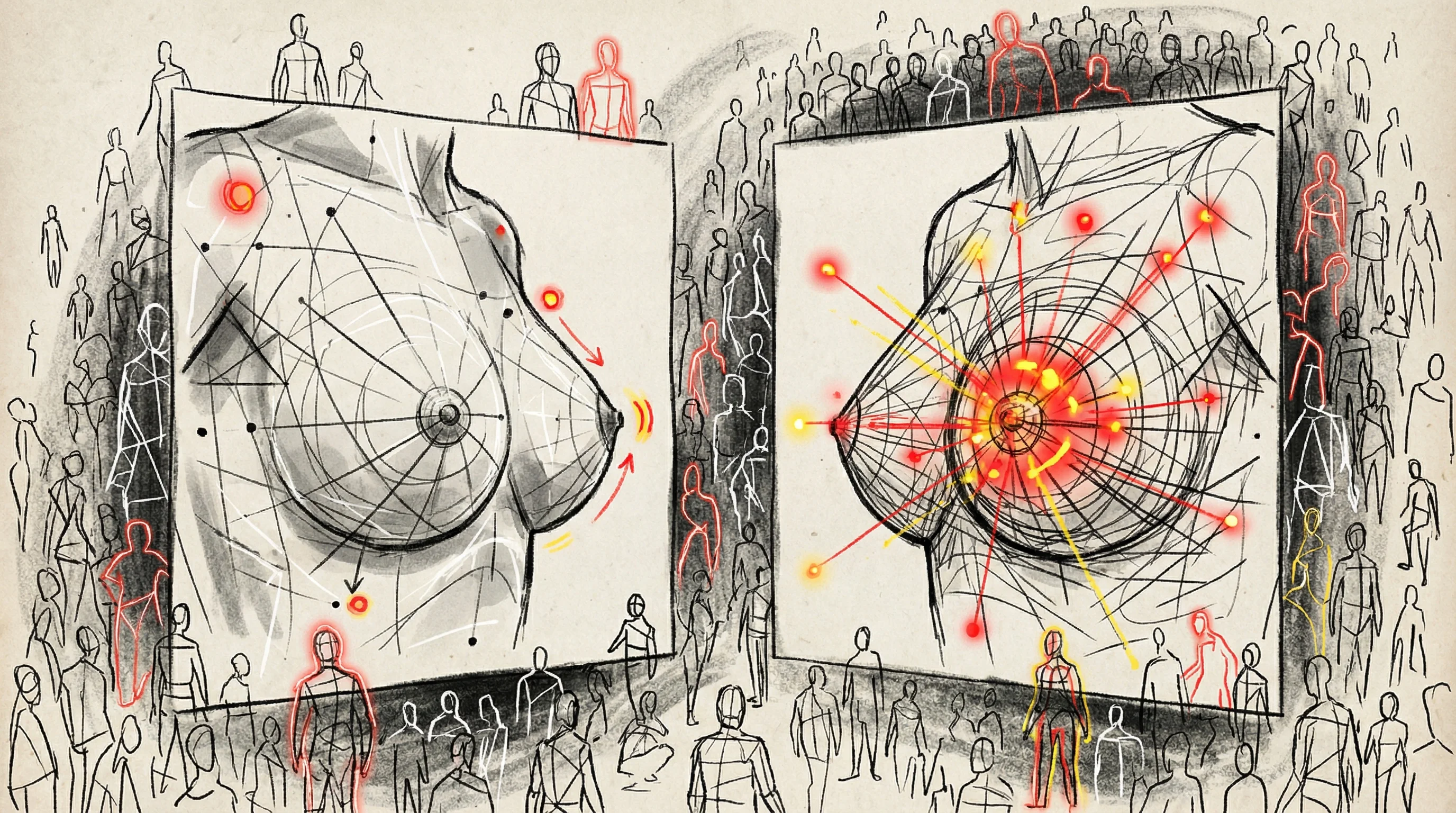
The evidence isn't theoretical anymore, which matters when you're trying to convince conservative industries to adopt new methodologies.
FDA's own VICTRE trial—a virtual imaging clinical trial with 2,986 in-silico patients—compared digital breast tomosynthesis against full-field digital mammography. The computational results aligned with clinical outcomes and supported regulatory evaluation of imaging devices. Proof of concept for digital evidence at scale.
Dassault Systèmes' Living Heart Project, a multi-year FDA collaboration, has been developing in-silico trials for cardiovascular devices, creating virtual heart models from patient imaging data to simulate device performance across physiologically diverse populations. The Living Heart consortium now includes research institutions and medical device companies working toward submissions incorporating digital evidence. Real submissions, not concept papers.
Novadiscovery's Jinkō platform demonstrated predictive power in oncology by modeling the Phase III MARIPOSA trial using quantitative systems pharmacology and 5,900 digital patients. The simulation predicted trial outcomes before the clinical data read out. Pharma executives noticed.
ELEM Biotech, a Barcelona Supercomputing Center spin-out, runs Alya Red, an HPC-based engine for cardiovascular virtual human twins. Their technology creates patient-specific heart models from imaging and echo data, then scales to virtual populations for in-silico trials. It's the kind of physics-driven, computationally intensive work that required supercomputing infrastructure a decade ago, now accessible through cloud elasticity and API calls.
The technical convergence matters as much as regulatory acceptance. Cloud infrastructure eliminated capital barriers to high-performance computing. Running thousands of simulated patients no longer requires institutional supercomputing centers. Physics-informed machine learning approaches are compressing the personalization problem—a 2024 arXiv paper demonstrated noninvasive calibration of cardiac digital twins using self-supervised learning on hemodynamic data.
Market Architecture and Who's Building What
The projected $10 billion biosimulation market by 2030 breaks down across overlapping segments: in-silico clinical trials at $5.59 billion (7.74% CAGR), healthcare digital twins reaching $3.55 billion (25.9% CAGR), PBPK modeling software growing from $185 million in 2024 to $549 million by 2033.
These aren't separate markets. They're different cuts through the same infrastructure layer.
Established players have regulatory traction. Certara's EMA qualification for Simcyp means drug developers can reference the platform for cytochrome P450-mediated drug-drug interactions without reconstructing validation evidence. Eleven regulatory agencies have licensed Simcyp, making it de facto infrastructure for PBPK submissions.
Simulations Plus' portfolio—GastroPlus, DILIsym, ADMET Predictor—spans PBPK, quantitative systems toxicology, and ADME prediction. The FDA itself licenses DILIsym for internal use, which tells you something about institutional confidence.
Open Systems Pharmacology offers PK-Sim and MoBi as free, open-source tools with community contributions and regulatory acceptance. The existence of a credible open-source alternative matters. It sets baseline expectations for model transparency and prevents vendor lock-in at the methodology level.
Newer companies are targeting the integration layer, where value may ultimately concentrate.
Mantis Biotechnology, a New York-based YC Winter 2026 company with roughly three people, positions itself as "infrastructure powering human-in-computer models." Their Wellfound recruiting copy describes a "unified biomedical testing and regulatory platform linking CAD → simulation → bench → verification → FDA Q-Submissions"—essentially Palantir for biomedical evidence.
The company's LinkedIn posts frame their mission around the "impending collapse of the animal model system" and the shift toward human-relevant digital physiology. Whether a three-person team can execute on infrastructure ambitions that overlap with multibillion-dollar engineering software vendors remains to be seen. But the positioning indicates where founders see gaps: regulatory-grade traceability, automated submission packaging, and unification across previously siloed data types.
InSilicoTrials in Italy provides a platform for device and drug modeling. Ansys and Siemens bring multiphysics simulation governance and AI acceleration—Ansys added AI copilot features across solvers in their 2025 R2 release. These are CAE powerhouses extending into life sciences, not biotech companies learning simulation. That matters when you're thinking about who has sustainable competitive advantages.
The Convergence of Modalities

A cardiac digital twin for device testing might start with CT/MRI anatomy, layer in electrophysiology from ECG, validate hemodynamics against echo, then simulate device interaction via finite element contact mechanics. That's imaging data, electrophysiology, fluid dynamics, and structural mechanics unified in a single evidence package.
Mantis's pitch around unifying "in-vitro, simulation, and digital physiology with traceable evidence" targets exactly this integration burden. A 2025 arXiv paper proposed explainable AI-driven workflows for "sloppy modeling" in QSP, accepting that not every parameter needs exact biological measurement if the fit-for-purpose predictions are robust.
The methodologies aren't new—physiologically based pharmacokinetic modeling, quantitative systems pharmacology, finite element analysis for device mechanics have existed for years. What changed: regulatory acceptance, cloud economics, and AI acceleration arriving simultaneously.
Sports Organizations Running Ahead
Sometimes the most interesting adoption patterns emerge outside regulated industries.
Tata Consultancy Services' "Future Athlete Project" creates individualized heart digital twins for elite runners like Des Linden, simulating cardiac response to training loads and optimizing recovery. Kitman Labs provides athlete data infrastructure with 150+ integrations for clubs and leagues, creating a unified view of player health and performance. The NFL works with AWS on "Digital Athlete" initiatives.
These aren't medical device submissions. But they're proving the data infrastructure and validation workflows that medical applications will require. Sports organizations move faster because the regulatory burden is lighter and the economic incentives—injury prevention, performance optimization—are immediate and quantifiable.
BioDigital Human, with 1,000+ conditions and 14,000 anatomical structures, serves Massachusetts General Hospital, Johnson & Johnson, and the National Academy of Sports Medicine for education and patient communication. It's 3D anatomy visualization, not simulation for regulatory purposes. But adoption by major health systems indicates institutional comfort with digital anatomy as a clinical tool, which lowers the psychological barrier to more sophisticated applications.
Reality Checks Worth Heeding
Regulatory acceptance is necessary but not sufficient. A point executives sometimes miss in their enthusiasm.
A 2024 systematic review in npj Digital Medicine found roughly 80% effectiveness across 45 outcomes in digital twin applications for precision health—Type 2 diabetes interventions, NAFLD, heart failure. But it also catalogued gaps: data quality, validation against real-world outcomes, ethical frameworks, legal guidance, and multi-stakeholder coordination.
A 2025 scoping review comparing Human Digital Twin implementations against the National Academies' definition found alignment on core concepts but fragmentation in practice. Model credibility assessment remains labor-intensive. ASME V&V 40 provides a framework, but applying it requires context-of-use specification, verification planning, validation dataset curation, and documentation that regulatory reviewers can evaluate.
That's specialized expertise, not turnkey software.
Data governance for clinical digital twins—patient consent, privacy, interoperability—lacks mature legal frameworks. A regulatory-grade model might require EHR data, imaging, genomics, wearable sensor streams, and patient-reported outcomes, each with distinct privacy and consent requirements. Institutional Review Boards and data use agreements weren't designed for perpetual model refinement.
Organizational resistance shouldn't be underestimated. Drug development teams have decades of experience with animal models and clinical trial design. Regulatory reviewers have comparable institutional knowledge. Shifting to model-informed development requires training, process redesign, and tolerance for new failure modes.
An EMA review of PBPK usage in 2022-2023 Marketing Authorization Applications found 25 of 95 "full" applications included PBPK modeling, primarily for drug-drug interactions. Meaningful penetration, but hardly universal. Technology often diffuses more slowly than its advocates expect, not because the technology fails but because institutional adoption requires aligned incentives and cultural shifts.
What to Watch

The regulatory infrastructure for model reuse is nascent but accelerating. FDA's Model Master File pathway, if it expands beyond generics, could create platform economics similar to Drug Master Files for excipients—validated models as shareable assets that lower barriers for subsequent users.
Animal testing reduction policies will continue. The FDA/NIH roadmap from April 2025 and the December draft guidance on monoclonal antibody toxicity studies are opening wedges, not endpoints. Pressure from animal welfare organizations, cost considerations (non-human primate studies are expensive and time-consuming), and scientific arguments about human relevance all point in the same direction.
For medical device companies, the credibility assessment framework is now clear. CDRH guidance from November 2023 and the January 2024 webinar gave industry a roadmap. Early movers building V&V 40-compliant evidence packages will establish reviewer familiarity and potentially accelerate their own timelines. Q-Submission interactions provide feedback loops before full submissions.
For drug developers, the ICH M15 finalization will standardize model-informed development planning globally, making cross-regional submissions more consistent. The MIDD Paired Meeting Program through fiscal 2027 remains available for strategic integration questions.
Infrastructure providers—whether startups like Mantis positioning as regulatory evidence platforms, or established simulation vendors extending into life sciences—face the question of where value accrues. Is this a winner-take-most platform market where qualified models and network effects create moats, or fragmented vertical solutions for specific organ systems and therapeutic areas?
The fact that open-source alternatives exist for PBPK suggests commoditization pressure on methodology, which would push value toward integration, user experience, and regulatory packaging. The areas Mantis emphasizes, incidentally.
The Evidence Base Grows
FDA's VICTRE trial, Dassault's Living Heart submissions, Certara's qualification, and academic publications demonstrating predictive validity are building a corpus of regulatory precedent. Each successful submission that incorporates computational evidence as primary or supporting data lowers perceived risk for the next.
FDA leadership—including Dr. Tina Morrison at CDRH—has given public talks on how simulation can transform regulatory pathways, signaling institutional commitment beyond guidance documents.
The market estimates converging around $10 billion by 2030 reflect analyst consensus that this crosses from niche to standard practice. Whether specific company projections or timelines prove accurate matters less than the directional momentum.
Regulators are investing in reviewer training and guidance development. Pharma and device companies are building internal modeling teams. Software vendors are adding features. Investors are funding startups.
What remains uncertain is the pace of organizational change.
The $10 billion market isn't about replacing clinical trials entirely. Anyone selling that vision is overselling. It's about rebalancing the evidence portfolio. Smaller, better-designed clinical trials informed by modeling. Device submissions with computational evidence reducing the need for large-scale human studies. Preclinical packages that use validated human models alongside animal data, then gradually shift the weight as confidence builds.
For executives making resource allocation decisions now, the question isn't whether in-silico models become part of regulatory submissions—that's already happening, as Simulations Plus' January announcement makes clear. The question is how quickly credible, traceable, reusable models become commodity infrastructure versus differentiated capabilities.
And whether your organization builds, buys, or partners its way into competence that regulators and payers will trust. Because the monkey's getting that reprieve whether you're ready or not.


