

Sam Rogers is nineteen years old, running a startup from a cattle station in Queensland, and he thinks the future of ranching looks nothing like the past. No helicopters thundering over scrub, no motorbikes kicking up dust at dawn. Just drones—autonomous ones—doing what stockmen have done for generations: moving cattle, reading their moods, keeping them healthy. Only faster, he says. And cheaper. And with data.
In January, Rogers raised $1.2 million in pre-seed funding for GrazeMate, the company he founded after dropping out of robotics studies at the University of Sydney. The pitch? Prove that machines can herd livestock as well as humans, maybe better. It's a bold claim from a teenager. But then again, Rogers grew up on a cattle station. He knows the work. And he knows the math isn't working anymore.
Across two continents, what began as academic curiosity and government-backed trials has started attracting venture capital, USDA research grants, and—perhaps most tellingly—interest from aging ranchers facing a problem with no easy fix: fewer workers, shrinking margins, and cattle that still need moving every few weeks, whether you can find the help or not.
The Arithmetic Doesn't Add Up
The US cattle industry is both shrinking and graying. As of January 1, 2026, the national herd stood at 86.2 million head, according to USDA NASS. That marks the seventh straight year of decline for beef cows since 2019. Beef cows and heifers that calved totaled 27.6 million, down 1% from the prior year.
Meanwhile, the people running these operations keep getting older. The 2022 Census of Agriculture, released in February 2024, pegged the average producer age at 58.1. Nearly 3.37 million producers trying to manage work that demands stamina, long hours, and—increasingly—technological fluency they may not have.
The industry's structure makes the challenge sharper. According to 2025 data from the USDA Economic Research Service, operations with 100 or more beef cows represent just 10.5% of all cattle operations but hold 60.5% of the inventory. These are the sprawling ranches in Montana, Texas, California—thousands of acres where moving cattle isn't a weekend chore but a logistical operation that can cost anywhere from $10,000 to over $1 million annually. Helicopter mustering, contractor crews, aging staff: pick your poison, all of them expensive.
In Australia, where stations can span hundreds of thousands of acres, the economics have been brutal for years. Helicopter mustering runs hundreds of dollars per hour when you factor in fuel, insurance, and pilot scarcity. A 2020 ABC report quoted operators saying sky-high insurance premiums were pushing some to the brink. Night mustering with motorbikes? Dangerous. Daylight-only constraints mean cattle stay ungathered in rough country, costing time and money.
Something had to give.
Three Forces Converging
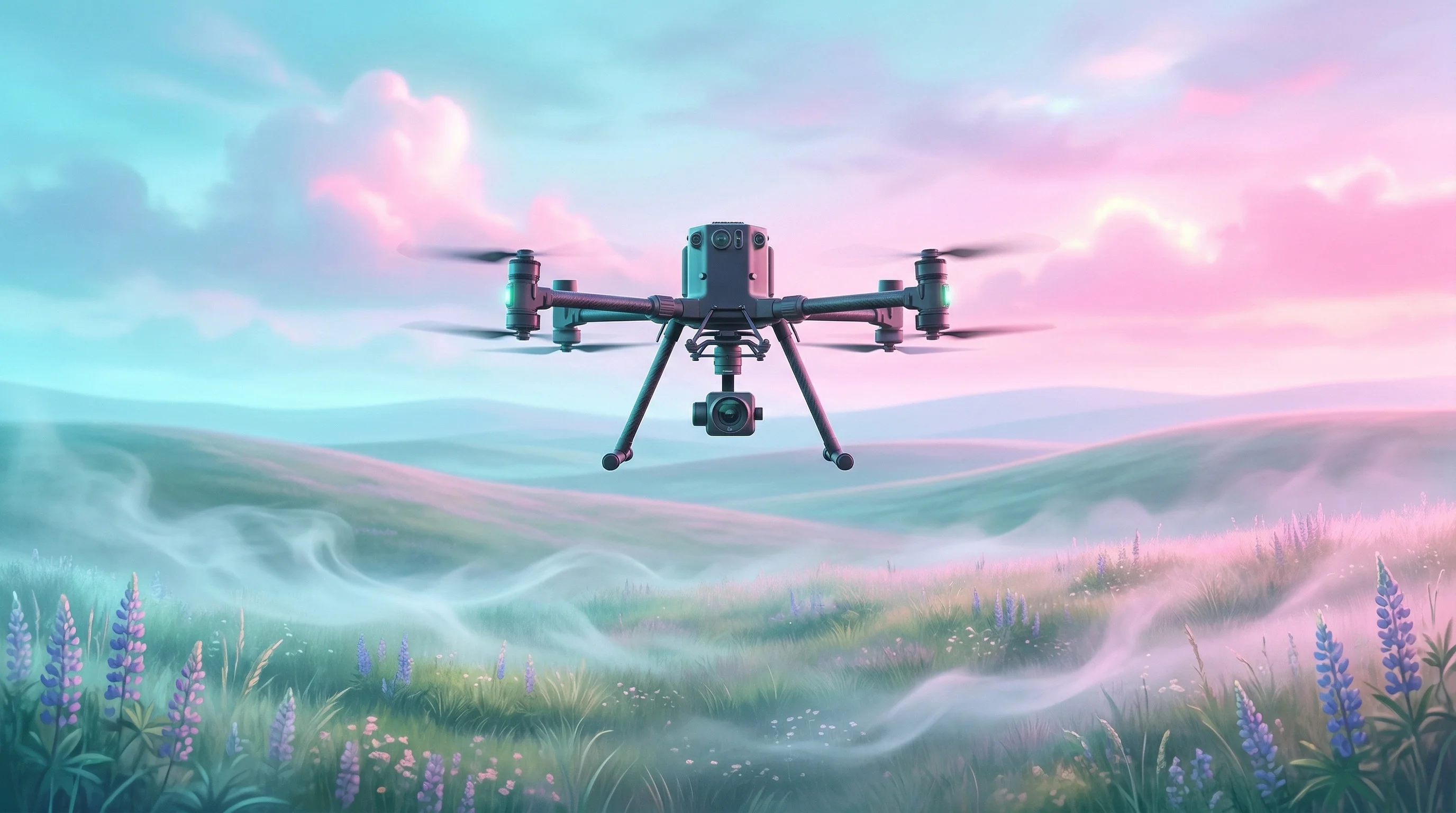
Three trends are pushing autonomous cattle herding from R&D curiosity toward commercial reality in 2026.
First, the hardware's ready. DJI's enterprise drones—the Matrice 30T with thermal imaging, for instance—are robust, field-tested platforms at a fraction of the cost of custom agricultural robots from a decade ago. Thermal cameras spot cattle at night or in dense brush. Battery life has improved; GrazeMate claims 30-minute recharges and the ability to manage up to 2,000 animals with a single drone. "Drone-in-a-box" systems with solar panels and Starlink backhaul can launch missions on schedule, no human required on-site. Whether those claims hold at scale remains to be seen, but the components are there.
Second, the AI is catching up. Early trials showed promise and problems. Cattle habituate to drones. Clumsy piloting stresses animals instead of guiding them. A 2023 study in Applied Animal Behaviour Science documented herding success rates between 51% and 75% initially, dropping by day three as cattle grew accustomed. But newer systems—GrazeMate's among them—claim to read cattle behavior in real time and apply what Rogers calls "stockmanship pressure." The spatial positioning and movement an experienced stockman uses to nudge a herd without spooking it, now algorithmic.
The University of Kentucky secured a five-year USDA grant in September 2024 to study cooperative drone herding. ArXiv papers from late 2024 and early 2025 explore control barrier functions for multi-robot coordination. The sophistication is arriving, even if it's not fully proven at ranch scale yet.
Third, the regulatory and market winds are blowing, unevenly but persistently. In Australia, the Civil Aviation Safety Authority's Landholder Rule allows property owners to fly larger drones on their own land under specified safety conditions without full commercial licensing. That regulatory shortcut accelerated adoption. Meat & Livestock Australia has funded trials since at least 2022, validating drones as cheaper and safer than traditional methods. At Beef Australia 2024 in Rockhampton, a live remote muster demonstration drew national media coverage. By August 2025, Australian Agricultural Company—one of the continent's largest landholders—was routinely using thermal drones for night mop-up musters on its Moray Downs property.
In the United States, the picture's messier. Operators must comply with Part 107, including Remote ID enforcement since March 2024. Beyond-visual-line-of-sight operations—essential for ranch-scale autonomy—generally require waivers. The FAA published a BVLOS notice of proposed rulemaking on August 7, 2025, outlining a framework under proposed Part 108 that explicitly includes agriculture. The comment period closed, reopened in January 2026, and as of late March 2026, the final rule remains pending.
Until it arrives, truly autonomous multi-thousand-acre missions exist in regulatory limbo.
Hardware procurement adds another wrinkle. In late 2025, the FCC restricted new foreign-made drones from entering the US market, though existing fleets can receive updates through at least January 1, 2027 under temporary guidance. Tariff volatility through 2025 raised costs and availability risks for DJI-class equipment. For startups like GrazeMate—whose system is built on DJI hardware—that's a procurement headache to manage.
What's Actually Happening in the Field
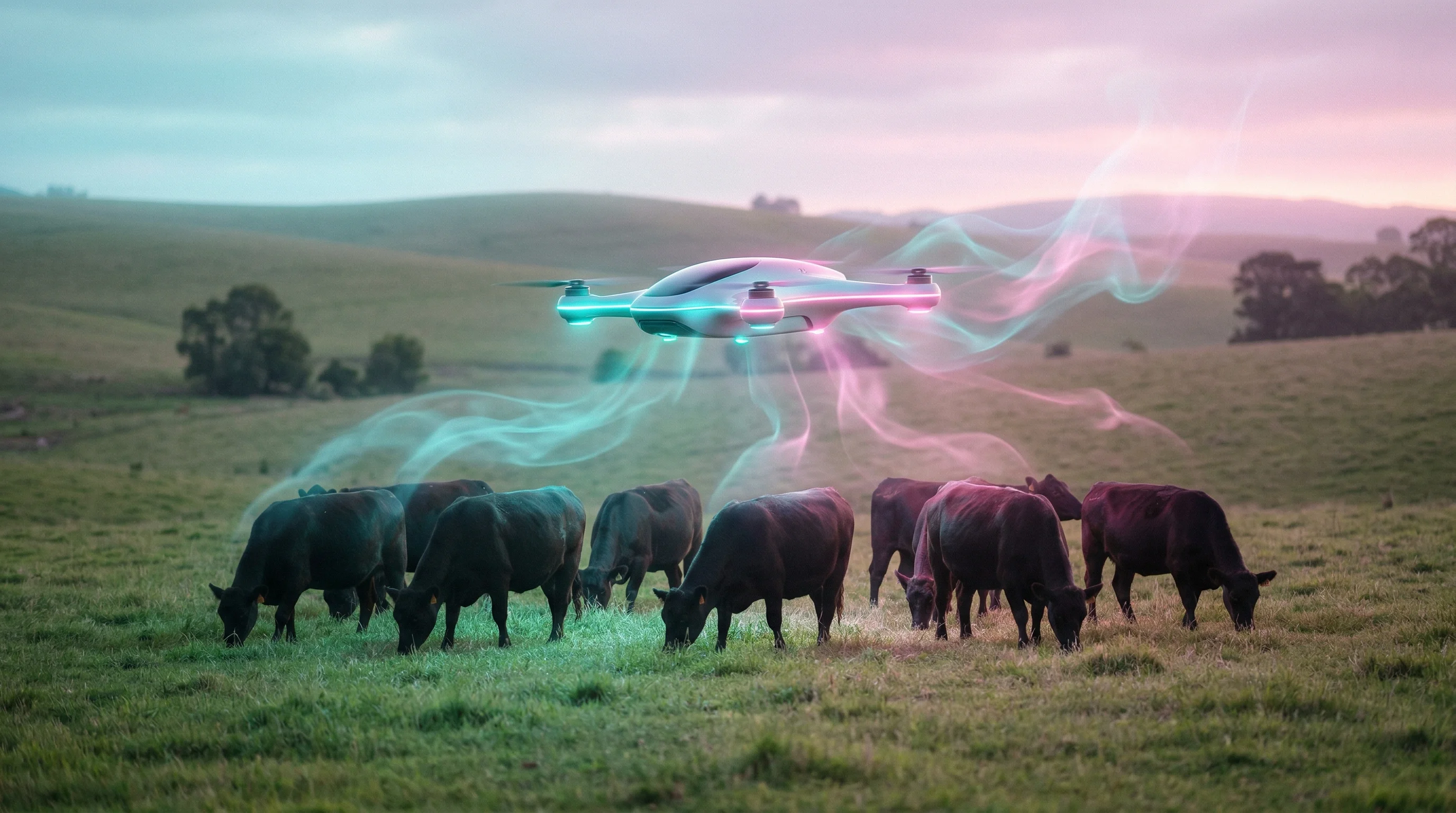
GrazeMate's Gamble
GrazeMate emerged from Y Combinator's Winter 2026 batch with a four-person team and a pitch centered on "physical AI" for ranching. Rogers positions the product as app-driven autonomous mustering: ranchers select a target paddock on their phone, and drones position around the herd to guide animals while simultaneously collecting pasture biomass data, livestock weights, infrastructure condition. Every muster becomes a data-gathering mission. The company's website touts PastureView biomass estimates and GroundView asset checks.
The $1.2 million pre-seed round announced January 14, 2026, was led by Y Combinator, with participation from Antler, NextGen Ventures, and—according to company posts and industry press—Meat & Livestock Australia. (Consider MLA participation company-announced pending independent confirmation.)
Forbes Australia covered Rogers's youth and ranch background. The Van Trump Report, a US agricultural newsletter, noted in February 2026 that GrazeMate had commitments on 1.7 million acres in Queensland and New South Wales and was expanding to California.
The claims are ambitious. A single drone controlling 2,000 head. Solar-powered recharge stations. Local and off-grid operation modes. The YC launch page positions annual ranch spend at "$10k–$1M/year" on cattle movement and promises real-time weight and pasture insights.
But independent validation at commercial scale remains limited. These are vendor claims backed by early pilots, not peer-reviewed ranch-wide studies. That gap matters.
Australian Trials: From Demo to Deployment
Australia is further along, propelled by regulatory tailwinds and geography. The MLA-funded project P.PSH.1374, detailed in a 2023 report, validated drones as more cost-effective and safer than helicopters or motorbikes, with documented productivity advantages. SkyKelpie, a training and equipment provider, led workshops under the Landholder Rule and staged high-profile demonstrations—including the "world-first remote muster" at Beef Australia 2024 and another at evokeAG 2025 in Brisbane.
A Nuffield Scholarship report by Luke Chaplain, published in October 2024, documented multi-site field trials across Queensland properties from 2022 to 2024. Effectiveness ratings hit 9 or 10 out of 10 in several trials. Night mustering with thermal drones reduced stress compared to motorbikes, according to landholder testimonials. Extended visual line of sight and BVLOS elements were tested under CASA oversight. The report included operational detail: DJI M30T-class drones, battery swap logistics, thermal imaging protocols.
In November 2025, JBS Australia publicized a trial with Sensorem at Yambinya and Beef City feedlots in New South Wales and Queensland. Autonomous "drone-in-a-box" systems equipped with Starlink reduced routine inspections from around six hours to under one hour. The drones flew scheduled missions, capturing imagery and flagging anomalies, with privacy zones programmed around sensitive areas. JBS aims to add AI-driven bunk and feed insights, turning feedlot monitoring into predictive management.
SkyKelpie's customer anecdotes, featured on the company website, claim 200% ROI and savings around $80,000 per year for some operators. MLA economic analyses modeled mustering cost reductions versus helicopter alternatives, with some scenarios assuming roughly $130 per hour for UAV lease costs. The exact savings depend on property size, terrain, and utilization rates, but the direction is clear: drones cost less than choppers and pose fewer safety risks.
US Adoption: Thermal Searches and Federal Interest
In the United States, adoption is fragmented but accelerating. Utah State University extension services published guidance in April 2025 on using thermal camera drones for cattle roundup, noting practical value in rough terrain and outlining Part 107 compliance basics. Anecdotally, ranchers in Montana, Wyoming, and Colorado have used drones to locate strays and survey fence lines for years.
The University of Kentucky project, funded by USDA's National Institute of Food and Agriculture in September 2024, is a five-year study on cooperative drones for monitoring and herding. It's academic research, not commercial deployment, but it signals federal interest in validating the technology. Mississippi State's Agricultural Autonomy Institute is exploring ground-and-aerial herding coordination, with project photos from 2023 onward showing multi-robot setups in pasture trials.
Wildlife conflict management offers an unexpected application. In August 2025, the Associated Press reported on drones used to haze wolves away from cattle. Colorado Parks & Wildlife launched a study in September 2025 to test whether drones can deter predators without habituating them or causing unintended stress. Early results are pending.
The Collar Competition
Autonomous herding drones aren't the only automation play. Virtual fencing startups like Halter (New Zealand), Vence (acquired by Merck Animal Health in 2022), and Nofence (Norway) use GPS-enabled collars with audio and electric cues to guide cattle without physical fences.
Halter raised a $100 million Series D in June 2025 at a roughly $1 billion valuation and reported deployments exceeding 400,000 head as of July 2025, with over 11,000 miles of virtual fence active in the US since 2024. Nofence deployed 200,000-plus collars globally as of February 2026 and launched collar-to-collar communication in September 2025 to handle connectivity in remote areas.
Virtual fencing and autonomous drones address overlapping but distinct problems. Collars excel at rotational grazing—moving cattle daily or weekly through planned paddock sequences with minimal human intervention. Drones shine at mustering scattered herds across thousands of acres, locating animals in rough country, and gathering data during the move. Some ranches may use both. It's not either-or.
What Happens Next
The next 12 to 24 months will determine whether autonomous cattle herding becomes a standard tool or remains a curiosity. Several factors will shape the outcome.
Regulation as Rate-Limiter
In the US, BVLOS rulemaking is the single biggest unlock. If the FAA finalizes a rule in 2026 that allows routine BVLOS operations for agriculture under clear safety frameworks—perhaps with third-party oversight or geofencing requirements—large ranches in Class G airspace with low human density will likely adopt quickly. The precedent from Australia, where the Landholder Rule enabled faster scaling, suggests regulatory clarity drives commercial confidence.
Until then, US operators face a patchwork of waiver applications, pilot-in-command line-of-sight constraints, and uncertainty about compliance costs. Some ranches may proceed with waivers. Most will wait.
Hardware supply chains present a separate regulatory risk. The FCC's late-2025 restrictions on new foreign-made drones and tariff volatility create procurement challenges for DJI-dependent systems. Expect increased interest in US- or EU-manufactured platforms and integrated "drone-in-a-box" solutions that meet Remote ID and future BVLOS standards. Companies that locked in hardware inventory or diversified suppliers will have an advantage through 2027.
Validation Gaps and Animal Welfare
Independent, peer-reviewed validation of fully autonomous cattle herding at commercial scale remains limited. The 2023 Applied Animal Behaviour Science study documented success rates and habituation effects. The Australian Nuffield trials and MLA reports provide strong qualitative and operational data. But ranch-wide studies with control groups, stress biomarkers, and multi-year economic outcomes are scarce.
Animal welfare isn't a solved question. Preliminary research from 2021 measured heart rate and movement responses in beef cattle exposed to UAVs, indicating potential stress that must be managed through altitude, noise, and flight-pattern protocols. A 2024 Australian extension commentary suggested that small, well-operated drones can assess welfare "without adverse effects" when flown correctly, but operator skill and training matter.
Low-stress stockmanship—whether human or robotic—requires reading animal behavior in real time and adjusting pressure accordingly. GrazeMate and others claim their AI does this. Proving it at scale will require transparent data, not just marketing copy.
The broader livestock industry will watch closely. Feedlot and dairy operations have different needs than rangeland beef producers, but the underlying technology—autonomous flight, thermal imaging, edge AI for animal detection—translates across contexts. JBS's feedlot trial hints at that convergence.
Market Dynamics and Integration
The global agricultural drone market was valued at $1.92 billion in 2025 and is projected to reach $12.05 billion by 2035, per Precedence Research (February 2026)—a 20.16% compound annual growth rate. Precision livestock farming, which includes drones, collars, sensors, and farm management software, was estimated at $5.10 billion in 2025 and could hit $14.9 billion by 2033, according to Transpire Insight. North America held a 33.5% share of the ag drone market in 2025, per Grand View Research.
Those numbers are analyst projections, subject to revision and varying methodologies. The directional trend, though, is clear: capital is flowing into agtech, and autonomous systems are a focal point.
Integration with conservation programs could provide a policy tailwind. USDA's Natural Resources Conservation Service supports rotational and managed grazing through programs like the Environmental Quality Incentives Program (EQIP) and the Grazing Lands Conservation Initiative (GLCI). Drones that reliably enable frequent, low-stress moves and document grazing patterns align with climate-resilience and soil-health objectives. If autonomous herding can demonstrate reductions in overgrazing, improved pasture utilization, and verifiable carbon or biodiversity benefits, it may qualify for cost-share or ecosystem-service payments. That's speculative, but not implausible.
Who Wins, Who Watches
For founders, the opportunity is real but execution-dependent. GrazeMate's advantage lies in Rogers's ranching background and early traction in Australia, where regulatory and economic conditions favor rapid iteration. Scaling to the US will require navigating BVLOS uncertainty, hardware procurement risks, and proving ROI to skeptical American ranchers who've seen plenty of agtech promises fall short.
Climate tech investors watching this space should note the dual narrative: operational efficiency (cost, labor, safety) and sustainability (rotational grazing, carbon, land stewardship). Drones that deliver both will attract capital and customers.
Agricultural operators—particularly large ranches with aging crews and tight labor markets—are the early adopters. A drone that saves $50,000 to $100,000 annually in mustering costs and provides real-time herd data has a clear value proposition, assuming it works reliably. Smaller operations may wait for prices to drop or lease models to emerge.
Robotics entrepreneurs will find cattle ranching a compelling edge case for autonomy. It's a partially structured environment (fenced paddocks, known obstacles) with dynamic, unpredictable actors (cattle) and real-world consequences for failure (lost animals, welfare issues, broken fences). Solving it requires sensor fusion, behavior prediction, and robust control—skills transferable to other agricultural and logistics domains.
Policy watchers should track the FAA BVLOS rulemaking, FCC equipment restrictions, and any federal livestock management programs that could accelerate or slow adoption. State-level privacy laws, wildlife conflict protocols, and animal welfare codes will also shape where and how drones operate.
The age of the robot cowboy isn't quite here. But it's closer than most ranchers thought possible five years ago. Whether it arrives in 2027 or takes another decade will depend less on the technology—which already works in limited contexts—and more on regulation, economics, and the willingness of an aging, cautious industry to trust machines with work that has, for centuries, required a horse, a hat, and a human eye.


