

The robots were already working.
Not in a demo video. Not in a carefully staged pilot program designed to impress venture capitalists. But on an actual Toyota production line in North America, tending machines, setting tools, kitting parts—the kind of unglamorous, margin-critical work that separates research projects from manufacturing reality.
That operational head start helps explain how Walden Robotics, a Cambridge-based startup that only incorporated in January, managed to secure roughly $300 million in seed funding at a post-money valuation of $1.1 billion when it emerged from stealth this summer. It's one of the largest seed rounds of the year and a rarity in venture capital: a company hitting unicorn status before most people had heard its name.
The deployment timeline is striking. Walden's general-purpose robots reportedly went into production at the Toyota facility in February—meaning the company compressed what industry observers typically describe as a multi-year validation cycle into a matter of weeks. Whether that pace reflects the maturity of the technology or the advantages of spinning out from Toyota Research Institute with preexisting relationships is hard to disentangle. Probably both.
A Corporate Venture Deal With Teeth
Toyota didn't just write a check. The automaker co-led the round through three entities—Toyota Motor Corp., Toyota Invention Partners, and Toyota Ventures—creating a capital structure where the company's largest investor is also its first customer and, in a sense, its institutional parent. That's a level of alignment that even seasoned corporate venture practitioners would call unusual.
Deviation Capital, an early-stage firm that spun out of Two Sigma Ventures, co-led alongside Toyota. The broader syndicate reads like a cross-section of the physical AI investment thesis: NVIDIA and CoreWeave bring compute infrastructure exposure; Boeing and Samsung Ventures add industrial and electronics heft; Prologis Ventures connects to logistics real estate. Financial investors—Calibrate Ventures, Colle Capital, Shine Capital, NextView Ventures, Squarepoint Capital, One Madison Group, KAS Venture Partners, Menlo Ventures, and others—rounded out the cap table.
It's the kind of investor roster that suggests Walden isn't just selling a product. It's positioning itself at the intersection of several converging bets: that AI scaling laws apply to physical tasks, that humanoid form factors (or near-humanoid ones) can navigate legacy industrial infrastructure, and that the "robotics-as-a-service" business model can finally deliver on its long-deferred promise.
The Research Pedigree
Walden's technical leadership carries weight in academic and applied robotics circles. CEO Russ Tedrake is an MIT professor who previously served as Senior Vice President of Large Behavior Models at Toyota Research Institute. Ben Burchfiel, the CTO, and Adrien Gaidon, Chief Strategy Officer, round out a founding team with deep roots in manipulation research and simulation. The Boston Globe reported that the company has also recruited talent from Amazon Robotics, Berkshire Grey, and Kiva—veterans of prior waves in warehouse automation.
The technical foundation rests on what Walden calls "Large Behavior Models," a scaling framework for robot manipulation that emerged from research Toyota Research Institute published in Science Robotics. The company layers this with Diffusion Policy, a generative approach to motion planning, and pairs autonomy with human remote assistance—a hedge that acknowledges most real-world manufacturing environments aren't ready for lights-out operation.
Tedrake has described the system as delivering "a fully-capable robot immediately upon deployment," though what "fully-capable" means in practice likely varies by task and context. The robots continue learning on the job, which is standard language in this sector but also conveniently vague.
Form Factor as Strategy
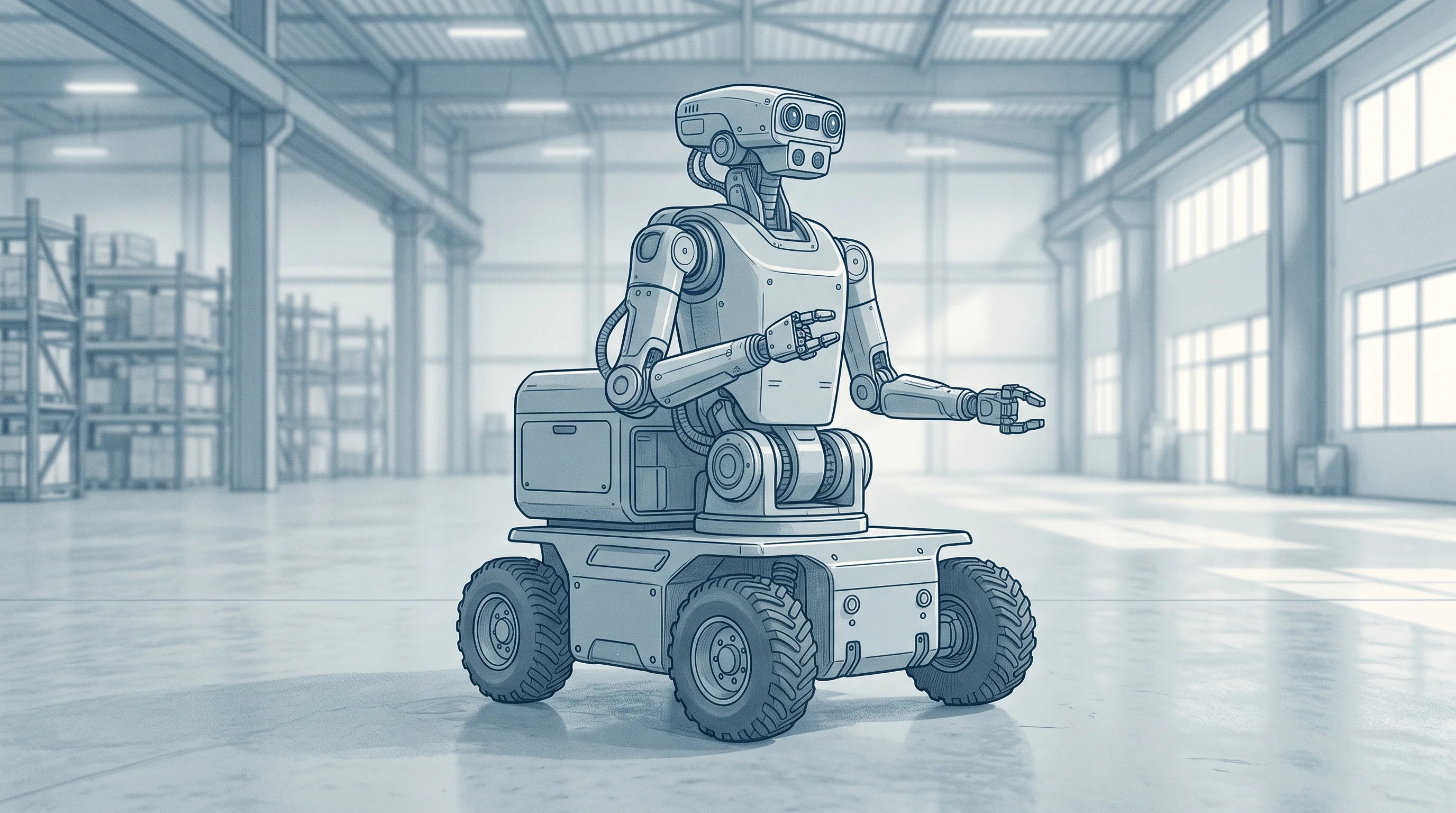
Walden's hardware is not a bipedal humanoid. It's a wheeled upper body—arms, sensors, head—mounted on a mobile base. In remarks published when the company went public, the design choice was framed around existing safety standards and faster time-to-productivity in factory settings. Translation: walking is hard, expensive, and overkill for most indoor industrial tasks. Wheels work fine when the floor is flat.
That pragmatism extends to the business model. Walden is starting with robots-as-a-service, targeting manufacturing and logistics customers. The company has mentioned strategic partnerships spanning automotive, aerospace, semiconductors, electronics, and life sciences, though specific names beyond Toyota haven't been disclosed. Which is typical—early enterprise deals often come with NDAs, and customers don't always want to telegraph their automation strategies to competitors.
The company is hiring across AI, hardware, software, and operations, with roles split between Cambridge and San Francisco. Employee headcount hasn't been made public, though based on typical staffing patterns for companies at this funding level, the team is likely still relatively lean—perhaps a few dozen, maybe approaching a hundred if hiring has accelerated.
A Crowded, Capital-Intensive Field

Walden's funding arrives in a year that's seen aggressive capital deployment across physical AI and humanoid robotics. Skild AI reportedly raised around $1.4 billion earlier in the year at a valuation north of $14 billion. Apptronik closed a $520 million Series A extension in February, bringing its total raised close to $1 billion. NEURA Robotics, a European player, announced a Series C of up to $1.4 billion in June.
The sums reflect both genuine progress in the technology—better simulation, more capable foundation models, cheaper sensors and actuators—and a certain amount of hype-driven momentum. Investors are placing bets that this robotics cycle is different from the ones that fizzled in the 2010s, when companies like Rethink Robotics and others burned through capital without reaching sustainable scale.
Walden's factory deployment offers a concrete counterargument to skeptics, at least in one setting. Whether that success translates across diverse manufacturing environments, or into the messier, less structured world of logistics and fulfillment, remains to be seen.
But for now, the company has something most robotics startups lack: robots that are already clocking in.


