

Isaiah Kaiser likes to describe what happens on the surface of a wound as a race. On one side: bacteria, jockeying for space. On the other: the body's own tissue cells, trying to regenerate. The winner determines whether healing happens—or whether infection takes hold instead.
For decades, the standard playbook has been to dose wound dressings with antibiotics, tilting the contest chemically. Auxilium Health, the Cleveland startup Kaiser co-founded, is trying something different. Their approach engineers the physical architecture of the dressing itself, creating porous structures that, in theory, make it harder for bacteria to colonize while giving human cells a foothold. No drugs required.
It's an ambitious gamble on materials science. And investors—at least the regional and strategic ones Auxilium won't name—seem willing to see where it leads. The company announced on July 14, 2026 that it had closed an oversubscribed $3.4 million seed round, fifteen months after securing its pre-seed. A filing with the SEC from May 15, 2026 showed Auxilium had pulled in $3 million from 13 backers at that stage, targeting $4 million total.
"Last year, the question was whether the science was real," Kaiser said in a statement at the time. "This year, it's how fast we can get it to patients."
Whether speed and science will align remains an open question.
The Material Advantage
What Auxilium calls its Aer platform hinges on bioaerogels—lightweight, highly porous materials that look almost impossibly delicate under magnification. The company's pitch is rooted in a concept that biomaterials researchers have been circling for decades: "the race for the surface," a phrase coined by surgeon-scientist Anthony Gristina back in 1987. The idea is straightforward enough. Whichever cell type—bacterial or human—colonizes a wound surface first tends to win. Auxilium's dressings are designed to rig that race at the structural level.
The technology originated in the lab of Dr. Sadhan Jana at the University of Akron, where co-founders Kaiser and Aparna Agrawal both earned PhDs in polymer and materials engineering. Auxilium holds an exclusive license to the work. According to an abstract tied to a National Science Foundation grant the company received, the dressing is multi-layered, managing fluid while incorporating colorimetric pH indicators meant to flag infection in real time. If bacteria start to thrive, the pH shifts; the dressing, in theory, changes color.
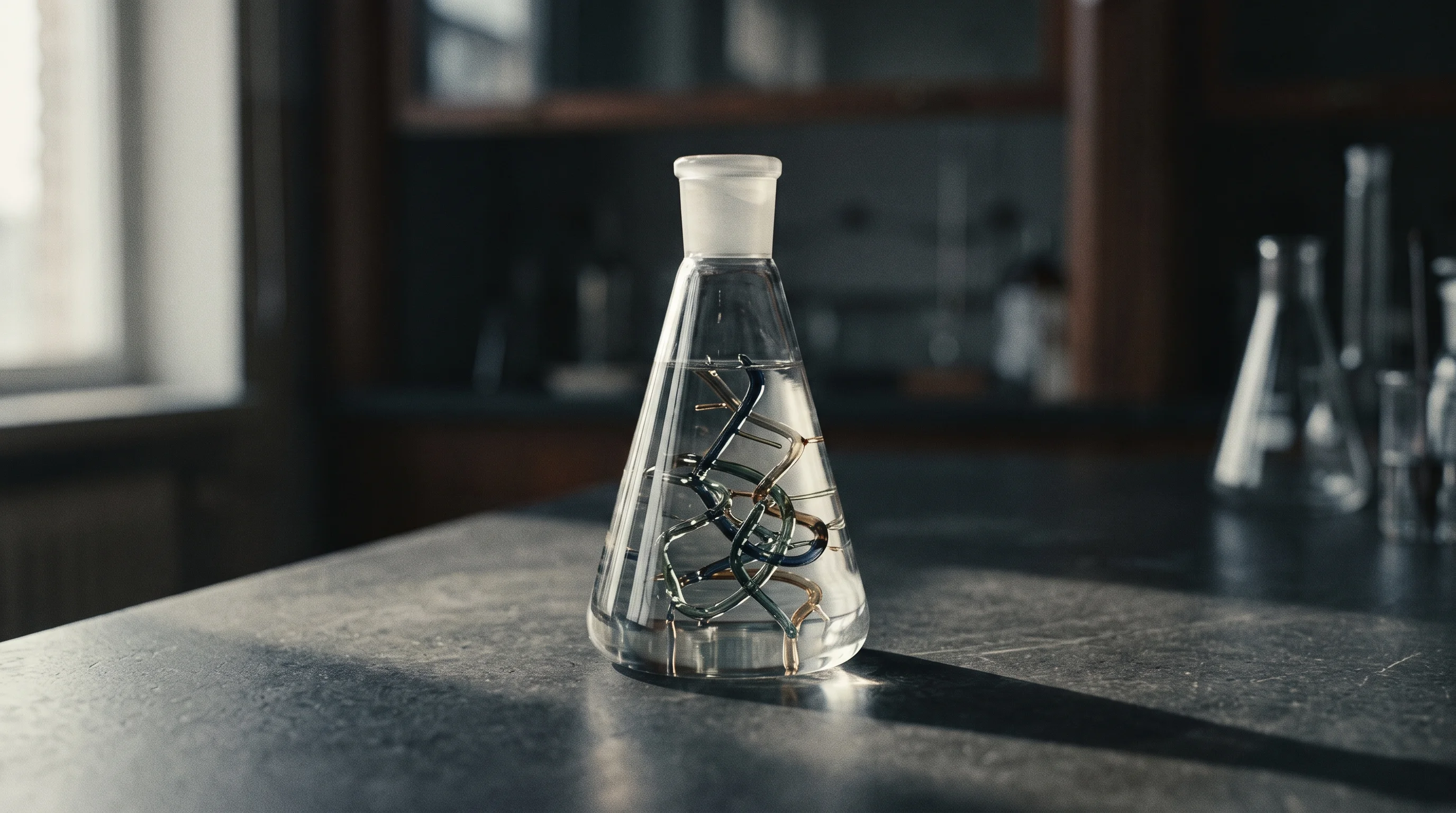
The company operates out of the Cleveland Clinic's Global Innovation Center on Cedar Avenue—a deliberate perch for a startup hoping to navigate FDA approval and, eventually, clinical adoption.
A Crowded, Expensive Problem
Chronic wounds are not a niche concern. Roughly one in six Medicare beneficiaries—some 10.5 million people, based on 2019 figures reiterated in publications through 2025 from the Agency for Healthcare Research and Quality—deal with wounds that refuse to heal. Diabetic ulcers, pressure sores, venous leg ulcers. The kind of injuries that linger for months, sometimes years.
The market for advanced wound care products has grown accordingly. Grand View Research valued it at $11.7 billion in 2025, projecting it could hit $17.8 billion by 2033. Fortune Business Insights offered a slightly rosier estimate, pegging the 2026 market at $14.08 billion and forecasting $23.33 billion by 2034. Estimates vary, as they tend to with fast-moving sectors, but the direction is clear.
Auxilium would be entering a space already occupied by entrenched players—Smith+Nephew, 3M, Mölnlycke, ConvaTec, Coloplast—companies with deep distribution networks and decades of relationships with hospitals and clinics. Breaking in won't be simple.
The Road Ahead—and the Uncertainty
Auxilium has outlined a familiar next-steps narrative: use the seed capital to push Aer toward FDA clearance and first-in-human trials, and grow the team along the way. A report from Ohio's Third Frontier program in mid-2025 indicated the company planned to file for 510(k) clearance—a regulatory pathway for devices deemed substantially equivalent to existing ones—by late 2026. As of mid-July that year, no such clearance appeared in FDA databases, though timelines in medtech have a way of slipping.
The company has been deliberate, if modest, in its growth. LinkedIn suggested Auxilium had somewhere between two and ten employees around that time; a third-party tracker put the count at eleven. Its board, according to the May SEC filing, includes Kaiser, Duane Mancini (CEO of Project Medtech), and William Morgenstern.

Before the seed round, Auxilium had pieced together earlier funding: a $1.5 million pre-seed in April 2025, a $275,000 NSF SBIR Phase I grant, and a recommended $200,000 from Ohio's Third Frontier initiative that July. The company also went through the Synthe6 Materials Accelerator, a program run by Bounce Innovation Hub and the Polymer Industry Cluster.
Perhaps more than Kaiser expected, the question now isn't just whether the science holds up—it's whether a startup built around material innovation can move quickly enough to matter in a market where incumbents rarely sit still. The race for the surface, it turns out, has more than one meaning.


