

The pitch sounds almost too neat. A Y Combinator startup claims its drones can perch on live power lines, siphon energy directly from the conductors, and stay airborne indefinitely—or at least long enough to inspect vast stretches of transmission infrastructure without ever touching ground. Skepticism would be warranted if not for the pedigree: Voltair's technology originated at the University of Washington, documented in peer-reviewed papers, and tackles a problem utilities can't wish away.
How do you keep inspection drones flying long enough to monitor 200,000-plus miles of high-voltage lines? That's not a theoretical question anymore. It's an economic and operational one, with wildfire risk tightening the timeline.
American utilities spend somewhere between $6 billion and $8 billion annually just on vegetation management—trimming trees, clearing brush, maintaining defensible space around conductors. Much of that expense traces back to wildfire prevention, a liability that has bankrupted one California utility and haunts the balance sheets of others. Meanwhile, decarbonization scenarios call for roughly doubling U.S. transmission capacity by 2035, which means more lines to inspect, more corridors to patrol, and more money spent keeping them safe.
Traditional inspection methods—helicopters flying transects, ground crews walking rights-of-way, occasional manned surveys—don't scale to the cadence modern grid operators need. Drones seemed like the obvious answer. Except for one stubborn constraint.
The Battery Problem Nobody Solved
Drones have been flying power line inspections for years now, accumulating real operational hours. Xcel Energy logged over 13,000 miles of beyond visual line of sight (BVLOS) flights with Phoenix Air Unmanned by 2022. Evergy in Kansas completed 150 miles of what they called "true BVLOS" back in 2019, relying only on onboard detect-and-avoid systems—no ground observers. New York Power Authority deployed Skydio Docks last September after an 18-month validation program. ComEd is scaling similar dock-based workflows.
But every one of these programs hits the same wall: battery life. Twenty to forty minutes of flight time, maybe less in cold weather or headwinds. Then the drone needs a recharge.
Drone-in-a-box systems address this by scattering charging pads across a utility's service territory. The aircraft flies its route, returns to base, recharges, and launches again. It works. It's approved. Major utilities are deploying it. But it also means building infrastructure—getting permits, running power hookups, securing site access—at every deployment point. For utilities whose corridors thread through remote canyons or cross private land where easement negotiations drag on for months, that's expensive. And slow.
The industry has tried alternatives, each with its own compromises. Doosan Mobility Innovation's hydrogen fuel-cell drones can stay aloft for over two hours—long enough for pipeline or wind farm inspections, though hydrogen refueling infrastructure introduces its own logistical puzzle. PowerLight Technologies announced kilowatt-class laser power beaming this past January, with integrated flight tests planned for early this year using Kraus Hamdani Aerospace's K1000ULE platform. (Whether utilities will embrace invisible laser beams crisscrossing their rights-of-way remains an open question.) Emrod demonstrated 550 watts of microwave-beamed power across 36 meters inside an Airbus warehouse—impressive, but a far cry from field conditions with wind, weather, and regulatory scrutiny.
Each approach trades off complexity, safety certification hurdles, and cost in different ways. None has cracked the code on persistent, low-cost aerial surveillance at scale.
Charging Where the Electrons Already Flow

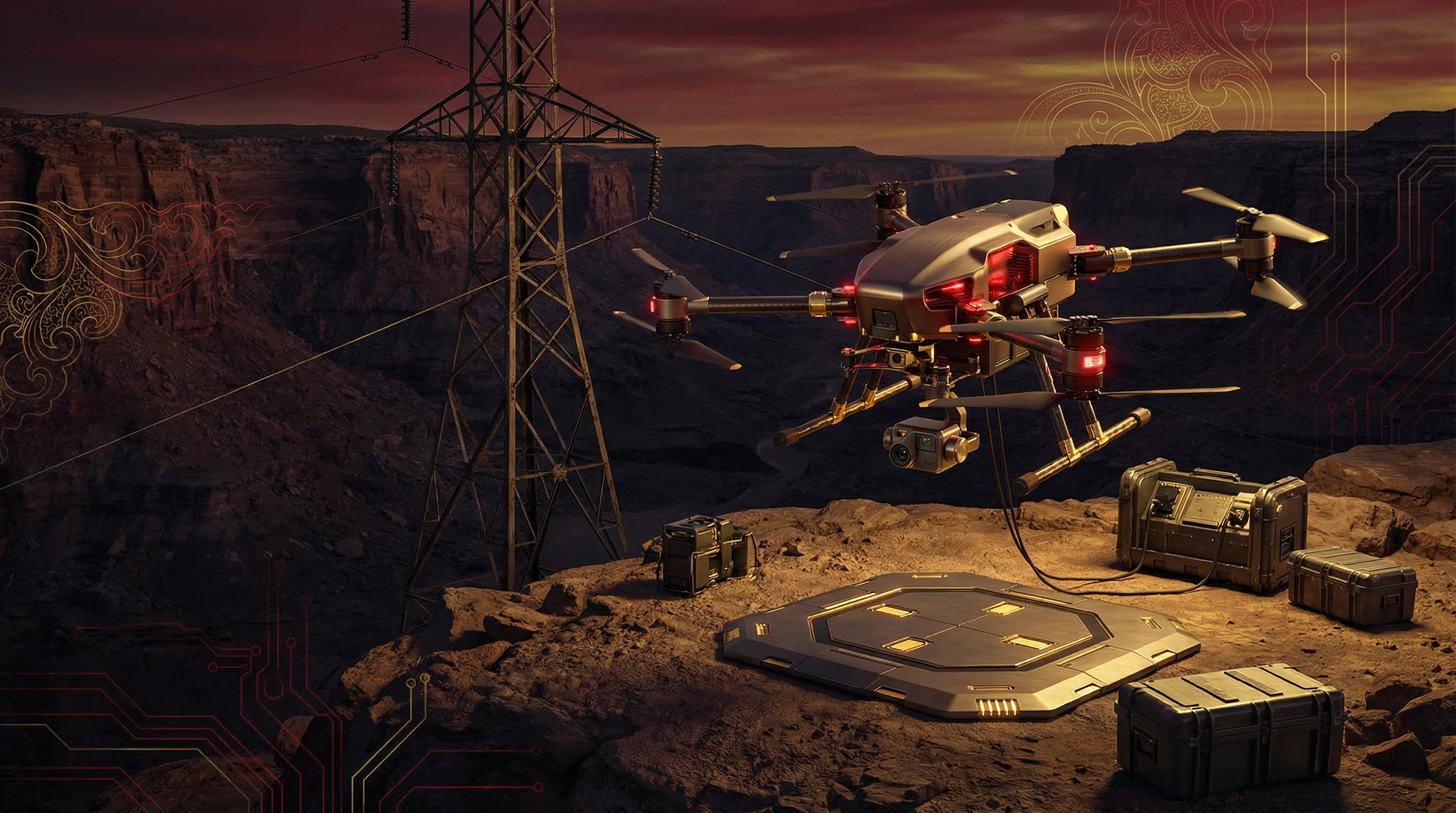
Voltair's proposition is more elegant on paper: let the drones recharge on the very conductors they're inspecting. Why build charging infrastructure when the power grid itself is, by definition, everywhere you need to inspect?
The concept emerged from research at the University of Washington, where co-founders Ronan Nopp and Hayden Gosch developed patent-pending technology for autonomous recharging from overhead lines. A 2024 arXiv paper from the team documented fully autonomous fly-land-recharge-takeoff cycles on an active outdoor three-phase line. The system uses a passively actuated grip and a split-core current transformer that both clamps onto the conductor and harvests energy inductively—drawing power from the magnetic field around the line without making electrical contact.
An earlier 2023 paper in MDPI's Applied Sciences detailed the charging station's design, addressing maximum power point tracking, electrical protections, and the perching manipulator. The authors were candid about constraints, noting "significant power limitations" that required further R&D. That kind of honest engineering assessment is rare in startup marketing materials, which tend toward breathless optimism.
The company won the 2025 UW Environmental Innovation Challenge grand prize and the $25,000 Dempsey Startup Competition. Nopp told UW Engineering last July the goal was "to enable autonomous inspections of the power grid with the goal of completely eliminating wildfire risk for public utilities that use our technology." Ambitious, perhaps more than the founders expected anyone to take literally, but it signaled intent.
The YC launch post, published around mid-to-late January, framed it more modestly: "Our drones can remain deployed indefinitely… positioned where utilities need them most."
Yet here's where it gets murky. Voltair's own website, as of last month, emphasizes inductive charging pads and hybrid fixed-wing survey services—not charging directly on conductors. The divergence suggests either a strategic pivot or parallel product tracks. Early-stage companies often test multiple approaches simultaneously, letting customer feedback and technical reality winnow down the options. The final commercial offering may land somewhere between research prototype and what utilities actually buy.
A Market Already Moving
Voltair is entering a space that Drone Industry Insights projects will grow from $40.6 billion in 2025 to $57.8 billion by 2030, with energy as a top vertical. But calling it a growth market undersells the competition already entrenched.
Percepto offers autonomous drone-in-a-box systems with nationwide shielded BVLOS waivers granted by the FAA in 2022 and 2023—approvals that took years to secure and represent real regulatory moats. American Robotics (now part of Ondas) holds type certification for its Optimus platform, a designation few drone makers can claim. Skydio's Dock has been deployed at multiple utilities, relying on wireless charging pads from companies like WiBotic. These systems work. They're approved. Utilities are writing checks.
Internationally, adoption is moving faster. In Spain, Fuvex secured a contract with Naturgy's UFD to inspect up to 40,000 kilometers of lines through 2026, possibly extending to 2028, using thermal, LiDAR, and AI on hybrid drones claiming 20 times typical range. In Taizhou, China, 207 DJI fixed-wing "drone airports" run 2,484 daily sorties covering thousands of kilometers of transmission and distribution lines. It's a glimpse of what normalized autonomous infrastructure operations might look like when regulatory hesitation lifts and budgets align.
The value proposition is shifting, too. Oak Ridge National Laboratory demonstrated an automated drone system responding to grid anomalies with EPB of Chattanooga last August. Deloitte's work with Exelon and Baltimore Gas & Electric focused on edge-AI for real-time anomaly detection—spotting problems before they cascade into outages. PwC built a remote asset inspection pipeline on AWS integrating computer vision with GIS data. The competitive advantage isn't just hardware anymore. It's the data workflows, the analytics, the integration with asset management systems utilities already use.
The Regulatory and Engineering Gauntlet

The FAA published a Notice of Proposed Rulemaking for "Normalizing UAS BVLOS Operations" on August 7 last year. After initial comments, the agency reopened the comment period from late January to mid-February, soliciting fresh input on right-of-way and detect-and-avoid requirements. If finalized as a performance-based rule—big if—routine BVLOS for infrastructure inspection should scale significantly. Until then, operators rely on waivers requiring case-by-case safety demonstrations. Time-consuming, expensive, and uncertain.
For any system landing on energized conductors, the engineering challenges multiply in ways dock-based systems never face. OSHA 1910.269 mandates minimum approach distances for work near exposed energized parts—10 feet at voltages under 50 kV, increasing with voltage. NERC's FAC-003-5 transmission vegetation management standard, which took effect last April, drives utilities' inspection cadence and spending. Electromagnetic interference and corona effects near high-voltage assets can degrade avionics and sensors; EPRI has run testing programs studying safe standoffs.
The 2023 MDPI paper discussed equipotential design and electrical protections, but acknowledged that power harvesting scales with line current and coupling geometry. On lightly loaded rural lines—exactly where utilities struggle most with access—harvestable power may be insufficient for rapid recharging. On heavily loaded urban feeders, the drone may recharge faster but face airspace congestion and access challenges. It's a use-case-dependent proposition. Not a universal solution, whatever the marketing might suggest.
The Economics Utilities Actually Care About
Vendor estimates suggest drone inspections cost $50 to $300 per mile versus helicopters at $1,200 to $1,600 per mile. Compelling on a spreadsheet. But cost per mile is only part of what utilities evaluate. They're looking at total program economics: capital expenditure for hardware, software integration with legacy asset management systems, training, regulatory approvals, insurance, and organizational change management—the messy human work of getting veteran lineworkers to trust data from flying robots.
A technology that eliminates charging pads could simplify deployment logistics. But only if it passes muster with operations and safety teams inherently wary of novel live-line contact methods. These are the same people who've seen plenty of "revolutionary" technologies fail to account for ice storms, nesting birds, or the reality that power lines aren't always where GIS data says they should be.
Some utilities' drone programs have stalled without clear return on investment or integration strategy, according to a 2025 T&D World analysis. Large utilities like NYPA are betting on dock-based autonomy after rigorous validation programs that took years. Others are waiting for regulatory clarity before committing budget. The market is less about which technology is theoretically superior and more about which one earns utility trust, survives procurement processes designed to minimize risk, and integrates cleanly into operational workflows refined over decades.
Wildfire mitigation budgets are creating urgency, though. Pacific Gas & Electric's undergrounding and hardening programs face cost scrutiny, but spending continues—the liability calculus overwhelms the capital costs. Hawaiian Electric reported substantial wildfire risk mitigation expenditures between 2018 and 2022. These are capital programs desperate for force multipliers—technologies that reduce inspection costs while increasing coverage frequency and response speed.
Proof in the Field, Not the Lab
Voltair is hiring a Founding Drone Pilot & Field Operations Lead, signaling near-term field trials. Whether the company commercializes direct line charging, pad-based systems, or some hybrid approach will depend on customer feedback, regulatory approval pathways, and technical performance in real-world conditions—not lab demonstrations or academic papers. The YC backing provides runway to iterate. The UW research foundation gives technical credibility. But the proof will be in utility contracts and deployed systems that survive winter weather, regulatory audits, and the unforgiving economics of infrastructure markets.
The broader trajectory seems inevitable: utilities will adopt more autonomous, persistent inspection systems as BVLOS rules normalize and wildfire compliance pressures intensify. China's model of hundreds of automated drone bases may preview U.S. utility operations once economics and regulations align. Substation-hosted docks, corridor BVLOS waivers, and edge-AI analytics are likely the near-term path for utilities unwilling to wait for more exotic solutions.
For technologies like Voltair's line-charging concept, the question isn't whether utilities need better solutions. They do, desperately. It's whether landing on energized conductors, with all the attendant safety certifications, regulatory approvals, and operational complexity, offers advantages compelling enough to justify the engineering lift and risk profile compared to already-approved alternatives.
The company has perhaps two years to answer that question with deployed hardware before investor patience and market windows shift. Maybe less, depending on how quickly competitors scale.
In an industry where infrastructure investments span decades and operational conservatism is rational—not bureaucratic—revolutionary rarely beats evolutionary. Voltair's challenge is proving its approach isn't just clever engineering, the kind that earns academic citations and wins university competitions. It needs to be a better, safer, more economically compelling answer to a problem utilities already know how to solve, even if imperfectly.
That's a higher bar than most startups clear.


