

The new plant in Wilson, North Carolina, sprawls across a considerable footprint—enough space, in theory, to churn out cultivated meat at commercial volumes. Believer Meats had built the facility as what appeared to be a flagship operation, the kind meant to convince skeptics that lab-grown protein wasn't just a science experiment but an actual business.
It never produced a single commercial batch.
On December 10, the company announced it would cease operations entirely. The news landed with a dull thud rather than shock—perhaps because, by late 2025, closures and contractions in the cultivated meat sector have become almost routine. What makes Believer's exit particularly stark is the timing: the Wilson facility had only just finished construction. The investment had been made, the ribbons cut. And then, nothing.
If you've been watching this industry with any degree of attention, the shutdown reads less like an isolated setback and more like the clearest admission yet that the economics of cultivated meat—despite billions in venture capital, despite sustained media fascination—are proving far more intractable than most investors bargained for.
This isn't a rough patch. Companies are shuttering facilities, slashing payrolls, and abandoning even the pretense of near-term commercial viability. The sector isn't delayed. It may be broken.
Where Did All the Chicken Go?
Try to buy cultivated meat in the United States right now. You can't.
UPSIDE Foods, one of the sector's most visible players, ended its lone restaurant partnership with Bar Crenn in San Francisco back in February 2024, according to Bloomberg. Since then? Silence. No new foodservice deals, no retail launches, no pivot announcements with any real commercial traction. In March 2025, the company announced layoffs—phrased, as these things always are, as a strategic "focus on commercialization and scale." It was the second round of cuts following reductions the year prior. The language doesn't quite square with the reality: there is nothing to commercialize at present, and scale remains a distant ambition.
Singapore, often cited as the industry's most hospitable regulatory environment, offers the only live data point. GOOD Meat launched GOOD Meat 3 at Huber's Butchery in May 2024—a hybrid product containing just 3% cultivated chicken, the rest conventional poultry. The 120-gram packs sold for S$7.20. The company said the product would be available "for the remainder of 2024." No updates since. Even in the world's friendliest jurisdiction, the actual product on shelves relies almost entirely on traditional meat. The cultivated portion is, effectively, a garnish.
This is a sector that, not long ago, forecast imminent ubiquity. Now it struggles to maintain a token retail presence anywhere.
The Regulatory Backlash You Didn't See Coming
The U.S. market is fracturing in ways few anticipated. Florida banned cultivated meat sales effective July 1, 2024. Alabama followed on October 1. Then Mississippi, Indiana, and Texas added their own prohibitions throughout 2025. Indiana and Texas imposed two-year moratoriums; Mississippi's ban has no sunset provision.
Legal challenges are underway—a federal judge in Florida kept portions of a lawsuit alive in late April—but the trend is unmistakable. This is not a favorable regulatory climate. It's hostile.
Internationally, Italy enacted a national ban in November 2023. Hungary did the same in November 2025. Both face potential conflicts with European Union law, but the political will behind these restrictions is evident. Regulatory momentum, once imagined as a tailwind for the sector, has reversed.
Federal oversight in the U.S. splits awkwardly between agencies. The FDA handles pre-harvest cell culture; the USDA's Food Safety and Inspection Service manages processing, inspection, and labeling. Last October, FSIS issued a sampling program notice requiring environmental and product testing—every other batch until at least ten samples are collected. The scaffolding for regulation exists. What's missing is a functioning market with viable economics and political support.
The Intractable Math of Media Costs

Cell culture media dominates variable costs at pilot scale. The expense is driven by recombinant proteins—albumin, primarily—and growth factors like FGF2 and TGF-β. A technoeconomic analysis from CE Delft, published several years back, flagged media as the primary cost driver. Historical list prices for these inputs reached levels that rendered scaled production economically implausible. The analysis concluded that even if growth factors and recombinant proteins could be slashed through innovation or supply-chain breakthroughs, capital expenditures would simply emerge as the next insurmountable barrier.
Researchers have made strides, to be fair. A study from Tufts in 2024 engineered cells to produce their own FGF2 via autocrine signaling, eliminating the need for external supplementation. Work on substituting albumin with rapeseed protein isolate, or embedding growth factors in scaffolds, has shown some promise. Materials from the Good Food Institute suggest that in-house production of TGF-β and FGF2 might contribute as little as $0.82 per liter of media—at research scale.
But research scale isn't industrial reality. The sector frequently cites a target of under $1 per liter for food-grade, serum-free media as essential for competitive pricing. That threshold hasn't been publicly demonstrated at volumes meaningful for commercial output. An academic study from a few years ago estimated wholesale costs around $63 per kilogram, with retail exceeding $100 per kilogram under certain assumptions. For context, that's roughly ten times the cost of conventional chicken.
You can innovate around the margins. But order-of-magnitude cost gaps don't close quickly.
Bioreactors: The Next Brick Wall
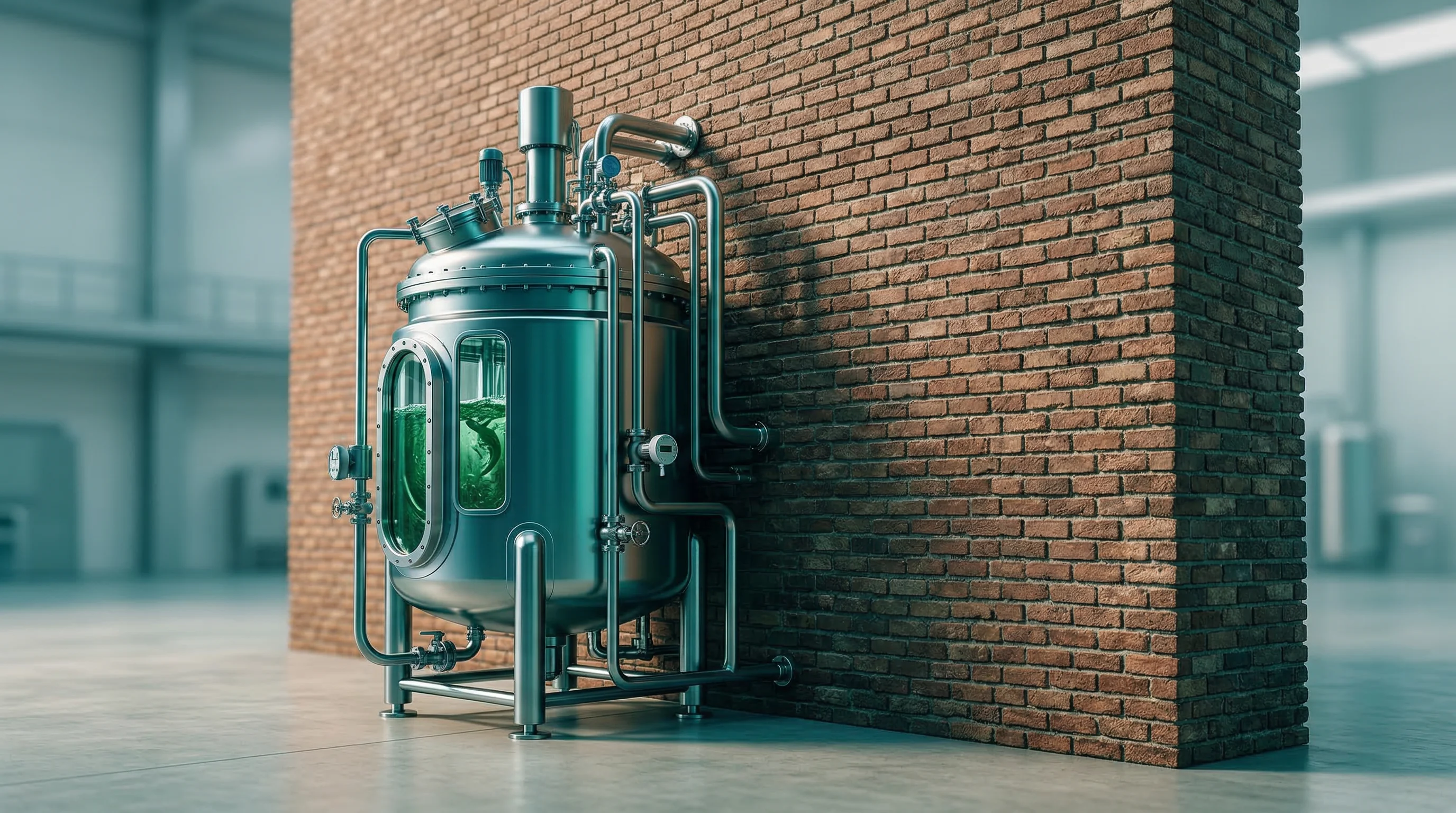
Assume, generously, that media costs collapse. Capital expenses are waiting.
Bioreactor costs reported to GFI's scale-up survey range from $50,000 to $4 million, depending on size and configuration. A 1,000-liter system might run about $100,000. A 200-liter single-use unit, closer to $300,000. A combined 200-liter and 2,000-liter setup can approach $1 million. These are small systems by food industry standards—laughably small, in fact.
Operators surveyed by GFI ranked supply-chain access, suitable large-scale bioreactor designs, filtration hardware, and experienced bioprocess talent as their top pain points. Facilities require near-pharmaceutical asepsis—cleanroom-adjacent environments—which drives installed costs sharply upward. Multiple technoeconomic models conclude that after aggressive media cost reductions, capital expenditures often become the dominant remaining expense.
And then there's the biology itself. Mammalian cells are fragile. They're oxygen-hungry. Oxygen transfer and mixing constraints intensify as reactor volume increases. Larger stirred tanks face steep oxygen gradients and higher shear stress, both of which damage cells. Low growth rates, metabolic inefficiency, catabolite and CO₂ inhibition, shear-induced cell damage—all of it limits practical bioreactor size and achievable cell density, according to analyses by Open Philanthropy.
Industry models discuss targets around 150 grams per liter by the end of the decade. Translating lab-scale results to facilities producing tons of product remains, at best, unproven. At worst, implausible.
Contamination, Texture, and Environmental Questions
Contamination control at food scale is expensive. Microbial and mold contamination rank as top concerns in operator surveys, and FSIS's sampling program reflects regulatory attention to the risk. Frequent contamination events push processes toward pharmaceutical-like clean-in-place and sterilize-in-place protocols, or heavy reliance on single-use systems. Both add cost.
Then there's differentiation. Moving from proliferated cells to muscle or fat tissue with actual texture slows production cycles and requires scaffolds, biophysical cues, additional unit operations. Throughput drops. Costs per unit rise. The industry is exploring perfusion systems, rocking or wave bioreactors, fixed-bed or fluidized-bed reactors—all attempting to balance mass transfer against shear. These approaches remain largely experimental at food scale.
The environmental case, once considered settled in favor of cultivated meat, is now contested. A preprint from UC Davis in 2023—not peer-reviewed, and vigorously disputed—suggested that near-term cultivated meat using pharmaceutical-grade inputs could carry higher greenhouse gas intensity than conventional beef. The conclusion depends on process and input assumptions, but it's a reminder that the sustainability argument isn't locked down. Reviews from the past couple of years emphasize that environmental performance hinges on achieving food-grade media, higher productivity, and renewable energy. Until then, lifecycle assessments diverge wildly.
What Happens When Biology Meets Economics

The struggles in cultivated meat aren't about regulatory delay or a temporary funding drought. They reflect something more fundamental: a collision between biological constraints, economic realities, and political resistance that no amount of venture capital can simply muscle through.
The technoeconomic analyses published over the past several years consistently surface the same obstacles—media costs, bioreactor scalability, contamination control, capital intensity. These aren't problems that yield to incremental iteration. They require breakthroughs in metabolic efficiency, media formulation, and bioprocess design. Breakthroughs that remain uncertain in both timing and feasibility.
Believer Meats' shutdown, UPSIDE's layoffs, the near-total absence of sustained commercial sales—these signal that the sector is entering a period of reckoning. For investors who poured money into the space during the 2020–2021 boom, the lesson is sobering. Deep-tech commercialization in biology doesn't follow the arc of software, or even hardware. The journey from lab bench to industrial scale in mammalian cell culture is constrained by physics, chemistry, and microbiology in ways that capital alone cannot overcome.
The cultivated meat story isn't over. But the gap between aspiration and commercial reality has never looked wider. Or, frankly, harder to close.


