

Walk into certain startup offices lately and you might notice something off. The typing—that steady percussion of productivity—has gotten quieter. It's not what you think. People are working, maybe harder than ever. They're just talking instead.
Voice and vision AI have finally, after years of false starts and awkward demos, become something approaching useful. Not in every context, not for every task. But for enough workflows that lean teams are starting to reconsider which tools actually make sense.
The executive pressure is real. In 2026, 91% of customer service leaders were fielding questions from the C-suite about AI implementation, according to Gartner data published in February. That's not abstract curiosity anymore—it's manifesting in ambient meeting transcripts, voice-first support agents, computer vision tools that can see what's on a screen and actually help navigate it. For startups trying to operate above their weight class, the pitch is straightforward enough: automate the grunt work—typing, clicking, data entry—so your small team can focus on things that matter.
Whether it's that simple remains to be seen.
What Changed
The technology crossed some kind of threshold, though exactly when is hard to pinpoint. Voice and vision AI moved from venture-backed moonshots into production environments at major enterprises. More importantly, the scaffolding now exists for smaller companies to deploy similar capabilities without building everything themselves.
Intel expects more than half the PCs shipped this year to qualify as "AI PCs" with on-device inference—announced in March, a bet that local processing will matter for latency-sensitive voice work. Qualcomm launched its Snapdragon Wear platform with neural processing units specifically designed for voice-first "Personal AI" experiences. Microsoft's Copilot Vision, which rolled out across Windows through late last year, can now see your entire desktop and provide voice-guided assistance. Google's Search Live feature went global on March 27, 2026, combining real-time camera input with conversational voice queries.
These aren't experimental features tucked away in developer previews. They're shipping products, platform bets from vendors staking their roadmaps on multimodal interaction.
The enterprise software layer adapted fast, perhaps sensing which way the wind was blowing. On February 17, Slack added a Model Context Protocol server and Real-time Search API explicitly designed to let AI agents access company data and tools through voice or text interfaces. The infrastructure underneath—low-latency speech-to-text, text-to-speech with sub-200ms time-to-first-byte, WebRTC media handling—has matured enough that a three-person startup can wire up a functional voice agent in days rather than months. Whether they should is another question, but the technical barriers have dropped considerably.
Why Now
Three forces seem to be converging, though they're not always pulling in the same direction.
First: economics. McKinsey reported late last year that 23% of organizations were already scaling at least one agentic AI system, with another 39% experimenting. That's not just large enterprises with dedicated AI labs—the tooling has commoditized to the point where startups can access roughly the same building blocks. Deepgram's Aura-2 text-to-speech hit sub-200ms latency in May 2025. ElevenLabs launched a real-time Scribe v2 product with lower latency and integrated it with Twilio for production telephony. Cartesia positioned its Sonic-3 model for sub-100ms voice synthesis, which sounds incremental until you remember that conversational AI lives or dies on those milliseconds.
The technical progress is measurable, at least. A benchmark published April 6—Full-Duplex-Bench v3—compared real-time voice models from OpenAI, Google, Grok, and others on accuracy, latency, and interrupt handling. The systems are getting good enough that conversations don't feel stilted. Turn-taking works. Barge-in (when a user interrupts mid-sentence) is handled somewhat gracefully. These details matter enormously for adoption, because clunky interfaces don't get used. They just don't.
Second, and more paradoxically: regulatory pressure is accelerating adoption rather than slowing it. The EU AI Act's bulk applicability kicks in August 2. The FCC's February 2024 ruling classifies AI-generated voices in robocalls as illegal under the TCPA and remains in force. Tennessee's ELVIS Act, in force since July 2024, targets unauthorized voice replicas. A class action filed February 5 alleges Microsoft Teams collected voiceprints without consent under Illinois biometric privacy law.
Startups navigating this landscape are realizing that not implementing voice AI can be riskier than doing it thoughtfully. If competitors deploy voice agents that handle routine customer inquiries while your team manually types responses, you're at a disadvantage—perhaps more than the founders expected when they first started evaluating these tools. The trick is building with transparency and user consent baked in from day one, which better platforms now support. In theory.
Third, and maybe most important: founder attention is finite. Gartner forecasts roughly 10% of customer service interactions will be fully automated by 2026—a number that's been floating around since late 2025. That might sound modest, but for a 10-person startup, automating even 10% of support volume means reclaiming dozens of hours weekly. Hours that can go toward shipping features or landing the next customer instead of answering "how do I reset my password?" for the hundredth time. Or maybe the two hundredth. Who's counting anymore?
Where It's Actually Working

The adoption patterns tell a story about where this technology works now, not in some imagined future three years out.
Healthcare became an early proving ground, which makes sense given the documentation burden clinicians face. Mayo Clinic announced on January 14, 2025, that it would deploy Abridge's ambient clinical documentation tool to 2,000 clinicians, with subsequent rollouts at Duke Health and Johns Hopkins. Suki AI expanded to more than a dozen health systems via MEDITECH integration. A May 2025 study from Included Health showed that 540-plus clinicians using a custom AI scribe reported 94% reduced cognitive load and 97% less documentation burden—numbers that might be inflated but probably reflect real relief. By late March, a survey found 75% of U.S. health systems were using at least one AI application, with clinical documentation improvement at 43% adoption.
Physicians aren't typing patient notes anymore. They're talking through encounters, and the AI writes the chart. It's a narrow use case, but it's high-stakes—medical documentation errors have real consequences—and it seems to be working more often than not.
Customer service is the other obvious beachhead. Stanley Steemer deployed a Genesys voicebot in mid-2025 that resolves cancellation and reschedule calls without human assistance. Papa John's partnered with Google Cloud as the first customer for its Food Ordering agent, demoed at NRF 2026 with plans for nationwide deployment by the end of 2026. SoundHound AI reported record Q2 2025 revenue of $42.7 million, up 217% year-over-year, driven by partnerships in voice-powered ordering across automotive and hospitality verticals.
These aren't fringe experiments—they're production deployments at scale, handling real revenue and real customer interactions. The question is how long before smaller companies can deploy similar capabilities without burning through their seed round.
The less obvious shift is happening inside startups themselves. Computer-using agents—systems that can actually navigate graphical interfaces the way a human would—are moving from research labs to practical tools, albeit with significant caveats. OpenAI's 2025 technical report on its Computer-Using Agent documented a system that operates arbitrary GUIs. The CUA-Skill benchmark, published January 28, achieved a 57.5% success rate (best-of-three) on WindowsAgentArena tasks. Agent S2, presented at ICLR 2026, pushed scores higher on OSWorld and WindowsAgentArena through a compositional generalist-specialist framework—the kind of architecture that sounds impressive until you try to explain it to your head of ops.
What this means in practice: instead of writing a Zapier workflow or manually copying data between tools, you can describe the task in natural language and let an agent click through the interface. It's not magic. Reliability varies, and you wouldn't trust mission-critical workflows to it yet. But for repetitive administrative work, it's often good enough. Which turns out to be a pretty low bar that still covers a lot of ground.
What Comes Next
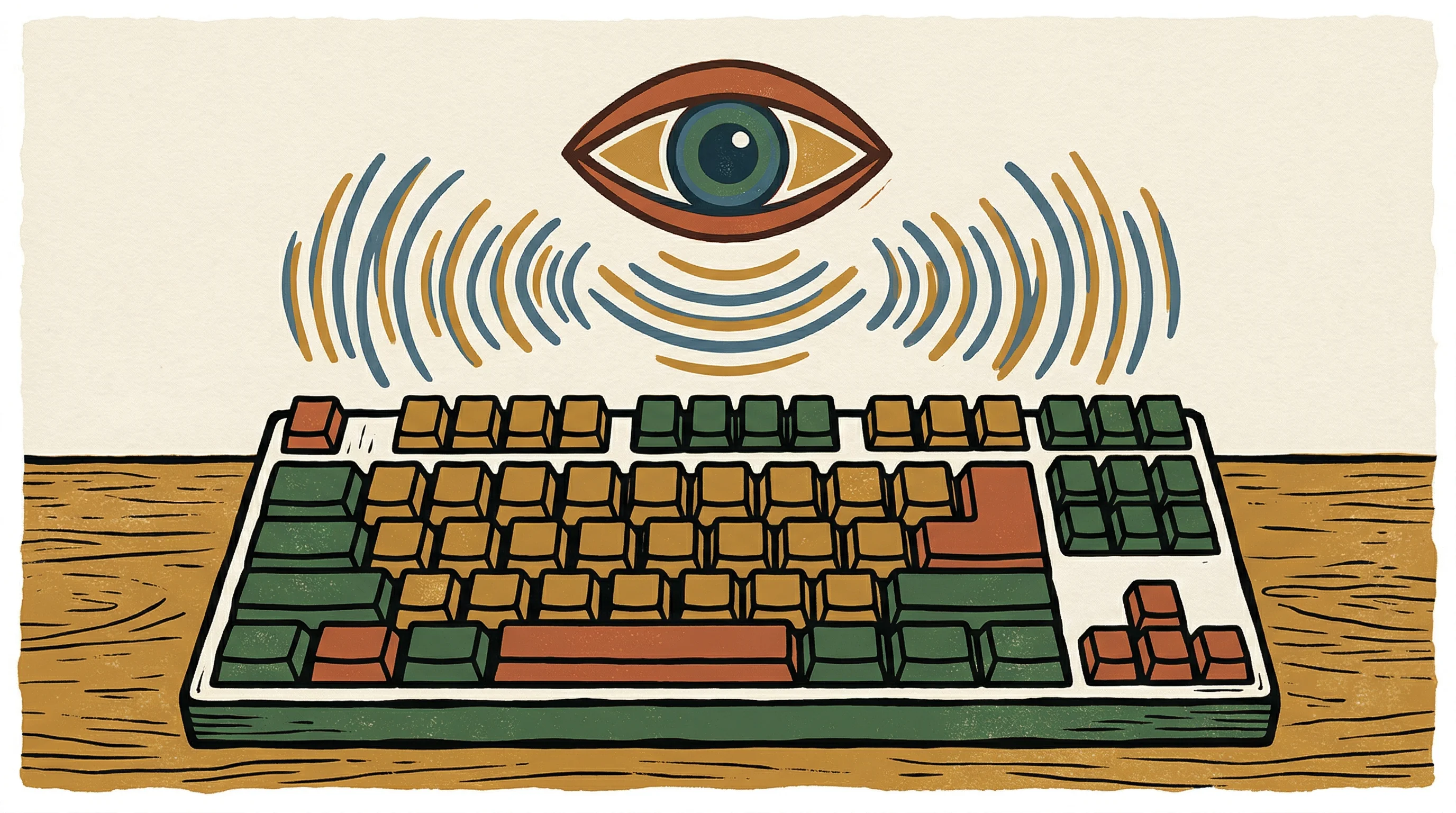
The trajectory from here seems relatively clear, even if the pace remains uncertain. Voice and vision interfaces won't replace typing for deep work—writing code, drafting strategy docs, financial modeling. Those tasks still require the precision and iterative control that keyboards provide. But for a growing set of tasks—customer support, meeting notes, data entry, simple research, internal help desk queries—talking or showing is faster than typing. The startups that figure out which 20% of their workflows can shift to voice or vision will free up meaningful capacity.
The tooling will continue improving. Benchmarks published through early this year show latency dropping, accuracy climbing, and interrupt handling getting smoother. Slack's MCP integration signals that enterprise platforms are building the connective tissue for agents to actually do things, not just chat. Microsoft's "Copilot Checkout," announced at NRF 2026, aims to complete purchases entirely within an AI agent. Adobe reported a 693% year-over-year rise in generative-AI-driven retail traffic during the 2025 holiday season—a number that probably includes a fair amount of tire-kicking but still suggests consumer comfort with these interfaces is growing. The commercial infrastructure is materializing, piece by piece.
Two challenges loom, though, and they're not trivial.
The first is reliability. OSWorld-Human and OS-Marathon benchmarks introduced through late 2025 and early this year measure agent performance on long-horizon tasks and temporal efficiency—the unglamorous stuff that determines whether something is a demo or a product. Agent scaffolding, memory management, tool orchestration: these matter as much as model quality, maybe more. Startups adopting this technology need to account for failure modes and build workflows that degrade gracefully when the AI gets confused. Which it will.
The second is trust and compliance. The Illinois biometric privacy lawsuit against Microsoft Teams, filed in February, is a warning shot that reverberated across the industry. Voice and vision systems inherently collect more personal data than text-based tools. Startups building these capabilities need explicit consent flows, transparent data handling, and compliance with emerging regulations like the EU AI Act. Getting this wrong isn't just a PR problem—it's potentially an existential one, particularly for companies operating across jurisdictions.
But the most interesting question might be cultural. Founders who cut their teeth in the keyboard-and-mouse era will need to rethink what "productivity" looks like. If your best engineer can dictate feature specs while walking the dog, or your operations lead can verbally query company metrics without opening a dashboard, does the traditional 9-to-5 desk setup still make sense? Maybe not, though that opens a whole other set of questions about work boundaries and always-on expectations.
The startups winning this year aren't necessarily the ones with the most AI on their roadmap. They're the ones ruthlessly focused on leverage—extracting maximum output from the smallest team. Voice and vision AI, deployed thoughtfully, are starting to deliver that leverage. Not consistently, not perfectly, but enough to matter.
The keyboard isn't going away. But for a growing number of workflows, it's no longer the default. And that shift, quiet as it's been, might be more significant than the hype cycles around it would suggest.


