

Construction drawings arrive in thick stacks, sometimes hundreds of pages for a single commercial building. Somewhere in those blueprints: thousands of electrical symbols marking outlets, fixtures, conduits. An estimator's job is to count them all, price them out, and submit a competitive bid before the deadline. Miss too many, and you've underbid yourself into a money-losing project. Count too conservatively, and someone else wins the work.
Most electrical contractors, as a result, can only afford to bid on a fraction of the opportunities crossing their desks. The math just doesn't work otherwise.
Jesse Choe and Gautham Ramachandran—neither of whom have construction backgrounds—think they've found a way to change that calculus. Their company, Bidflow, emerged from Y Combinator with an AI copilot designed to automate electrical takeoffs, the painstaking symbol-counting work that forms the backbone of every bid. The pitch is appealingly simple: help contractors bid on four times more projects by collapsing days of estimating work into minutes.
Whether the industry is ready to trust software with work that's always required human judgment is another matter entirely.
The Jane Street Coders Who Discovered Construction
Choe is a college dropout with a competitive programming background and a stint at Jane Street, the quantitative trading firm that's become something of a feeder system for ambitious technical founders. Ramachandran brings similar coding competition credentials. The two previously launched Ghostship, an automated QA testing tool, through an earlier YC batch before abandoning it for construction software.
Their corporate entity still carries the Ghostship AI Inc. name—a vestige of that earlier incarnation—but the focus has shifted entirely to electrical estimating. It's the kind of narrow vertical play that venture investors have been gravitating toward: deep specialization in an unsexy industry where incumbent software hasn't kept pace with what's now technically possible.
The pivot from quality assurance testing to electrical takeoffs seems, at first glance, random. But there's a logic to it. Both involve pattern recognition at scale, tedious processes ripe for automation, and industries where speed creates direct competitive advantage.
How the Software Actually Works
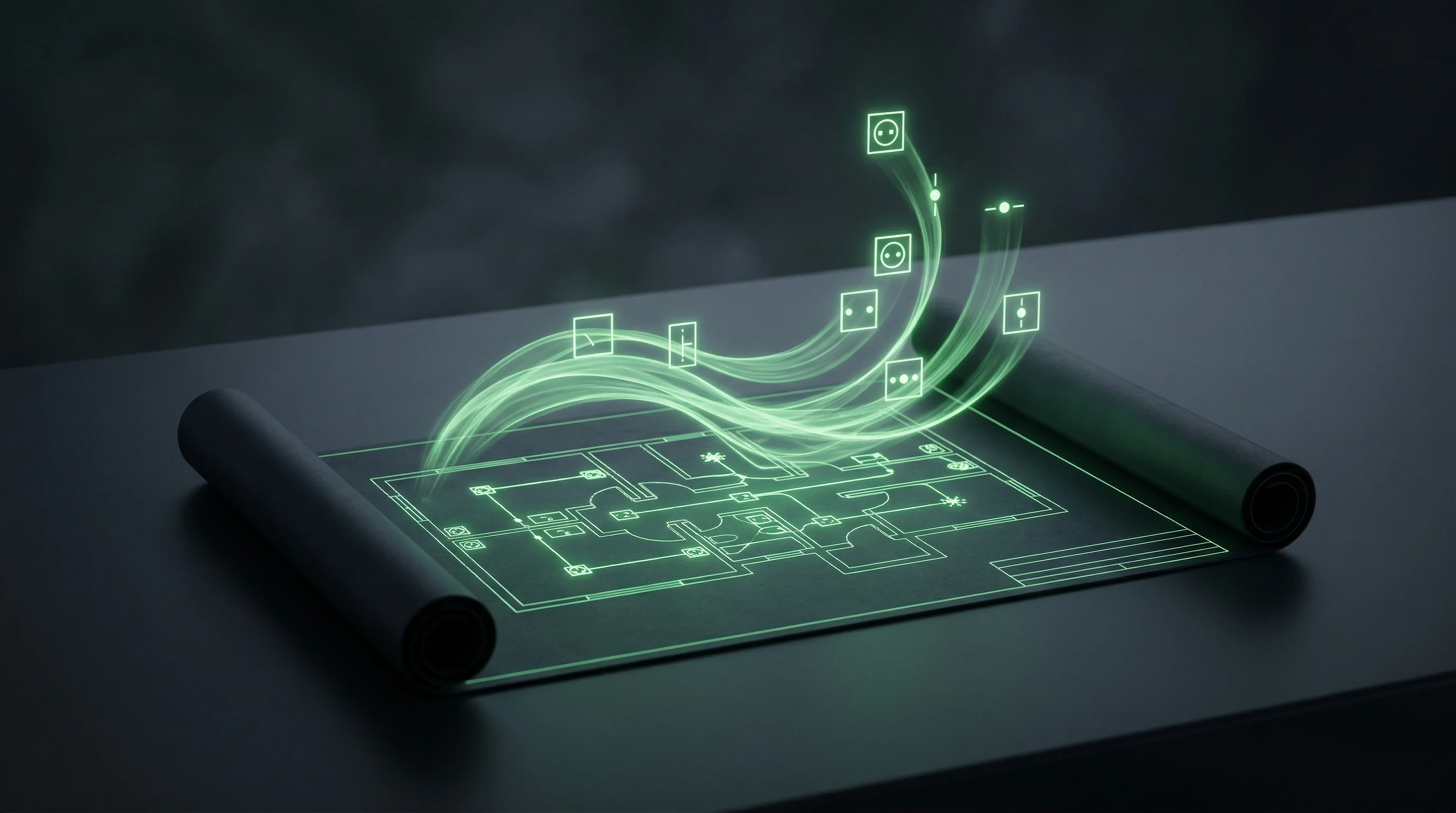
Bidflow tackles the most time-intensive part of electrical estimating: the initial takeoff. Contractors upload PDF drawings and specifications. The AI scans the documents, hunting for the standardized symbols that indicate power outlets, lighting fixtures, junction boxes, and other electrical components. Then it counts them, automatically.
The company's model—currently at version 2.4.0, according to their documentation—claims 95-99% accuracy on both power and lighting takeoffs. There are no independent benchmarks for those figures, and the company hasn't disclosed which types of projects or drawing complexity levels produce which accuracy rates. But the precision matters enormously. Miscount a few dozen outlets on a large commercial project and your bid becomes dangerously wrong, in either direction.
After the initial symbol count, Bidflow generates assemblies and identifies labor units for each work item. The system pulls in material pricing (presumably from databases that need regular updating), allows estimators to adjust labor rates and profit margins, then exports everything as spreadsheets or PDFs. The entire process, which contractors say typically takes hours or days depending on project size, supposedly drops to under 10 minutes.
Pricing follows a pay-as-you-go model: three cents per correctly detected symbol. Bidflow estimates that's roughly 70% cheaper than manual takeoffs in New York City, where they peg human time at around 10 cents per symbol. Those cost comparisons depend heavily on local labor rates and what you're counting as fully-loaded estimator time—variables that shift dramatically by geography and firm size.
The Verification Problem
Speed is worthless if estimators can't verify the work. An AI that counts quickly but unreliably creates more problems than it solves.
Bidflow's answer is something the founders call "proof of work"—not the cryptocurrency mining sense, but literal references showing where the AI found each item. Click on any detected outlet or fixture and the system shows you the exact location in the original drawings. It's a design choice aimed at keeping human estimators in control rather than asking them to trust a black box.
The platform includes built-in PDF measurement tools for scaling wire and conduit runs, plus the ability to audit and correct mistakes by manually adding or deleting detection boxes. There's also a Q&A feature for querying the drawings directly. Ask for fixture mounting heights from a specific specification section, and the AI attempts to pull the answer with a source reference.
Whether this level of transparency is enough to overcome decades of "trust but verify" instincts among estimators—who've built careers on catching exactly these kinds of errors—remains to be seen.
A Very Crowded Space

Bidflow is entering a market that's already thick with competitors, both established and emerging.
Trimble's Accubid platform has dominated electrical estimating for years. They've been adding API capabilities and cloud-based tools. ConEst offers IntelliBid and SureCount, which include automated symbol counting backed by extensive NEC databases. Countfire specializes in automated PDF takeoffs. STACK has launched something called STACK Assist. Togal.AI is pushing into electrical estimating with its own AI-powered approach.
And within Y Combinator's recent cohorts alone, construction tech copilots have multiplied. ContextFort built one for construction drawing review. Constructable offers an AI copilot for broader construction workflows. The accelerator seems to be churning out variations on the same thesis: that construction is a massive, tech-averse industry where AI can automate tasks that have resisted automation until now.
Bidflow differentiates through electrical-specific specialization and pay-per-symbol pricing instead of subscriptions. Maybe that's enough. Maybe contractors prefer paying for results rather than monthly seats. Or maybe the fundamental product—AI-powered symbol detection—is becoming commoditized before the market has even fully formed.
Timing, At Least, Seems Right

The broader backdrop is favorable, or at least potentially so. The U.S. electrical contracting industry is navigating what appears to be a data center construction boom. Industry data suggests data center construction spending has surged dramatically, with costs per square foot climbing steeply. Electrical work represents an enormous component of those projects—complex, high-stakes installations where competitive bidding and fast turnarounds create real pressure.
If Bidflow's pitch about helping contractors compete for four times more contracts has any validity, that's where it would show up first: in markets where demand is outstripping contractors' ability to respond to opportunities.
Still Very, Very Early
Bidflow remains in its earliest stages. The company lists a team size of two. No external funding rounds beyond the standard YC investment have been announced publicly, though the founders likely pitched at Demo Day. They're seeking introductions to electrical contractors and driving adoption through direct demos—the classic early-stage playbook.
The company hasn't disclosed customer names, revenue metrics, or validated case studies through official channels. Growth indicators, if they exist, aren't yet visible.
There's a straightforward path to relevance here: get into enough electrical contracting shops, prove the accuracy claims hold up across diverse project types, demonstrate real time savings, and expand from there. Whether two technical founders with no construction industry background can navigate the relationship-driven, risk-averse world of commercial electrical contracting is the more interesting question.
For now, Bidflow represents a bet—one of many being placed right now—that electrical estimating is ripe for AI-driven automation. The founders have built software. What they're really selling, though, is trust: the idea that contractors should let an algorithm handle work that's always required experienced human eyes.
The market, as it tends to do, will have the final say.


