

The pitch arrived in late July 2026, delivered with the straightforward confidence of founders who've already spent years in the aerospace trenches: a rocket small enough to launch from a standard shipping container, fast enough to cross 450 miles in fifteen minutes, and designed to land on dirt.
Los Angeles-based Hop Aero—six people, a Y Combinator badge, and what appears to be an operational prototype—calls it Rook. The vehicle is meant to haul 250 kilograms of cargo on a suborbital arc, reach hypersonic speeds on reentry, and touch down autonomously. No runway. No fixed launch infrastructure. Just a 40-foot ISO container, the kind you see stacked on cargo ships, that doubles as a mobile launch platform.
It sounds like science fiction. Then again, so did reusable boosters not long ago.
What sets Rook apart—at least on paper—isn't just the containerized launch concept, though that's the hook. It's the application: point-to-point hypersonic delivery for scenarios where waiting simply isn't an option. Military resupply to remote or contested zones. Emergency parts for offshore oil rigs where downtime bleeds millions per hour. Critical pharmaceutical shipments. Manufacturing components that can't miss a production window.
Whether any of those markets can sustain a rocket-based logistics business remains an open question. But Hop Aero already has something most hypersonic startups don't: $1.25 million from the U.S. Air Force and hardware tests completed at the Oklahoma Spaceport.
Who's Building This
CEO Matija Milenovic isn't new to the game. Before Hop Aero, he ran Porkchop, a satellite electric propulsion startup that managed to fly hardware on SpaceX's Transporter-3 mission before exiting via an IP sale. Earlier still, he worked at Destinus—one of Europe's more ambitious supersonic ventures—where he led systems engineering for high-speed UAVs. He holds a master's in aerospace engineering from Sweden's KTH Royal Institute of Technology.
CTO Jacob Balaj's résumé reads like a tour through the last decade of American space and defense hardware. MV-22 avionics in the Marine Corps. Falcon 9 and Falcon Heavy booster refurbishment at SpaceX. LauncherOne integration at Virgin Orbit before that company's spectacular implosion. Lunar lander work at Masten Space Systems under NASA's Commercial Lunar Payload Services program. A stint at SpinLaunch, the company attempting to hurl satellites into orbit via kinetic launch.
It's the kind of background that suggests comfort with both iterative hardware development and the regulatory labyrinth that governs anything attempting to fly above controlled airspace.
The company itself dates to 2024. By the summer of 2026, Hop Aero had joined Y Combinator's latest cohort and publicly announced Rook.
The Air Force Connection

The $1.25 million contract came through AFWERX, the Air Force Research Laboratory's innovation arm, under a Phase II Small Business Innovation Research award. The project title: "ROOK: Rapid Operations Over Kilometers." Award date: September 24, 2025. The contract was set to expire in October 2026.
That places Hop Aero squarely within the Department of Defense's broader—and somewhat quixotic—exploration of rocket-based logistics. AFRL designated "Rocket Cargo" a Vanguard program back in June 2021, later rebranding it "Point-to-Point Delivery." The most visible (and expensive) piece of that effort is SpaceX's contract, awarded in January 2022 for up to $102 million, to explore cargo delivery via Starship—a vehicle designed to move tens of tons, not hundreds of kilograms.
Rook occupies a different slice of the problem space. At 250 kg, it's several orders of magnitude smaller. Think rapid delivery of critical, low-volume cargo rather than bulk transport. Surgical strike versus heavy airlift.
Other companies are circling adjacent territory. Rocket Lab has flown suborbital HASTE missions for the military, though those are hypersonic test platforms, not cargo runs. Hermeus, which raised a $350 million Series C in April 2026 to build hypersonic aircraft, hit unicorn status a month later with additional Defense Innovation Unit backing. But as of mid-2026, no company has flown a licensed commercial point-to-point cargo delivery mission. The entire sector remains pre-revenue. Speculative, in other words.
What They've Actually Tested
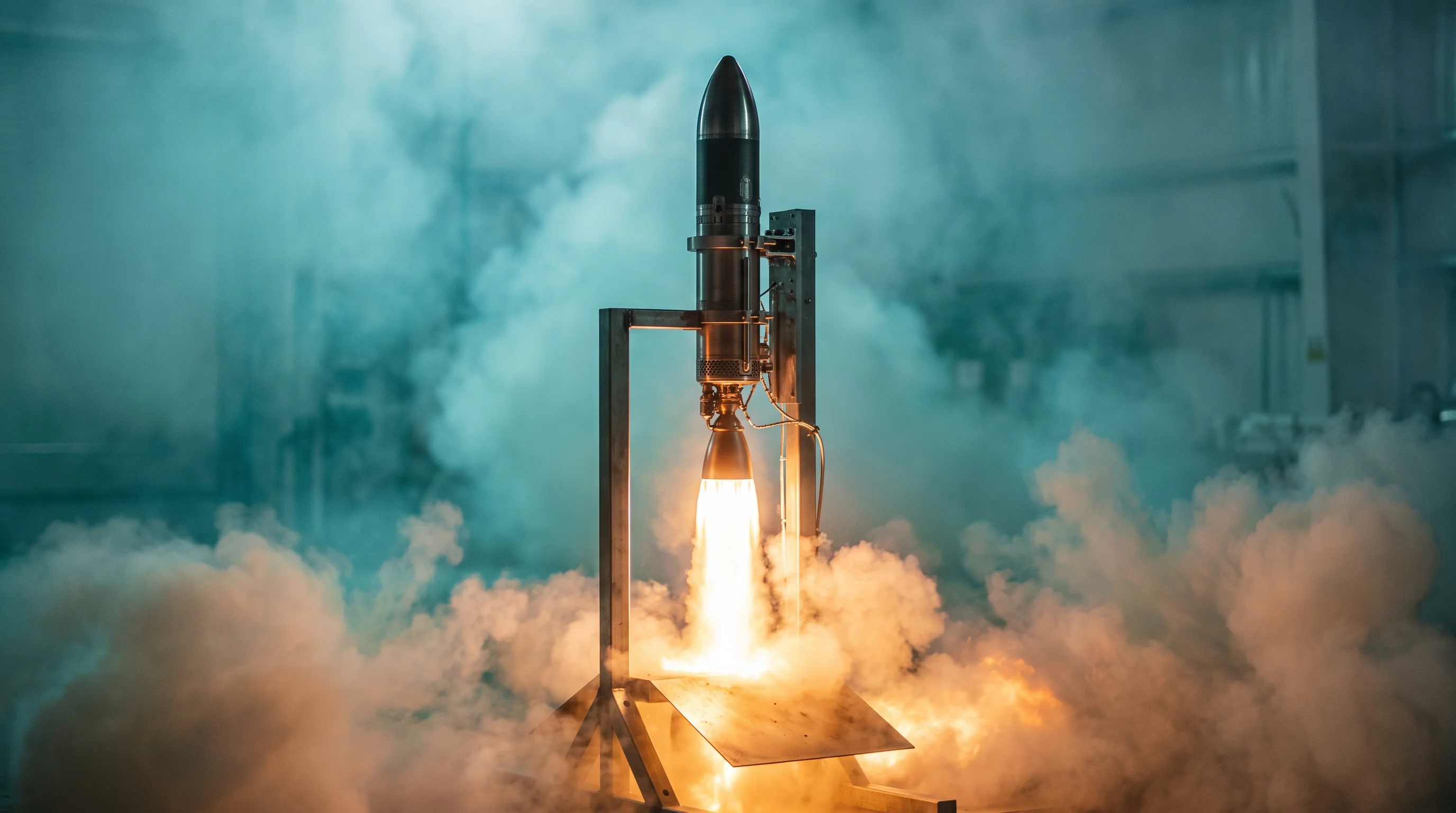
Hop Aero has demonstrated two things publicly: a small-scale tethered test of a Rook prototype at the Oklahoma Spaceport, and a hot-fire test of the rocket's engine and igniter. The company disclosed both milestones alongside its July launch, though it hasn't released independent test footage through its own channels—a detail that may or may not matter, depending on your tolerance for startup opacity.
Technical specifics remain sparse. Propellant type? Undisclosed. Engine cycle? Undisclosed. Thermal protection system for hypersonic reentry? Also undisclosed. What the company has shared is that it developed the engine and igniter using something called "hopOS," which it describes as AI-augmented design tooling. Make of that what you will.
The containerized launch system is where things get interesting—and complicated. Traditional rockets need fixed infrastructure: launchpads, flame trenches, propellant storage, integration facilities. Rook's platform is, in theory, transportable by truck, rail, or ship. Find flat ground, and you have a launch site.
In practice, the regulatory hurdles loom large. The FAA transitioned to a performance-based licensing framework under Part 450 in March 2026, which streamlined some approval processes for launch and reentry. But mobile launch systems still require operator licenses, site-specific permissions, airspace coordination, and environmental reviews. Experimental permits—useful for flight testing reusable suborbital vehicles—explicitly prohibit carrying property for compensation. That means Hop Aero will need full commercial licenses before flying paying cargo, a process that is neither quick nor guaranteed.
The Economics Question

Hop Aero is betting that a narrow but lucrative market exists for cargo that simply cannot wait for traditional air freight. The defense use case has obvious strategic appeal: resupplying forward operating bases, delivering critical munitions components in hours instead of days, supporting operations in contested zones where runways are vulnerable or nonexistent.
The commercial case is murkier. The company cites industries where downtime costs run into the millions per hour—offshore oil and gas, automotive manufacturing, aerospace assembly lines, pharmaceutical production. But it hasn't disclosed pricing, and the unit economics of rocket-based logistics remain unproven at any scale. How much will customers pay for a 15-minute delivery when a helicopter can do the same run in an hour for a fraction of the cost? Perhaps more than the founders expect, or perhaps not enough to matter.
Environmental considerations will factor in as well, though the magnitude depends on propellant choice and flight frequency. Rocket emissions, particularly black carbon deposited in the stratosphere, are an active area of research. The impacts vary significantly—solid propellants versus liquid hydrogen, for instance—but the optics of routine rocket launches for commercial cargo may prove challenging regardless of the chemistry.
For now, Rook remains a prototype backed by a modest government contract and a compelling demonstration. Whether it becomes a platform for routine hypersonic delivery depends on whether Hop Aero can navigate the intersecting challenges of technical maturation, regulatory approval, and market validation. It also depends on whether the market for 15-minute cargo delivery is real—or just aspirational.
But a rocket that fits in a shipping container?
That part, at least, they've already built.


