

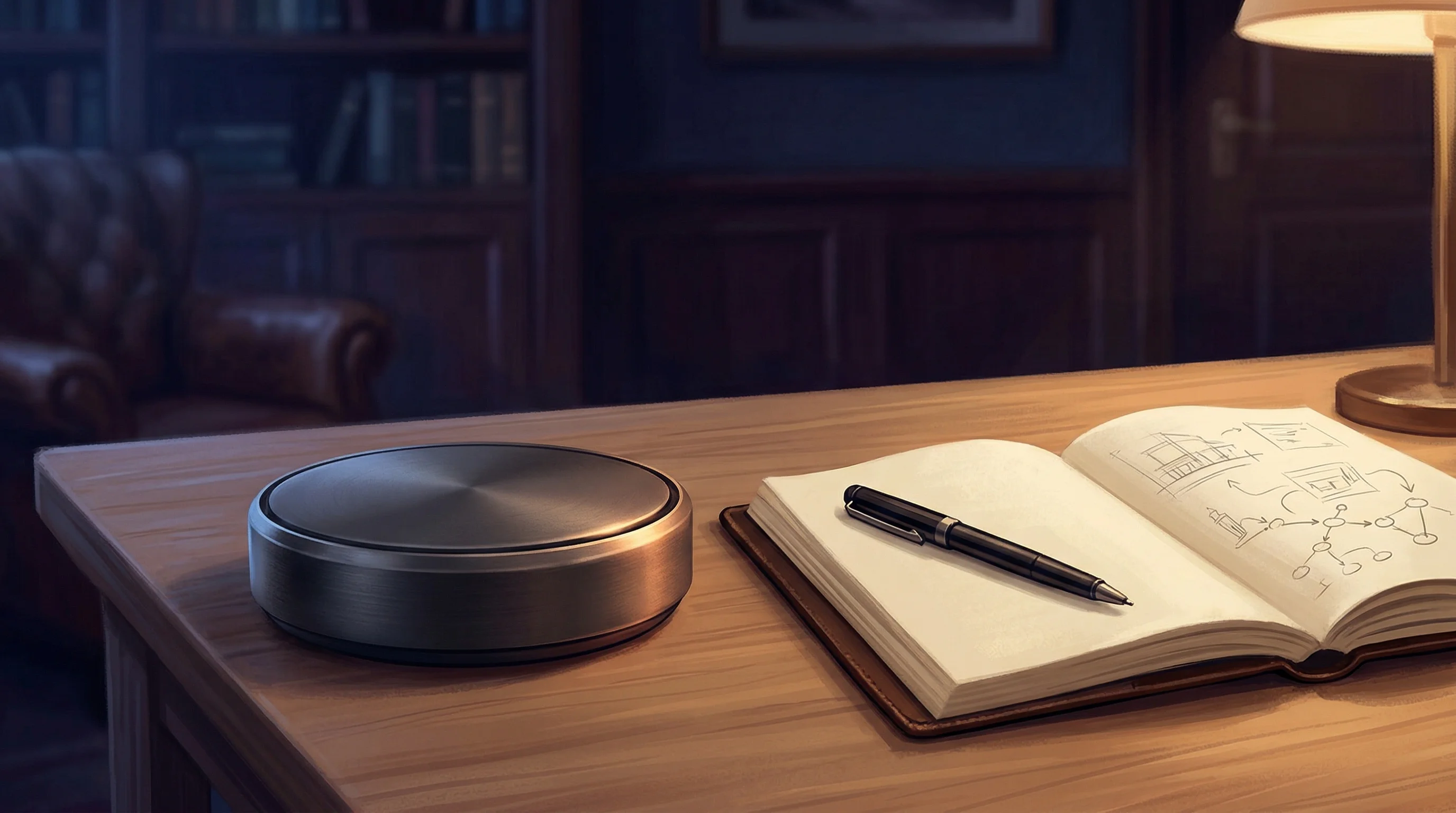
The aluminum disc is barely larger than a coin. Snap it onto the back of your iPhone, and it promises something that's eluded the AI hardware boom so far: actual traction. Five months after Pocket started shipping, the company says it's hit a $27 million annualized revenue run rate—a figure that, if it holds, would make it one of the faster hardware ramps in recent memory. No venture round announced yet. Just sales.
That may sound improbable in a market littered with AI gadget false starts. But the numbers the company is sharing—30,000 units delivered, 50 percent month-over-month growth—suggest that something is connecting. Perhaps it's the form factor, or the timing, or simply that someone finally figured out how to make these things less annoying to carry around.
A Contact Mic You Actually Use
Here's what Pocket does: it attaches magnetically to an iPhone via MagSafe, capturing both sides of phone calls without forcing you onto speakerphone. Two studio-grade microphones pick up in-person conversations. Everything gets transcribed, summarized, made searchable through apps that run on iOS, Android, and desktop. The underlying tech isn't revolutionary—contact mics have existed forever—but the execution seems tighter than most of what's come before.
The device officially launched March 3 through Y Combinator's Winter 2026 batch, though units had been trickling out since late the prior year. Current pricing sits at $129, down from an original $199 "launch special" that may or may not become permanent. There's also a $19.99 monthly subscription for what the company calls advanced features: unlimited storage history, faster processing. A free tier exists but caps stored recordings at 14 days, a limitation that's drawn grumbles in early user reviews.
Doing the math: 30,000 units over five months works out to roughly 6,000 per month now. For a hardware startup that's still wet behind the ears, that's real momentum.
The Category No One Asked For (That Everyone Seems to Want)
Pocket's trajectory coincides with what can only be called an AI note-taker arms race. CES in January was overrun with competitors: Plaud's NotePin S, a 17-gram wearable; SwitchBot's AI MindClip; refreshed offerings from Comulytic. WIRED's February buyer's guide ranked Pocket as "Runner-Up" behind Comulytic's Note Pro, praising transcription quality while noting the user experience still had some sharp edges.
The hardware form factors keep shifting. Amazon bought wearable AI startup Bee last July for its wrist-worn transcription tech. Rewind's pendant made noise back in 2023. Each company is solving for slightly different friction points—Pocket's bet is that a phone mount plus contact mic feels less intrusive than wearing yet another device or clipping something to your collar.
Whether that thesis holds as smartphone operating systems inevitably bake these features in natively... well, that's the existential question hanging over every hardware play in this space.
The Team Behind the Disc
Akshay Narisetti, Pocket's CEO, has been here before. He previously built Omi, one of the larger open-source AI note-taking hardware projects under the Based Hardware umbrella. That pedigree shows up in the architecture: 64 GB of on-device storage (down from 128 GB in earlier units, interestingly), four-day battery life, support for more than 120 languages. Co-founder Gabriel Dymowski was CEO of DoxyChain before this.
The team is six people. They filed a trademark for "POCKET" in December and maintain a public Trust Center documenting HIPAA compliance—SOC 2 Type I and II are listed as "in progress," the standard dance for any company trying to sell into regulated industries. The fact that they've shipped 30,000 units without apparent manufacturing meltdowns is worth noting. Hardware at scale is unforgiving.
What Users Actually Think
App Store ratings: 4.8 stars across 906 reviews. Google Play: 4.7 stars, over 10,000 downloads. The reviews reveal familiar early-stage hardware tensions. Users praise the summaries and action items. Others have complained about slow refund processing and subscription pricing that felt misleading after initial marketing emphasized "unlimited" features.
WIRED's review flagged the free tier's 14-day history cap and throttled exports as potential pain points. Speaker identification reportedly starts to falter after about two hours of recording. And the contact mic for phone calls—the feature that separates Pocket from purely ambient recorders—requires manually flipping a physical switch, which some users apparently missed entirely.
The company has pushed updates at a decent clip: iOS version 0.5.82 dropped March 26, and the team has rolled out desktop apps, a web beta, even a Model Context Protocol server to pipe recordings into AI assistants like Claude.
The $27 Million Question

Hardware is notoriously brutal, especially at this scale. Manufacturing, inventory management, customer support—it all compounds faster than software ever does. If Pocket's claimed $27 million run rate is accurate, that would place it ahead of many B2B SaaS companies at a similar stage. And it's doing it on a physical product that costs real money to manufacture and ship.
The market clearly exists. Productivity-obsessed founders, sales teams hunting for call records, professionals in regulated industries needing compliant transcription—there's enough demand to support multiple players. Whether Pocket can hold its ground as bigger companies muscle in, or whether the form factor even matters once Apple and Google integrate these capabilities directly into iOS and Android, remains very much an open question.
For now, the device is in stock. Shipping free. The company is hiring.
Not bad for five months out of the gate.


