

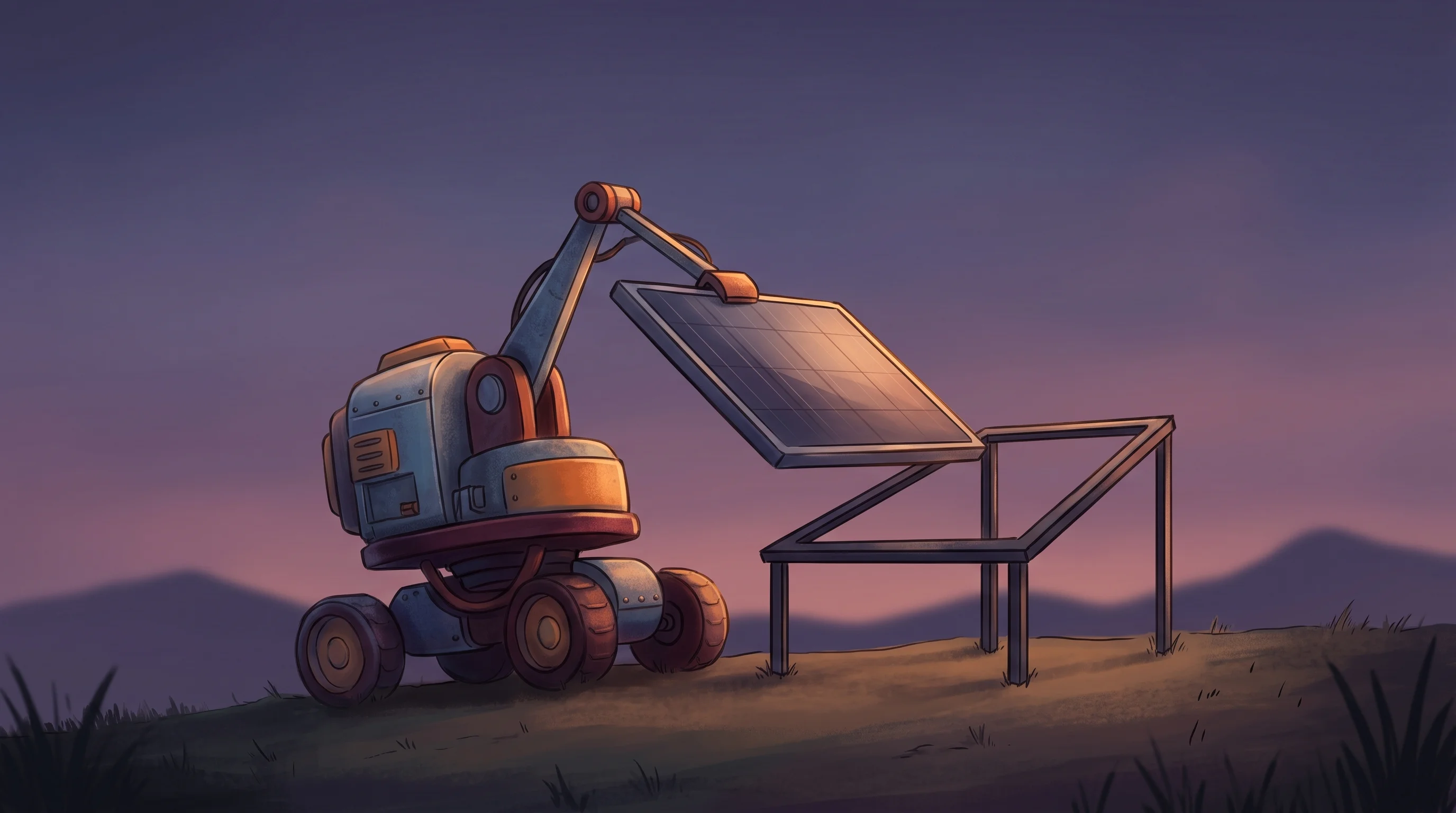
The robot weighs five tons, maneuvers on eight wheels, and can hoist a solar panel every half-minute with millimeter precision. It also, if you believe its builders, represents the first step toward constructing cities on Mars.
That's the dual bet Cosmic Robotics is making—a wager that the unglamorous work of automating solar farm construction might just be the fastest path to proving you can build things in space. It's an unusual pitch, even by startup standards. Then again, NASA has already cut them a check.
The San Francisco-based company, which emerged from Y Combinator in 2026 with eight employees and a pre-seed round of $4 million, has deployed its flagship Cosmic-1 system on utility-scale solar projects where it claims to have more than doubled labor productivity. Giant Ventures led the April 2025 financing. On February 3, 2026, Sunstall—a mechanical contractor specializing in large installations—was announced as the robot's first certified operator, putting the system to work in conditions that test both machines and people: triple-digit heat, dust storms, the occasional downpour.
"It's a force amplifier," CEO James Emerick told TechCrunch around the time of the fundraise, describing how the robot handles the backbreaking repetition while crews focus on supervision and problem-solving. Emerick spent years building autonomous earthmoving equipment at Built Robotics before co-founding Cosmic, so he knows something about teaching machines to do jobs humans would rather avoid.
The Mechanics of Speed
Cosmic-1 looks less like a sci-fi prop and more like industrial machinery: a trailer loaded with panels, towed by an eight-wheeled platform. The newer Cosmic-1A variant integrates a KUKA KR IONTEC robotic arm—originally designed for foundries—that uses suction cups to grip 90-pound photovoltaic modules and place them with ±1 millimeter accuracy, according to a December 2025 case study published by KUKA.
Cameras and high-precision GPS guide the system. Between shifts, it recharges at construction depots. As of mid-2025, the robot was cycling through panels every 30 to 40 seconds, a pace that allows smaller crews to cover more ground by splitting up rather than clustering around each installation point.
The shift is subtle in practice but significant on paper. Instead of manually hoisting hundreds of panels daily, workers become supervisors and troubleshooters, handling the tasks automation can't yet manage. Sunstall has improved crew throughput and reduced labor strain, though detailed site-level productivity metrics have not been publicly disclosed beyond the company's general claim of doubling efficiency.
Two installations were underway in Colorado and California as of late 2025. Whether that footprint has expanded substantially since then remains unclear.
From Deserts to Dead Moons

Cosmic Robotics doesn't particularly try to hide the endgame. The company's stated mission includes "autonomous construction on Earth and beyond," with Mars colonization as the long-term destination. It sounds like the kind of thing founders say to get attention at demo days. Except in this case, NASA took the idea seriously enough to award the company $149,521 in 2025 under its Small Business Innovation Research program.
The Phase I grant funds development of Cosmic-XT, what the company describes as a "truss-traversing general-purpose outfitting robot" intended for lunar environments. The project falls under Z-LIVE, NASA's umbrella for technologies that might one day support space habitats and off-world infrastructure.
Lewis C. Jones, Cosmic's co-founder and CTO, brings aerospace credentials: stints at Relativity Space, SpaceX, and NASA's Jet Propulsion Laboratory, plus a Forbes 30 Under 30 nod. The company's logic is that solar farms—tight margins, harsh conditions, zero tolerance for downtime—are the closest Earthbound analogue to construction in space. Prove the system works in a West Texas dust storm, the thinking goes, and you're halfway to proving it on the Moon.
Perhaps. Or perhaps the lunar contract is as much about recruiting talent and generating headlines as it is about actual extraterrestrial construction. Either way, it's a hedge.
Validation, With Caveats
Cosmic won BuiltWorlds' Construction Tech 2026 Demo Day in Chicago last July and showcased its robot alongside six competitors at FTC Solar's inaugural Robotics Day in Texas a couple weeks earlier. The company also participated in the U.S. Department of Energy's American-Made Solar Prize Round 8 as a semifinalist in the "Deployment and Workforce" category. A LinkedIn post claims Cosmic advanced to the "Set!" phase, though no DOE press release confirming that milestone had surfaced as of mid-2026, at least not publicly.
In July 2026, SEED Innovations Ltd extended an additional $350,000 via a SAFE with MFN. A filing from SEED noted that Cosmic reported a $1.8 million loss against $1.5 million in net assets for the year ending December 2025—numbers that track with an early-stage hardware startup burning through pre-seed capital to reach field trials.
Eight employees. Tens of thousands of panels installed, according to the company. Millions more to go if the business model holds.
A Narrow Window in a Crowded Race
Cosmic is hardly the only company chasing automation in solar construction. AES announced in March 2026 that its Maximo robot had logged 100 megawatts of installations at the Bellefield complex, claiming it moved twice as fast as conventional mechanical methods. Built Robotics—Emerick's former employer—has focused on autonomous piling systems for solar foundations rather than panel placement. Civ Robotics, Libra Robotics, Ozzies, RoboForce, Aonics, and BotCrew are all tackling different parts of the same problem: how to build solar farms faster when qualified labor is scarce and projects keep stacking up.
The urgency is visible in the numbers. The Bureau of Labor Statistics projects employment for solar photovoltaic installers will surge 48% between 2023 and 2033, far outpacing the broader labor market. Utility-scale solar contracts jumped 15% year-over-year in the second quarter of 2026, per the Solar Energy Industries Association. Meanwhile, the Inflation Reduction Act's prevailing wage and apprenticeship requirements have added compliance layers that make productivity tools more appealing—assuming those tools actually deliver.
For Cosmic, the immediate challenge is less about proving the robot works (Sunstall is already running it) and more about scaling from tens of thousands of panels to millions while keeping a lean team nimble enough to iterate on hardware and software. The lunar ambitions make for good copy, but the company's near-term survival hinges on whether solar developers see Cosmic-1 as essential infrastructure or an expensive curiosity.
The first certified operator is in the field. Whether others follow—and how quickly—depends on what happens when the spreadsheets get passed around and the project managers start asking hard questions about cost per watt installed. In the meantime, there's a five-ton robot somewhere in the American Southwest, placing panels one after another, preparing for the day it might do the same work somewhere with no atmosphere at all.


