

Ten people at a startup called Synphony believe they can solve strawberry harvesting—a problem that has humbled better-funded robotics ventures for the better part of a decade. The company emerged from Y Combinator's Spring 2026 batch this week with something that might be described as pragmatic hedging: yes, they're building robots to pick fruit, but they're also planning to sell synthetic data to other robotics companies while they work out the kinks.
It's an unusual pitch. Then again, agricultural robotics has become an unusual business, one where promising technologies routinely vanish into acquisitions by vertical farming operations or quietly pivot away from the open fields where most of America's produce actually grows.
California's strawberry industry offers both opportunity and caution. The state's growers harvested 2.531 billion pounds of berries in 2024, generating $3.14 billion in farmgate value, according to a California Department of Food and Agriculture report. But the economics have turned punishing: harvest labor now accounts for roughly 70% of total production costs—some $79,288 per acre against total expenses of $112,694, according to a UC Davis cost study published in March 2024.
That's the wedge Synphony is aiming for. Whether they can actually drive it home is another question entirely.
Robots, Yes—But Also a Data Business
Synphony's public materials emphasize software infrastructure more than hardware specifications. Their website showcases two products with names that wouldn't be out of place at an enterprise SaaS company: Crescendo Pipeline (tagline: "Deploy Research Faster") and Forte Engine ("Multiply Data With Words"). The robots themselves appear almost secondary to the data generation tools, though that may be deliberate positioning.
According to the company's Y Combinator profile, Synphony intends to generate revenue by selling "data, evals, and viral demos to robot foundation labs" while working toward broader robot deployments. It's a frank acknowledgment that agricultural robotics alone probably can't support venture-scale growth fast enough. The synthetic data business gives them breathing room, a parallel revenue stream while they tackle the considerably harder problem of building machines that can work in actual dirt.
The strategy reflects something roboticists have learned the hard way: Simulation and data are cheaper to scale than physical systems picking fruit in 90-degree heat.
Leading the effort are co-founders Lucas Amlicke and Sean Wu, along with Alex Anokhin as Chief Architect and technical co-founder. Wu spent time at NVIDIA AI and Stanford Bio Research. Amlicke's background includes work in neuromorphic computing and human-AI system optimization, according to company materials. The team collectively claims more than 15 hackathon victories among its members—a detail that signals hustle, if not necessarily field experience.
Where the Others Went
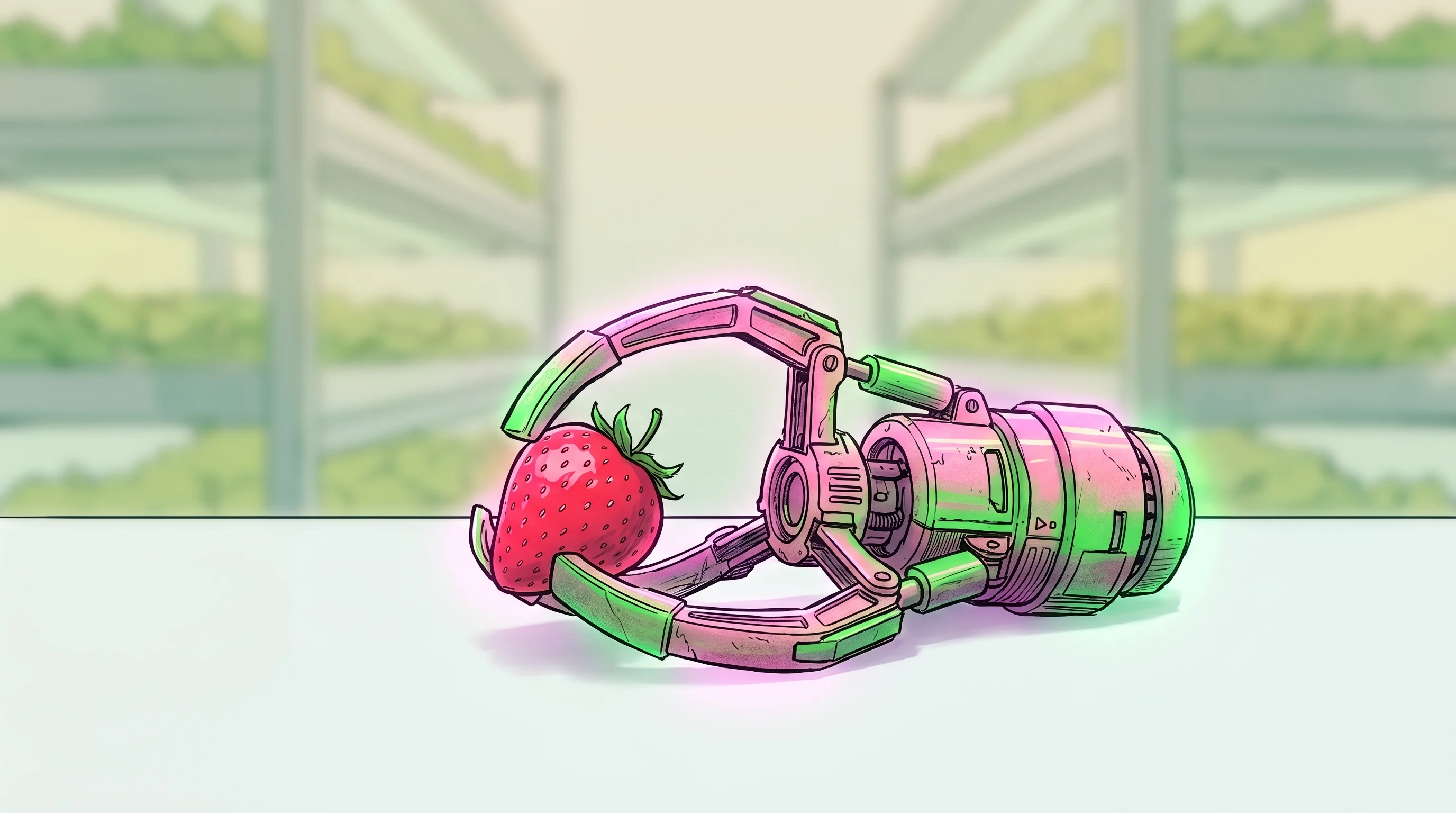
Synphony is hardly the first to chase this opportunity. The graveyard of strawberry-picking ventures tells its own story.
Traptic launched commercial deployments in 2021, only to be acquired by Bowery Farming in February 2022 and redirected toward indoor vertical farms. Tortuga AgTech, which won "Ag Robot of the Year 2024," met a similar fate when vertical strawberry producer Oishii bought the company in April 2025 to focus on controlled-environment harvesting.
Even the success stories come with caveats. Harvest CROO Robotics claimed in March 2025 trade press to have reached "commercially viable automated strawberry harvesting" with human-parity picking speeds—but primarily for Florida's tabletop growing systems. Over in the UK, Dogtooth Technologies announced in 2026 that its Gen5 system was "ready for practical use," mostly for greenhouse operations.
The pattern holds. Established players either exit to vertical farming companies or retreat to controlled environments where lighting, temperature, and plant positioning can be standardized. Open-field California strawberries—grown on 43,142 acres as of 2024, per CDFA data—represent a tougher problem. Unpredictable conditions. Variable ripeness. Plants that don't cooperate with robotic expectations.
A 2024 analysis in California Agriculture journal concluded that robotic strawberry harvest systems "will need improved technology and higher wages to be economically viable." Translation: The business case still requires either significant technical breakthroughs or a labor market so tight that growers have no alternative. Maybe both.
The California Wedge Gets Narrower

California grows more than 90% of U.S. strawberries, with production concentrated in Monterey and other coastal counties. Monterey County alone topped $1 billion in strawberry gross value for the first time in 2024, according to its July 2025 crop report.
But labor availability keeps tightening. Those UC Davis harvest cost figures reflect more than just wages—they capture the entire burden of recruiting, managing, and retaining seasonal crews willing to spend long days bent over strawberry rows. Costs are climbing faster than retail prices can absorb, and the pool of available workers continues to shrink.
Synphony's Y Combinator profile mentions inbound interest from unexpected sectors: semiconductors, even "autonomous space labs." Whether those represent actual pilots or simply founders fielding curiosity calls remains unclear. The company is hiring, with a software engineer position posted at $25-$60 per hour plus 5% equity for work on "agricultural robotics and physical AI" in the San Carlos or Santa Clara area.
What They're Not Saying

As of this week, Synphony hasn't disclosed pilot customers. No pricing models. No technical specifications for picking speed, success rates, or throughput. The company's blog page exists but contains no posts. There's no Launch HN thread, no press release with benchmark data—just the Y Combinator directory entry describing the opportunity and their dual approach.
Perhaps that's strategic. Strawberry growers have watched robot demos before, enough times to develop a healthy skepticism. Synphony seems to be building quietly, using synthetic data and simulation tools to compress development timelines while preparing for the field trials that will ultimately matter.
The company hasn't revealed funding details beyond its Y Combinator participation, which typically involves standard investment terms. With a 10-person team and active recruiting, they're operating in that narrow startup window between seed capital and the pressure to show results that justify a Series A.
California strawberry growers will wait and see. They've been pitched robotic solutions before, watched promising prototypes stumble over real-world complexity. What they haven't seen is a system that matches the speed, delicacy, and cost structure of experienced human pickers across an entire harvest season—day after day, week after week, under California sun or morning fog.
Synphony's wager is that better data infrastructure and a secondary revenue stream can buy them enough runway to crack the harder problem. The question isn't whether they can build a robot that picks strawberries. Several companies have managed that. The question is whether they can build one that works at a price point farmers will actually pay, in conditions where everything from weather to fruit ripeness refuses to be controlled.
The answer, as with most agricultural technology, will be written in dirt rather than demos.


