

The pitch is clean, maybe too clean: real-time 3D ultrasound imaging for a fiftieth of the usual price.
Lumius Imaging—four people, a Y Combinator pedigree, and lab work out of Duke—surfaced from stealth in early May with technology that could, in theory, upend how hospitals think about volumetric imaging. The caveat? Splashed across the company's website in the kind of fine print that speaks volumes: "These statements and products have not been evaluated by the FDA."
Translation: compelling science, no regulatory clearance. Not yet, anyway.
What Lumius has going for it is peer review. The core innovation, something called Diffractive Acoustic Tomography, landed in Nature Communications in January 2025. The work came out of Duke University's Photoacoustic Imaging Lab, and according to the university's announcement, it reconstructs 3D images fifty times faster than prior methods. That's not marketing fluff—it's published research.
But there's distance, often considerable distance, between a published paper and a device a cardiologist can legally plug in.
Hardware With Ambition
Lumius is building two versions of its system. One is a retrofit module meant to snap onto existing 2D ultrasound probes. The other is a standalone unit. Both purport to deliver what the company calls "True 4D" imaging: real-time volumetric ultrasound with uniform resolution across a 4×4×4 centimeter field.
Traditional 3D ultrasound relies on matrix-array transducers—dense grids housing thousands of tiny elements. Expensive to manufacture, expensive to maintain. Lumius claims its DAT approach sidesteps that complexity, achieving comparable results with simpler hardware. The company hasn't named a price, but the 50× cost reduction implies they're targeting a market segment well below where Canon Medical or Philips typically play.
For context, a handheld 2D system like Clarius's HD3 runs around $3,600, plus subscription fees. High-end cart systems with 3D capabilities? Six figures, sometimes deep into six figures.
Whether Lumius can hit that cost target at scale remains an open question. Startups frequently discover that manufacturing at volume introduces costs the lab prototype never hinted at.
Vascular Access: The Wedge Market
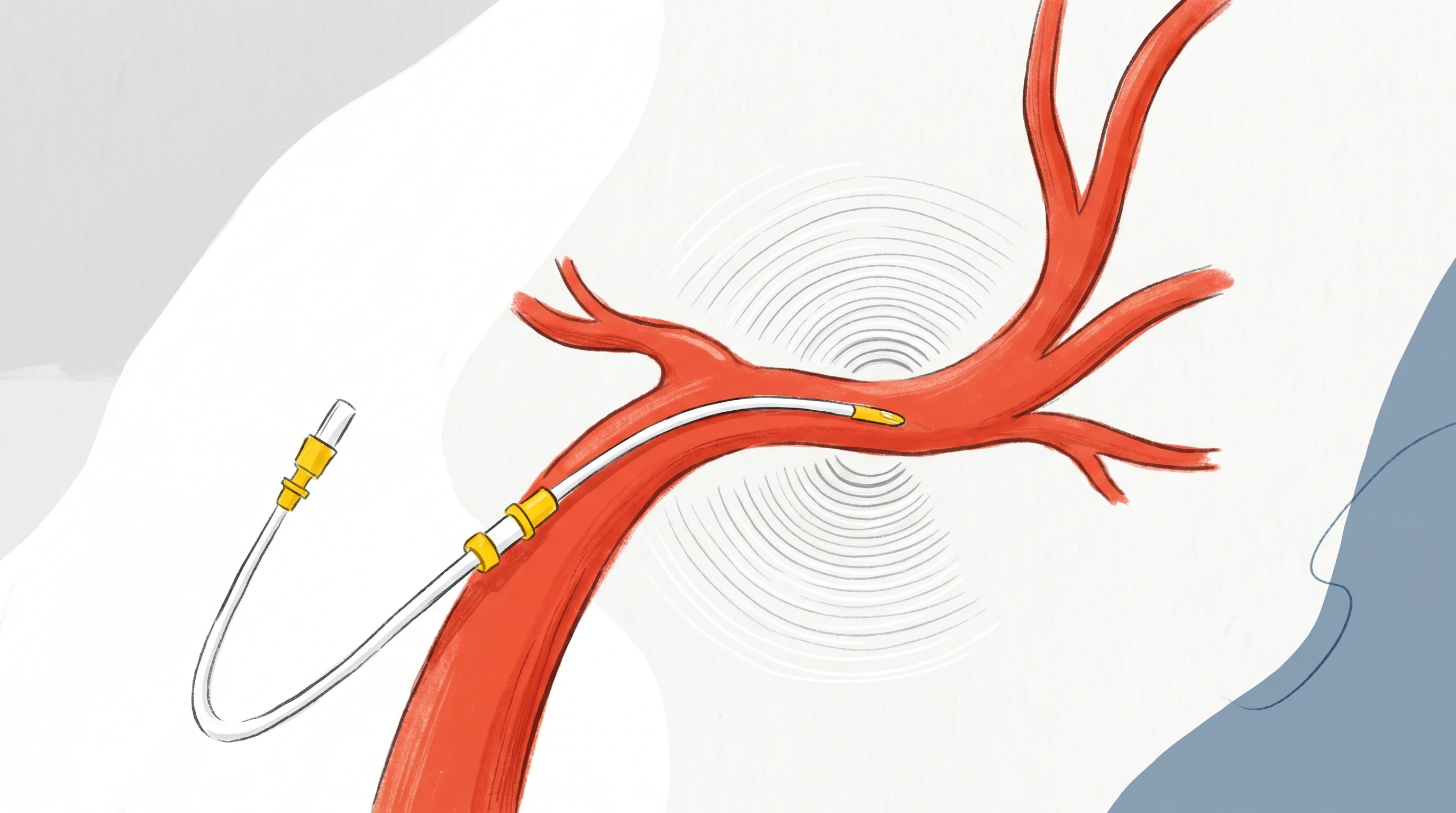
The company is zeroing in on vascular access procedures—central line placements, specifically. It's a logical starting point. According to medical literature the company references, first-attempt failure rates in certain contexts have been reported near 50%. Clinicians train extensively on 2D ultrasound guidance, but reading flat images while manipulating three-dimensional anatomy is, well, hard.
Real-time 3D visualization could reduce complications. Could. Lumius hasn't published clinical validation yet, and the company's site offers demo bookings without specifying when—or if—commercial shipments might begin.
There's a certain pragmatism to the choice. Vascular access is high-volume, reimbursable, and painful when it goes wrong. If Lumius can demonstrate value there, the wedge into other procedures becomes easier to imagine. But that's several trials and one FDA clearance away.
The Team and the Money
CEO Tri Vu earned his biomedical engineering PhD from Duke. CTO Luca Menozzi did his doctorate in ultrasound and photoacoustics. CFO and COO Chenhang Li studied wearable electronics, also at Duke. Scientific advisor Junjie Yao, a Jeffrey N. Vinik Associate Professor in Duke's BME department, oversaw the original DAT research.
It's a technical team, perhaps unusually so for a founding quartet. No commercial medical device veterans yet, no regulatory affairs hands. That could be intentional—get the science nailed down first, hire the go-to-market experience later. Or it could signal the stage they're really at: still figuring out what the product is.
Duke's ecosystem backed them early. An August 2025 translational partnership award from the Duke-Coulter program, plus February 2025 funding through North Carolina's biotech industrial internship initiative. Duke's innovation arm and the Christensen Family Center also played a role, according to a departmental LinkedIn post around March.
Lumius announced its acceptance into Y Combinator's Spring 2026 medical devices cohort on April first.
The Regulatory Silence
The FDA disclaimer isn't buried in a footer. It's prominent, almost defiant: these products "are not intended for medical use and should not be used to diagnose or treat any medical condition."
No 510(k) clearance in the public database. No De Novo submission visible as of mid-May. This is a research tool masquerading as a future medical device.
That's not unusual for pre-commercial hardware, but it does frame the company's cost claims differently. Lumius is comparing its prototype's theoretical price against commercial systems that have already absorbed the expense of regulatory compliance, manufacturing validation, and post-market surveillance infrastructure. Fair comparison? Debatable.
The regulatory path won't be trivial. Medical imaging devices draw scrutiny—rightly so, given that diagnostic errors can cascade into serious patient harm. Lumius will need clinical data demonstrating not just that the images look good, but that they improve outcomes in real procedural settings. That takes time, money, and hospital partners willing to participate in trials.
Timelines vary. Some companies clear in under a year; others spend five. Cost can run anywhere from hundreds of thousands to several million dollars, depending on how much supporting data the FDA requires.
A Crowded Space, With Caveats

Lumius isn't inventing the 3D ultrasound affordability pitch from scratch. PIUR Imaging has FDA clearance for its tUS Infinity system, which upgrades conventional 2D probes to volumetric imaging. When exactly PIUR cleared remains unclear from public materials, but they're shipping product.
iSono Health launched its ATUSA automated breast ultrasound system in January 2026, building on FDA clearance secured back in May 2022. Both companies have navigated the regulatory maze Lumius hasn't entered yet.
The difference matters. PIUR and iSono can price their systems, sell them, bill procedures. Lumius can book demos.
The 50× cost reduction is striking—exactly the kind of figure designed to get hospital CFOs and venture partners leaning forward. But it's also the kind of claim that procurement committees will dissect ruthlessly once Lumius tries to sell into a health system. Does that include service contracts? Training? Software updates? What's the total cost of ownership versus the sticker price?
For now, those questions hang unanswered.
What Happens Next

Lumius represents a familiar archetype in medical devices: strong science, credible founders, institutional backing, and a regulatory obstacle course still ahead. The DAT technology is real—published, peer-reviewed, intellectually defensible. Whether it translates into a commercially viable product depends on execution across domains the founding team hasn't yet been tested on.
They'll need clinical trial partners. They'll need regulatory counsel who can map the fastest pathway through FDA review. They'll need manufacturing partners who can hit that cost target at volume. And they'll need to do all of this while competitors with cleared systems continue iterating.
The pieces are in place for something interesting, maybe even disruptive. The Duke pedigree counts for something. So does the YC badge, at least in certain fundraising circles. But medical devices don't run on pedigree alone. They run on cleared labeling, reimbursement codes, and procurement committee approvals.
Right now, Lumius has the first part—the science. What comes next determines whether that 50× claim becomes a footnote in a research paper or a wedge into a multibillion-dollar imaging market.


