

The World Bank doesn't typically place chips on blockchain startups. But last month, its private sector arm took a 2.5% stake in a Malaysian company that's quietly become the connective tissue between China's national blockchain network and Southeast Asian governments trying to digitize everything from trade documents to Islamic banking.
The International Finance Corporation's $40 million equity infusion into Zetrix AI Berhad, announced February 25, amounts to a rare institutional endorsement of what the company calls "Digital Public Infrastructure"—blockchain-speak for the unglamorous but lucrative work of moving customs forms, identity verifications, and certificates of origin onto distributed ledgers. According to filings with Bursa Malaysia and local media reports, the deal valued Zetrix's shares at roughly 20 cents apiece for 199.5 million new shares.
It's a bet on plumbing. The kind that doesn't make headlines until it breaks—or, in this case, until it works well enough that governments start paying recurring fees for every verification ping.
The Infrastructure Play Nobody Watches
Zetrix operates at the intersection of three unsexy but essential systems: Malaysia's year-old Malaysia Blockchain Infrastructure (MBI), which went live last April; the country's national MyDigital ID program; and China's Xinghuo BIF blockchain, where Zetrix runs the international supernode. That last role gives the Petaling Jaya-based firm—employing about 1,866 people, per company data—a direct data pipeline between Malaysian customs and China's General Administration of Customs.
The company's ZTrade platform now processes digital Certificates of Origin through GACC Single Window connections, charging fees in renminbi per certificate. It's the sort of revenue model that venture capitalists might dismiss as incremental. But multiply small transaction fees across millions of cross-border shipments, and the economics start to resemble the toll-booth businesses that Warren Buffett favors.
IFC's investment, the agency said, targets "improved access to digital services" and economic efficiency through trusted data exchange—phrasing that mirrors Malaysia's 13th Malaysia Plan covering 2026-2030. Translation: the government wants this infrastructure standardized, and it's willing to pay for interoperability.
For context, Malaysia's MyDigital ID charges service providers RM0.40 (roughly 9 U.S. cents) per user verification annually on the MBI network. Modest per-unit economics, perhaps. But scale across a national identity system serving 33 million Malaysians, and the revenue potential clarifies.
From Government Contractor to Blockchain Evangelist
The company wasn't always called Zetrix AI. Until a July 2025 rebrand, it operated as MY E.G. Services Berhad—a name that telegraphed its origins as a Malaysian government services contractor. Co-founder and Group Managing Director Wong Thean Soon, a National University of Singapore engineering graduate, launched the predecessor entity in 2000. His co-founder, Dato' Fadzli Shah, previously served as Chief Strategy Officer at MDEC, Malaysia's digital economy agency.
The pivot from legacy government IT contracts to blockchain infrastructure wasn't exactly a straight line. Zetrix reported record earnings in its second quarter of fiscal 2025, driven by what it calls "Web3 service fees"—revenue from MBI operations, ZTrade, a cross-border ID tool called ZCert, and sales of ZETRIX tokens. The company now straddles blockchain-based customs clearance, digital identity registrations, and AI model licensing.
That last category includes NurAI, which Zetrix launched last August and markets as the world's first Shariah-compliant large language model. The company secured a letter of intent from JAKIM, Malaysia's Islamic authority, to develop a Shariah-aligned AI framework—an attempt to capture Middle Eastern and Southeast Asian markets where conventional AI chatbots raise theological questions about content moderation and financial advice.
Whether NurAI represents a genuine market opportunity or a branding exercise remains unclear. But it signals Zetrix's broader ambition: to become the infrastructure layer for governments seeking blockchain and AI systems that align with local regulatory and religious frameworks.
Beyond Malaysia's Borders
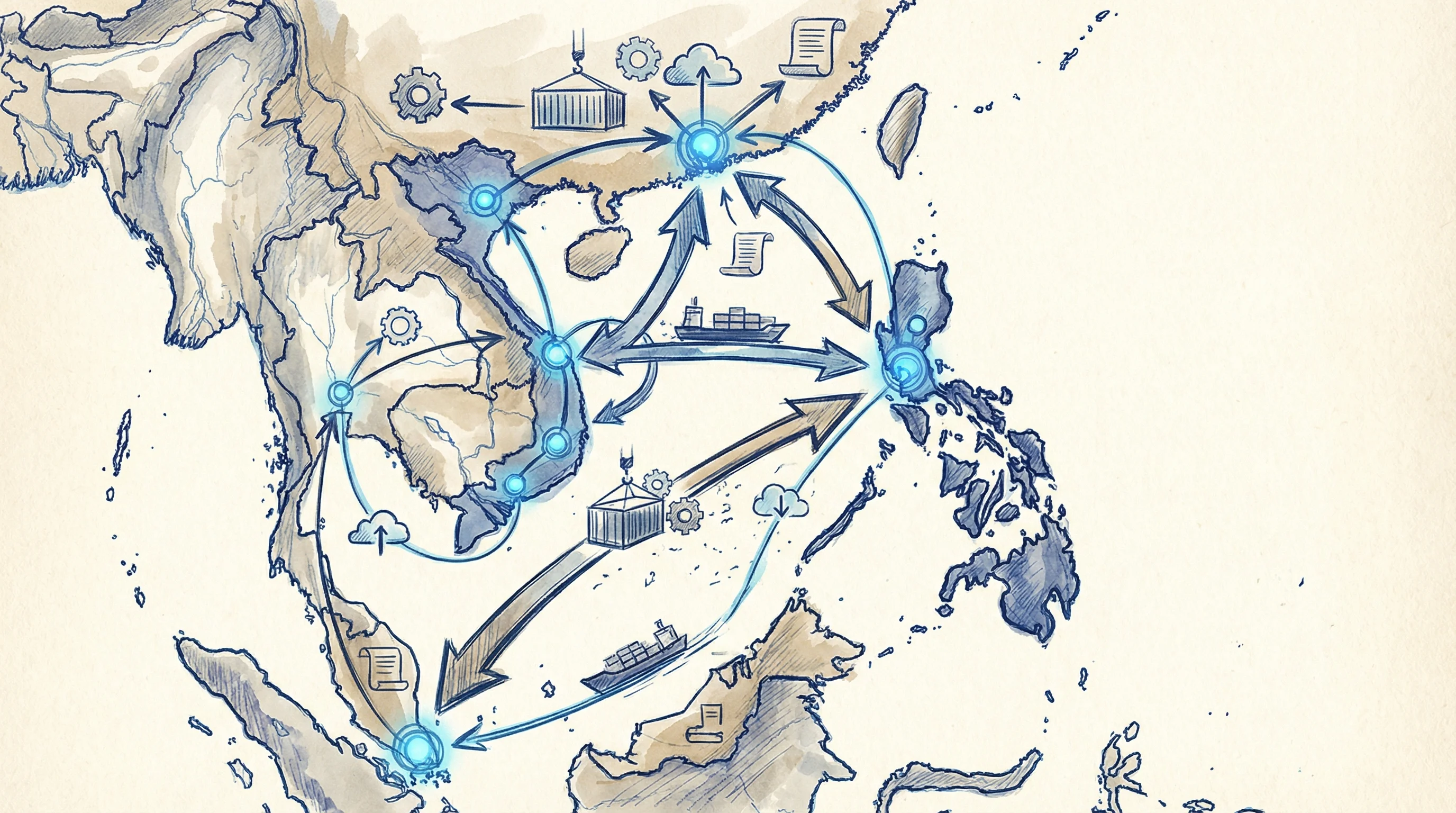
Zetrix has been methodically expanding its footprint across ASEAN. In July 2023, the company signed agreements with the Philippines Bureau of Customs to deploy ZTrade for Philippines-China trade flows—though public data on transaction volumes remains scarce. The company extended its ASEAN-China AI Lab to Indonesia last October through a partnership with PT Royal Solusi Investasi, building on government-to-government endorsement involving China's Beitou IT Innovation.
The company also forged exploratory ties with Singapore's SGTraDex, aiming to integrate cross-border trade data exchange between Malaysia and Singapore. And last December, the Regent of Johor launched the RMJDT, a ringgit-backed stablecoin running on Zetrix's blockchain, paired with what the company describes as a $121 million Digital Asset Treasury under a regulatory sandbox framework.
It's an aggressive expansion calendar—perhaps more aggressive than the revenue disclosures suggest the company can currently support. Pilots and letters of intent proliferate, but converting government enthusiasm into recurring transaction fees is where blockchain infrastructure companies typically stumble.
The Nasdaq Gambit
Zetrix plans to list its AI Foundation Lab unit on Nasdaq by year-end, according to statements reported by Bloomberg-sourced coverage in The Edge Malaysia and The Business Times. The company has not yet filed S-1 or F-1 registration documents with the U.S. Securities and Exchange Commission, leaving the spin-out structure, valuation targets, and underwriting syndicate unknown.
Timing a Nasdaq debut amid uncertain IPO windows and heightened scrutiny of blockchain-adjacent companies introduces execution risk. Particularly for a firm whose primary business involves government contracts and transaction fees denominated in ringgit and renminbi—not exactly the high-margin software story that U.S. public market investors typically reward.
There's also the matter of regulatory baggage. Bursa Malaysia reprimanded Zetrix AI and seven directors last July, issuing RM150,000 fines each for disclosure breaches tied to 2023 announcements involving immigration services. The exchange action preceded IFC's due diligence but apparently didn't derail it. Still, U.S. investors conducting their own reviews will likely scrutinize those compliance lapses.
The Real Test Ahead

IFC's $40 million gives Zetrix runway to convert its government relationships into measurable adoption across ASEAN markets where blockchain-based identity and trade infrastructure remains fragmented. The company's positioning as the bridge to China's Xinghuo BIF—combined with Malaysia's MBI rollout and digital ID integration—offers a potential template for cross-border interoperability that regional governments have struggled to achieve at scale.
But governments moving slowly is a feature, not a bug. And blockchain infrastructure, for all its decentralization rhetoric, still requires centralized institutions to mandate adoption. Zetrix now faces the challenge of translating pilot programs, sandbox experiments, and letters of intent into the kind of transaction volumes that justify both IFC's equity stake and a U.S. public market valuation.
The company's revenue model works if ASEAN customs agencies commit to processing millions of trade documents through its rails. If digital identity verifications become mandatory touchpoints for financial services and e-commerce. If Shariah-compliant AI finds genuine enterprise demand beyond novelty.
Those are substantial ifs. IFC, which has presumably modeled the scenarios, is betting that Malaysia's government-backed blockchain push—and Zetrix's first-mover position—tips the odds in the company's favor. By year-end, when Zetrix attempts its Nasdaq listing, public market investors will render their own verdict on whether blockchain plumbing deserves a growth stock multiple.
For now, the World Bank's money is in. The harder part—proving the infrastructure actually scales—comes next.


